



OVHcloud vs. AWS – which provider offers better value for money?
With cloud infrastructures, it's not just raw performance that counts, but also efficiency and cost-effectiveness. In this article, we compare the block storage offerings from OVHcloud and AWS based on current benchmark data and technical specifications. The focus is on performance (IOPS), scaling and cost. The aim is to provide well-founded recommendations for typical use cases.
 Marc AchsnichTeam Lead · synaigy
8 min read

Overview of test candidates
OVHcloud Block Storage variants
Volume type | Performance | Pricing structure |
Classic | 250 IOPS guaranteed | €0.00007/GB/hour |
High Speed | Up to 3,000 IOPS | €0.000142/GB/hour |
High Speed Gen 2 | 30 IOPS/GB (max. 20,000 IOPS) | €0.000142/GB/hour |
AWS EBS volume types compared
Volume type | Performance | Pricing structure |
gp2 | 3 IOPS/GB (max 250 IOPS/GB) | $0.10/GB/month |
gp3 | Custom (from 3,000 IOPS included) | $0.08/GB + surcharge |
io1 | Up to 50 IOPS/GB | 0.125 USD/GB + 0.065 USD/IOPS |
io2 | Up to 64,000+ | Similar to io1, more expensive |
Analysis approach
For the analysis carried out, open-source tool dbench was used. It's a Kubernetes-based benchmark framework testing persistent volumes for real-world performance. Dbench uses widely-used performance tool fio (Flexible I/O Tester) to simulate various load profiles while capturing metrics such as IOPS, throughput (MB/s) and latency.
How it works:
Within Dbench, fio runs, carrying out targeted read and write operations on the assigned storage.
Both random reads/writes and sequential reads/writes are tested, each with different block sizes.
Approach taken in this analysis:
Several read/write profiles with identical configurations were tested per volume size.
Each test run was repeated multiple times to identify outliers and determine the average.
Tested on a VM in Frankfurt (region DE) with identical compute resources.
Using dbench enabled a realistic comparison under production-like conditions and ensures high validity of the results.
Benchmark results in direct comparison
We tested the performance of volumes with different sizes (from 5 GB to 1,280 GB).
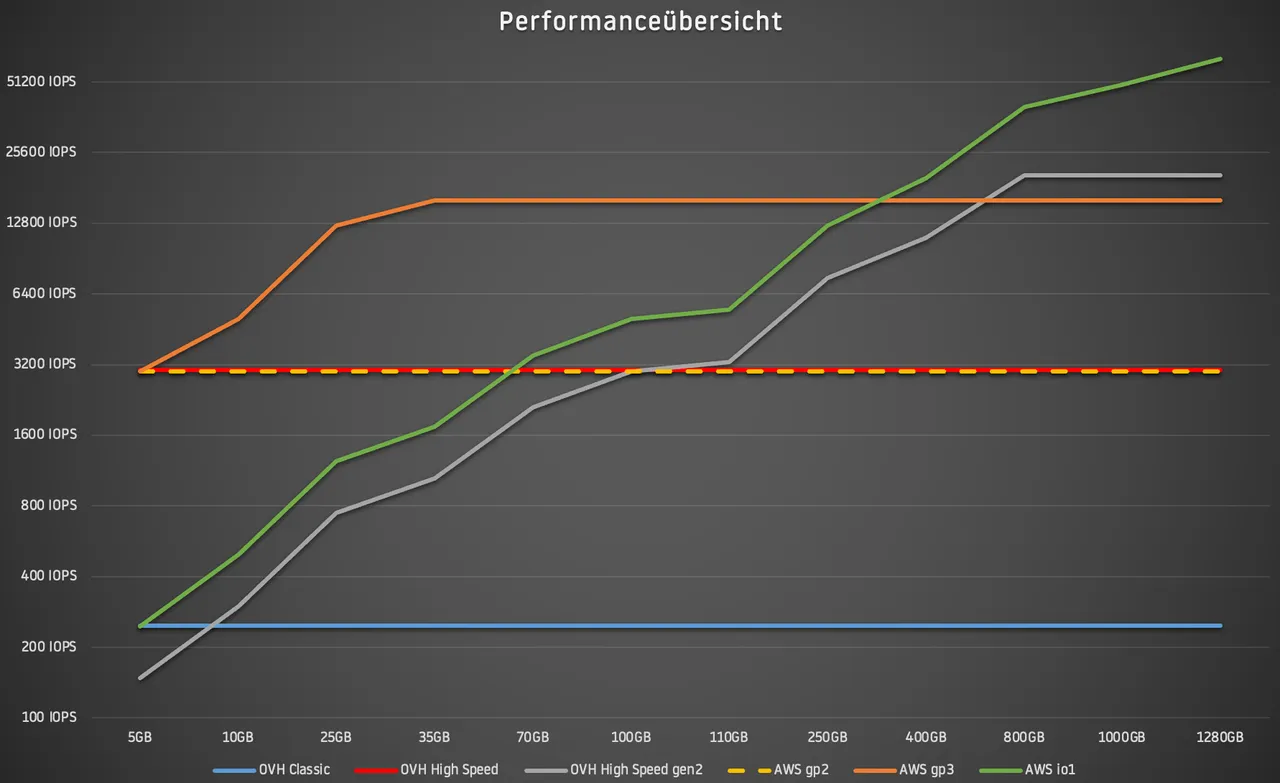
The chart above impressively visualises the IOPS scaling (input/output operations per second) of different block storage offerings from OVHcloud and AWS across various volume sizes – from 5 GB to 1,280 GB. It gives a clear picture of the performance characteristics of the different volume types.
Detailed interpretations of the curves
AWS gp2 (yellow)
Line shows flat, constant performance at 2995 IOPS
AWS gp3 (orange)
The curve starts at a medium IOPS level and stays constant, since gp3 provisions IOPS independently of volume size.
High-performing storage, but with high extra costs from manual IOPS provisioning.
AWS io1 (green)
This curve is strongly upward, showing that AWS io1 allows linear scaling up beyond 60,000 IOPS – depending on size and provisioned IOPS.
Designed for top performance – but with massive extra costs (up to several thousand euros a month).
OVH Classic (blue)
The line stays consistently at around 250 IOPS, regardless of volume size.
This underlines the simple, stable and predictable performance – ideal for base workloads with constant but low IOPS needs.
OVH High Speed (red)
This curve also runs horizontally, stable at around 3,000 IOPS across all volume sizes.
This shows capable baseline option for production workloads
OVH High Speed Gen2 (grey)
Starts at moderate IOPS values in the lower range, but rises linearly with volume size.
From 100 GB onward, performance increases noticeably.
From 800 GB onward, Gen2 hits its limit at 20,000 IOPS, where the line stabilises.
The following chart shows monthly costs for 100 GB block storage in direct comparison between various offerings from OVHcloud and AWS. Basis is combination of storage prices and additional IOPS-based performance surcharges payable at AWS. This illustration makes clear how much pricing structures differ – especially at high performance.
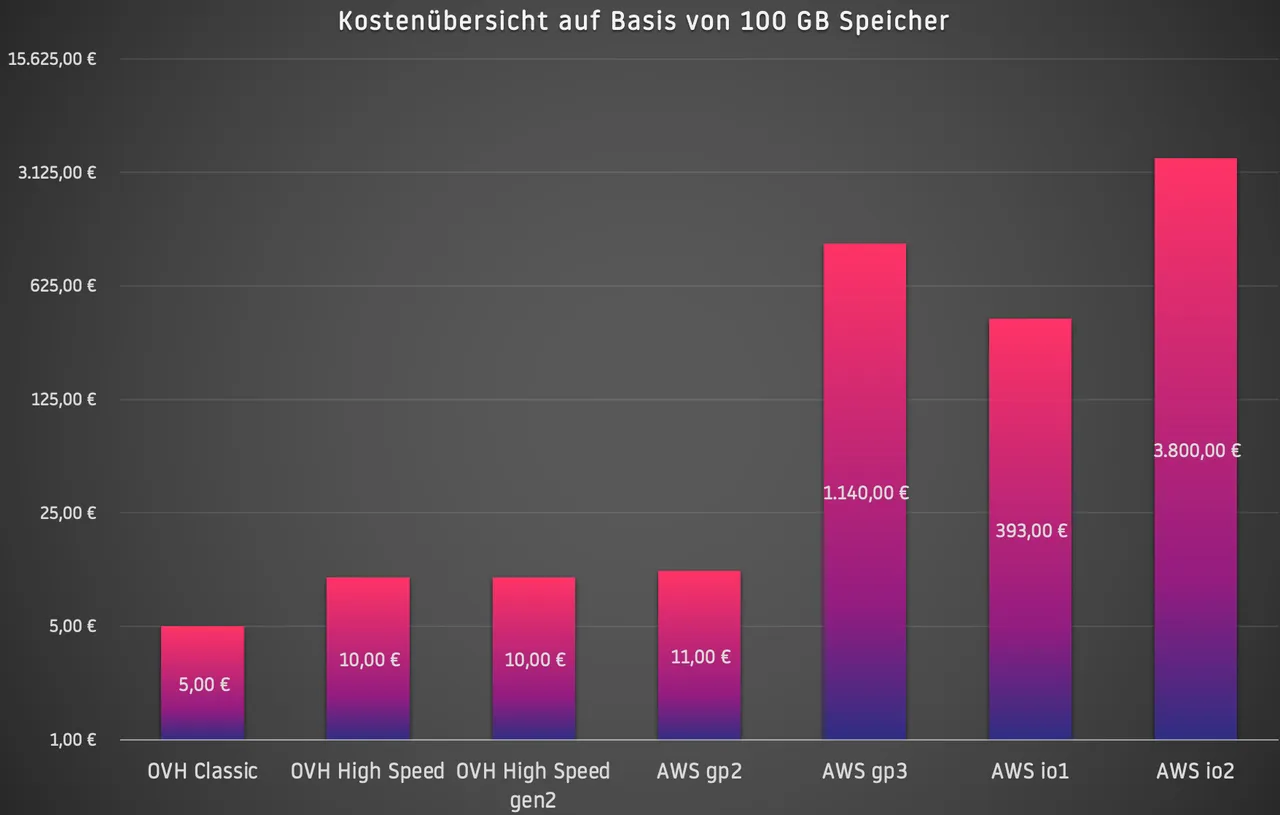
The three OVHcloud variants (Classic, High Speed and High Speed Gen2) sit in a very affordable range at 5 to 10 euros per month. The entry point is OVH Classic, which guarantees stable performance of 250 IOPS for just 5 euros a month. For simple workloads, boot volumes or test systems, that's a highly attractive option. Both OVH High Speed and High Speed Gen2 cost 10 euros for 100 GB, though performance differs considerably: while "normal" High Speed storage delivers up to 3,000 IOPS, Gen2 scales linearly at 30 IOPS per GB, which already gives up to 3,000 IOPS at 100 GB – and up to 20,000 IOPS on larger volumes. The big advantage: at OVHcloud, all IOPS capacity is included in the price, ensuring transparent and predictable costs.
By comparison, it's clear AWS pursues an entirely different pricing model – particularly for high-performance storage options. AWS gp2 at 11 euros per month sits slightly above OVH Classic tariff, but offers similarly low performance (approx. 300 IOPS). AWS gp3, at first glance cheaper in basic structure (0.08 USD/GB), becomes extremely expensive as soon as additional IOPS are needed: in our example with over 13,000 IOPS, monthly costs rise to 1,140 euros – multiples of what would be due at OVHcloud. Price development is even more drastic with AWS io1 and io2, designed for high-performance workloads with extreme IOPS requirements. While AWS io1 in 100 GB configuration already costs 393 euros per month, AWS io2 comes in at an incredible 3,800 euros per month – for similar storage space, but maximum performance.
This illustration makes it clear: while OVHcloud scores with fixed and predictable prices regardless of IOPS level, costs at AWS rise quickly and sometimes exponentially – especially with gp3, io1 and io2. That means: anyone needing higher performance on AWS also has to pay dearly for it.
Rating
The evaluation of the tested block storage options is based on the combination of measured performance (IOPS), pricing structure and the scaling logic of the respective volumes. Clear differences emerge between the offerings from OVHcloud and AWS, which have not only technical but also economic effects on ongoing operations.
OVH Classic positions itself as an ultra-affordable entry-level option. With a constant 250 IOPS and a price of just €5 per 100 GB, this storage type is particularly interesting for simple workloads such as test environments, boot volumes or small web applications. For production applications with a high database or transaction share, however, the Classic type is too underpowered.
OVH High Speed offers up to 3,000 IOPS, providing a solid foundation for high-performance workloads and competing directly with AWS gp2. In direct comparison, OVH High Speed delivers almost identical IOPS performance, but at a significantly better price. Its predictable, constant performance without bursts makes this option particularly attractive for mid-sized production environments.
OVH High Speed Gen2 is the most flexible option in the OVH portfolio. IOPS performance scales linearly with volume size – 30 IOPS per GB up to a maximum of 20,000 IOPS per volume. While smaller volumes (under 100 GB) still lag behind High Speed Gen1 in efficiency, Gen2 overtakes it from 100 GB onwards – and outperforms AWS alternatives too. The advantage becomes especially clear from around 800 GB: here OVH Gen2 hits its IOPS maximum and delivers performance that clearly outstrips AWS gp3 – at a price where AWS would only get you 10 GB of gp3 with comparable performance.
AWS gp3 designed to combine flexibility and performance. First 3,000 IOPS included free, but any performance beyond that must be provisioned and paid for separately. This can make gp3 expensive quickly under high demands. Combination of storage costs, IOPS and bandwidth fees makes calculation complex and less predictable than with OVHcloud.
AWS io1 and io2 are the most powerful volumes in the test field. With up to 64,000 or even 100,000 IOPS, they're barely beatable on paper – especially for latency-critical, transaction-heavy enterprise applications. However, this enormous performance comes at a price: monthly costs for 100 GB of storage including IOPS can easily run into several thousand euros. For most classic workloads, that's overkill – both technically and economically.
Conclusion: when is OVHcloud the better choice?
1. Cost efficiency with good performance
With OVH High Speed, customers get solid performance of up to 3,000 IOPS – comparable to AWS gp2 – but at a significantly lower price. Especially for medium to large workloads, this results in significant savings potential.
2. Strong performance option with High Speed Gen2
From 100 GB, the High Speed Gen2 unfolds its full potential. From around 800 GB in volume size, this storage achieves IOPS values that surpass AWS gp3, at a price where you'd barely be able to configure 10 GB with AWS. This makes Gen2 an attractive choice for data-intensive applications.
3. Predictable performance without bursting mechanisms
Unlike AWS gp2 or gp3, which rely on complex burst logic and IOPS allocation, OVHcloud offers constant, predictable performance. That's an advantage for production systems where stable IOPS is critical.
4. Transparent pricing and simple scalability
OVHcloud offers simple, transparent pricing structures: no extra costs for additional IOPS, no manual provisioning like with AWS gp3. This makes planning and automation easier.
5. European cloud with data protection advantage
OVHcloud is a European provider with data centres in the EU (e.g. Frankfurt) and meets the highest data protection standards. Particularly in regulated sectors such as finance, healthcare or the public sector, this is a decisive advantage over US hyperscalers.
- Marc Achsnich
Team Leadsynaigy
Show email address

Subscribe to the blog now and never miss any news
✔️free of charge ✔️weekly news ✔️expert knowledge
Please accept the corresponding cookies to view this embedded content.