



insights! #95: OVHcloud brings the cloud future - AI & cloud in focus
In the latest episode of insights!, Falk Weinreich from OVHcloud talks about the exciting topics of AI and data sovereignty. How does OVHcloud manage to safely navigate its customers through a data-driven world, and what does all this have to do with the Eiffel Tower? Watch and find out
 Joubin RahimiManaging Partner · synaigy
4 min read
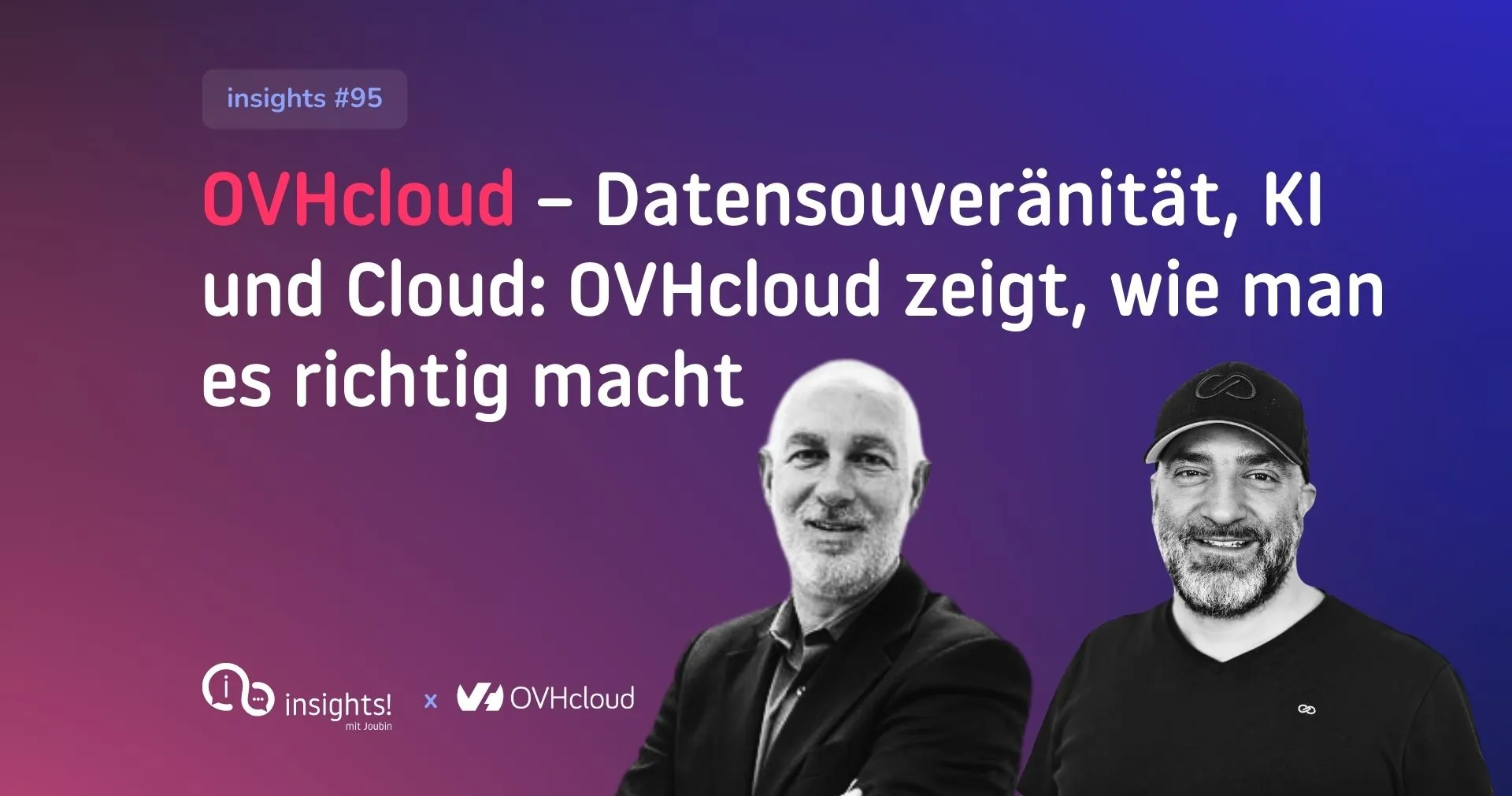
Does it start with the data somewhere? Where is the data located? Who has access to the data? What do I then do with the data? How do I train the data? Which algorithms do I use? And everywhere there are different challenges, but data sovereignty always plays a role.
In the second episode of insights! with Falk Weinreich, we talk about the dynamic challenges and fascinating opportunities that AI and data sovereignty offer. Tune in and find out more about OVHcloud's journey from hosting provider to innovation leader in the cloud world.
The Future of Technology: OVHcloud’s Vision for AI, Data Sovereignty, and Quantum Computing
Technological developments are advancing at a rapid pace, and companies must be prepared to take advantage of these new opportunities. With a clear focus on artificial intelligence (AI), data sovereignty, and quantum computing, OVHcloud offers an infrastructure that meets the highest standards—both today and in the future.
In this blog post, we’ll take a closer look at these three key technologies and show how OVHcloud has made them a central part of its cloud strategy.
Artificial Intelligence: The Computing Power for Smart Applications
AI has long since established itself in the business world. It is increasingly being used in areas such as automated data processing and the optimization of business processes. Training and running AI models effectively requires enormous computing power—a capability that OVHcloud provides through its GPU-based data centers.
In partnership with NVIDIA, OVHcloud ensures that businesses have access to state-of-the-art GPU technology. This enables the fast and efficient processing of large volumes of data required for machine learning and AI models. OVHcloud’s infrastructure is designed to provide businesses with the computing power they need without requiring them to manage the underlying technology. With a cloud infrastructure that is scalable and offers powerful tools, OVHcloud helps businesses successfully integrate AI and unlock new business opportunities.
Data Sovereignty: Control Over Your Own Data
Data sovereignty is a key issue in today’s digital world. Companies must ensure that their data is protected and processed in accordance with European legislation. OVHcloud relies on a sovereign cloud infrastructure that enables companies to store their data in Europe—far removed from the influence of non-European actors.
Sovereign data storage is particularly crucial in sectors such as healthcare, finance, and public administration, where the protection of sensitive data is a top priority. OVHcloud complies with the requirements of the GDPR and is not bound by the CLOUDAct. This data sovereignty enables companies to store data securely while meeting regulatory requirements, without compromising on data security or availability.
Quantum Computing: A New Dimension in Computing Power
Quantum computing represents one of the most exciting technological developments of recent years. Quantum computers use the principles of quantum mechanics to solve problems that cannot be processed in a reasonable amount of time using classical computers. Whether it’s optimizing complex calculations or simulating molecular structures, quantum computing could revolutionize the way we process data.
OVHcloud has already taken its first steps into the world of quantum computing. Through Quandela, they are already offering businesses the opportunity to test initial quantum computing models. Although quantum computing is still in the development phase, the technology has the potential to push the boundaries of computing power in the long term.
Particularly in fields such as finance and pharmaceutical research, quantum computers could help calculate models faster and enable new scientific discoveries in the future.
OVHcloud: Your Partner for Tomorrow’s Technology
The rapid development of technologies such as AI, data sovereignty, and quantum computing presents new challenges for businesses, but also offers enormous opportunities. OVHcloud not only provides a high-performance cloud infrastructure but also ensures that businesses are equipped with the right technology stack for the future.
With a focused approach to AI, data sovereignty, and quantum computing, OVHcloud enables businesses not only to meet their current needs but also to prepare for upcoming technological developments. Businesses that want to maintain control over their data, drive innovation with AI, and prepare for the future of quantum computing will find a reliable partner in OVHcloud.
Conclusion
Technological change is happening faster than ever before. OVHcloud helps businesses capitalize on this change without losing control. With a robust cloud infrastructure, a clear focus on data sovereignty, and a pioneering spirit in quantum computing, OVHcloud ensures that businesses will be successful not only today but also tomorrow.
Would you like to listen to the full episode?
Find the podcast of the interview here:
Please accept the corresponding cookies to view this embedded content.
Prefer to watch the episode? No problem!
You'll find a recording of the interview here:
Please accept functional cookies to watch this video.
Prefer to read?
Joubin Rahimi:
Brilliant that you're back for a new episode of Insights. My name's Joubin Rahimi and today, in the second episode: Falk Weinreich. Hi.
Falk Weinreich:
Hi. Hello Joubin, thanks for the invitation.
Joubin Rahimi:
Very happy to. We've already talked about OVHcloud and your USPs, but there's a lot we haven't properly covered. And what we want to start with today isn't your classic services, which you also offer, like bare metal and all those topics, but from my point of view AI, your use cases around it, and that paired with data sovereignty. I find that hugely, hugely exciting. But first, let's do a check: what's the entire portfolio you actually have?
Falk Weinreich:
Yes, thanks for the question and thanks again for the invitation. Before we get to AI and sovereignty, that doesn't really fit together logically. Where do we come from and what services do we have? Originally, over 25 years ago now, we were founded. And the origin was quite classic, in classic hosting back in the 2000s. That's our origin. We were founded by Octave Klaba. Since the early 20s, he then …
Joubin Rahimi:
He's techy, isn't he?
Falk Weinreich:
He's techy through and through and actually built this company on his own. Sure, a few banks probably helped, but there was no big venture capital backer in the background steering it all – instead, very early on he had to focus on generating cash, on being able to get loans again at all. So really a self-made entrepreneur. And what did he do? At the start he said: bare metal, so the classic approach – I offer you hosting, dedicated servers. Then, of course, shared infrastructure comes in, like PS. Naturally customers also need domains. That was a bit of the mass-market business he brought to market at the start, but very quickly …
Joubin Rahimi:
That's why you're not that well known, because with IONOS and so on we've actually also...
Falk Weinreich:
In Germany it's of course - yes, IONOS is a good keyword - they're even more in this mass market, even much more focused on this mass market. We've rather moved towards business customers and larger requirements, more complex requirements. You can see that in our portfolio too. And in France we're of course number one, and funnily enough in Poland too, because Monsieur Klaba and the Klaba family originally come from Poland. They then migrated to Roubaix in the 80s and rebuilt their life there. So French, but with Polish roots. That's why in Poland, in France, we're the number one brand. In Poland, by the way, the largest domain registrar in the market overall. It's kind of like GoDaddy worldwide. That's where we, OVHcloud, stand in Poland. And in France, as I said, we're the main brand as an alternative to all the cloud players. Germany not quite as well-known, also not on the market as long, and originally only entered in the mass market and a bit of a niche player. Yes, okay, you need a bit of bare metal or maybe a few features here and there, and we weren't as present. Only in the last five years have we developed a lot further in terms of portfolio too. The origin was that we took over the vCloud Air activity from VMware, now Broadcom, ourselves as an asset deal seven, eight years ago. So we carried out an acquisition, the first in our history, and bought the cloud activities from VMware. That's eight years ago now. But that was a quick start into the upper business customer market. And to this day we're still one of the largest partners of Broadcom because of that history and, of course, further development too.
Joubin Rahimi:
And you're also a major partner of NVIDIA?
Falk Weinreich:
In the GPU area too, exactly. But in terms of the portfolio, so after bare metal and the mass market, from domain, VPS and web hosting, the private cloud was added at some point, now via Broadcom, and relatively soon afterwards also the public cloud, which is Open Source based, Open Stack, which we use here. And we've now continuously expanded that with other open source databases, MongoDB as an example, in our portfolio. That means we've gone beyond just infrastructure, compute & storage, into the PaaS layer as well, and we demonstrably have the most services there as an alternative to the hyperscalers.
[00:04:54.880]
And that's actually the exciting point, because before I knew you, I already had the topic on the table, data sovereignty plus AI cloud too. One of our customers is Bosch, and Bosch Power Tools is a great story in itself, worth its own episode, but they have the company Cognitive Service, google it, and they have a service where you can take photos of parts, and they have a huge machinery set-up and from that a neural network gets developed, but the images, weight, cut drawing are also done afterwards, or technical drawing. But they run this neural network themselves, and they said this is in their own data centre, it must never go to Google, the images must never go to Google, rather they want to keep these assets for themselves. And you'd already gone down that road, hadn't you?
Falk Weinreich:
The topic of AI is a broad field. So first I need to have data, data, before it goes into models, before I train my models, before I then perhaps eventually develop apps from that. Does it start somewhere with the data? Where is the data stored? Who has access to the data? What do I then do with the data? How do I train the data? Which algorithms do I use? And everywhere you have different challenges, but data sovereignty always plays a role, because if someone can read along, process this data, use it, who shouldn't have it, we have an issue with GDPR, we have an issue with sovereignty. We have a reference, Moin AI.
Joubin Rahimi:
Moin, like the North German "Moin"?
Falk Weinreich:
Hello, hello from Hamburg, exactly. And they're active in the chat area and also have customers who perhaps work with health care data and also insurance companies. And that's data that potentially, or quite certainly, needs to remain sovereign. Throughout the whole discussion you also always have to ask yourself: which data is it okay for potentially everyone to read along? Or: how sensitive is the data? Everyone has to decide that for themselves. But if it's the case that you really want to keep it sovereign, then I also need a provider that isn't subject to the CLOUD Act. And that was the reason Moin AI chose us: they needed a sovereign provider that could really guarantee that the data has to be in the country, that it mustn't be read by any non-European provider. That's, well, GDPR is a European construct. And those were the requirements. Ultimately the customer's requirements, not even the Moin AI provider's, because they're there to ultimately meet the customer's needs. And that's how it came about that they needed a provider, a sovereign provider, that also has to provide the various tools and layers. GPU is a keyword, yes. We're one of the major partners of NVIDIA. AMD, by the way, now also has GPUs on the market, but NVIDIA is, I think, currently the number one in the market, and fortunately we're also seen that way by NVIDIA itself, in Europe among the alternatives. And fortunately we can also always provide our customers with the latest generation.
Joubin Rahimi:
That's not that easy, is it?
Falk Weinreich:
That's a resource topic through and through, absolutely. So having the scale and having worldwide appeal, and then not being able to serve customers in those countries from your own data centres, that's very much an issue. So there too, it's simply the case, scale, size matters too. At some point NVIDIA of course has to decide: who do I give my resources to? Who can even be supplied? Supply bottlenecks are absolutely an issue there, and luckily we've become one of those global players, so we can access these resources for our customers' benefit. That gets used very often too. Beyond that though, already the first models of what you even do with AI, so compute power is one issue, but beyond that, how it continues, we want to accompany our customers there too.
Joubin Rahimi:
Do you have two, three cases you can share, what customers do, that you're allowed to tell?
Falk Weinreich:
Yes, for us, Moin AI is, that's why I mentioned it, one of the references. We always have to be a bit careful. We also have many larger customers who aren't necessarily former start-ups or scale-ups, but actually come from the DAX environment, but as it goes, not everyone is happy to be named as a reference and have exactly what was done with them told publicly. So unfortunately I don't have too many official references I'm allowed to name publicly. But it's important to know, yes, every company, from small to large, is now in contact with AI in some way. The next step, we believe, will be in technology development, that we'll even move towards, we're already thinking about quantum computing, that the advances in technology may at some point no longer be sufficient in capacity using conventional means via normal computers as we know them, whether with CPUs or GPUs.
Joubin Rahimi:
And simply another quantum leap.
Falk Weinreich:
There I'm actually quickly out of my depth technically too, because it's really new topic, but what I already know is first companies, risk management in banks have case with start-up of ours, developing models on quantum technology, already one step further. And fortunately with Quandela we have one of first quantum computing, where even today you can already use first models via our website. It's still early days for whole industry, but journey continues. It doesn't stop with GPUs at Nvidia today.
Joubin Rahimi:
And I'd say that's a good call for questions or open to questions on the topic of AI data sovereignty. I think that makes sense to many, but quantum computing, also combined with AI, is a great topic. Feel free to put questions in the comments for us – Falk and I will be happy to answer them, or our teams who know more about the technology than we do. Thanks for being with us.
Falk Weinreich:
Thank you.
Joubin Rahimi:
Thanks Falk.
Falk Weinreich:
Thanks.
Have questions or feedback?
Then feel free to contact us directly.
- Joubin Rahimi
Managing Partnersynaigy
Show phone numberShow mobile numberShow email address
Subscribe to the blog now and never miss any news
✔️free of charge ✔️weekly news ✔️expert knowledge
Please accept the corresponding cookies to view this embedded content.