



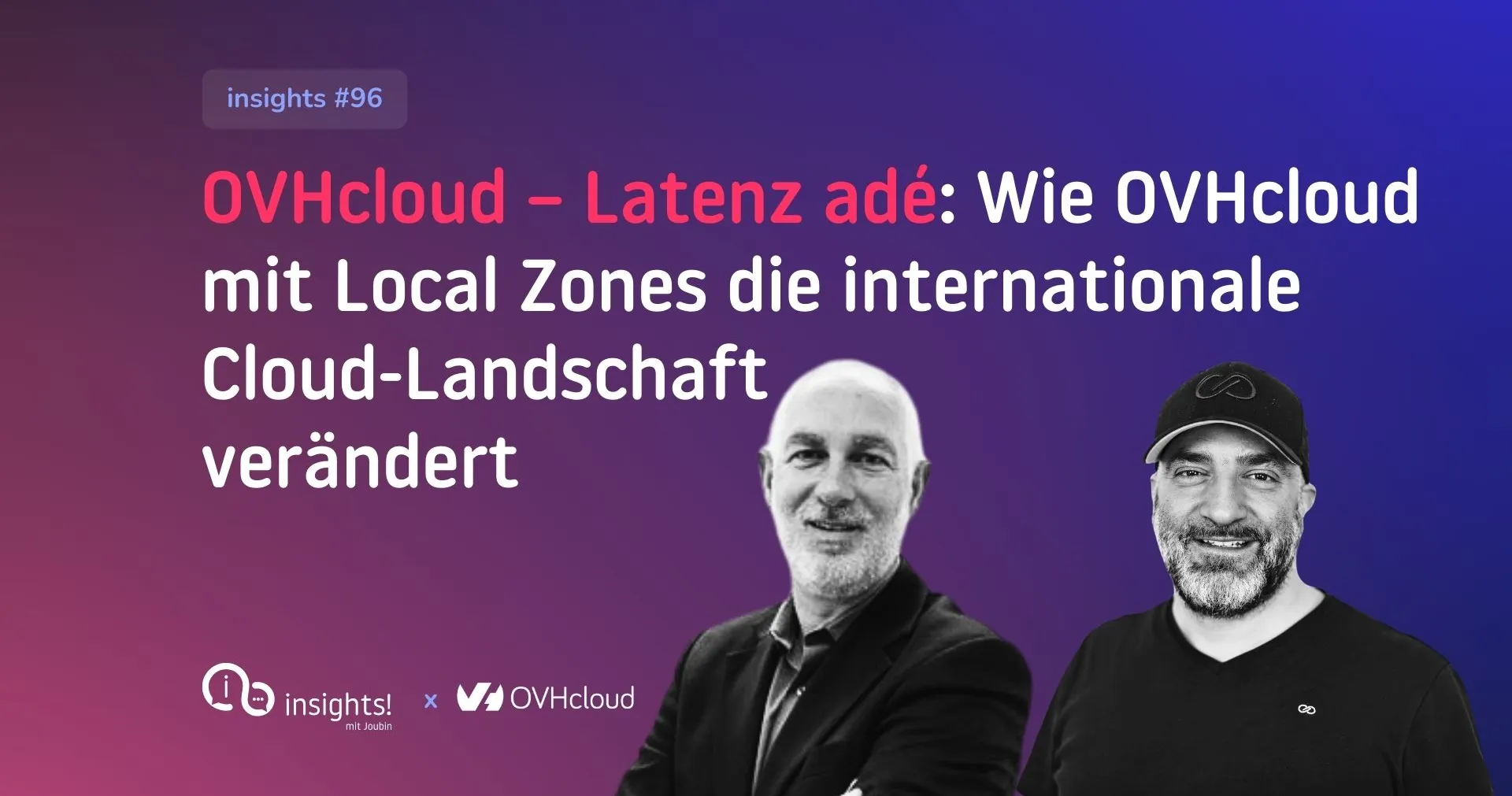
insights! #96: How Local Zones are redefining the rules of internationalisation!
New horizons of internationalisation! In the latest episode of insights! we speak again with Falk from OVHcloud. This time about the innovative introduction of Local Zones, through which they can bring their product to the international market effectively and with minimal resource use. Speed and data sovereignty are not just buzzwords but core customer concerns, and can be addressed through the worldwide build-up and expansion of various Local Zones. Today you'll learn first-hand what specific approaches OVHcloud is taking with its internationalisation and how your business can benefit from it too.
 Joubin RahimiManaging Partner · synaigy
5 min read
“We've already covered the most important markets today, but we don't want to stop there.”
In the third episode of insights! with Falk Weinreich from OVHcloud about the future technologies AI, data and quantum computing. He explains how these technologies are transforming businesses, offering new opportunities and changing the digital landscape. The ethical and secure use of AI and data is particularly important in order to secure a competitive advantage. Be sure to tune in and find out how your company can also be part of this revolution!
AI, data and quantum computing: the future of technology
In the world of technology, the rules of the game are changing rapidly. Artificial intelligence (AI), data processing and quantum computing are three areas that have the potential to transform not only the way companies work, but also society as a whole. These technologies offer countless possibilities, but also require careful consideration of their impact on the economy and ethics.
Data as the new raw material
Data is now considered the new oil – a valuable resource that plays a central role in the digital age. It forms the foundation for many modern technologies, especially AI. The collection, storage and analysis of large volumes of data enables companies to make more accurate predictions, create personalised experiences and increase process efficiency.
Data processing, however, goes beyond mere storage and analysis. Given increasing sensitivity of data, especially personal data, protection of this information is also an increasingly important aspect. Data protection and security are crucial for user trust and for compliance with legal regulations. Companies able to process their data securely and efficiently will have a significant competitive advantage.
Artificial intelligence: driver of innovation
Artificial intelligence is one of the most dynamic and most discussed technologies of recent years. It enables computers to develop human-like abilities – such as learning, problem-solving and language understanding. AI is now used in many areas, from automated production through medical diagnoses to personalised marketing solutions.
However, using AI requires not only technical expertise but also a deep understanding of the ethical and societal implications. The question of how to use AI responsibly and how to avoid potential risks such as bias and discrimination remains highly significant. Companies must ensure their AI solutions are fair, transparent and traceable.
Quantum computing: the next revolution
Quantum computing is still in its early stages, but it is seen as the next major technological revolution. While classical computers process information in bits, which can take the value 0 or 1, quantum computers use qubits, which, due to the principles of quantum mechanics, can exist in multiple states simultaneously. This enables quantum computers to solve extremely complex problems much faster than conventional computers.
Although quantum computing is not yet used to its full extent, there are already numerous research institutions and companies working on developing this technology. The potential applications are enormous: from simulating complex chemical processes that could drive the development of new medicines, to optimising supply chains and solving problems in materials science.
However, quantum computing is still far from revolutionising broad industry. The technology is still in its infancy, and considerable effort will be needed to make quantum computers scalable and reliable for practical use. But progress in this field offers an exciting prospect of a future in which quantum computers take on tasks impossible for classical computers.
Shaping the future
Technologies around AI, data and quantum computing have the potential to profoundly change the way companies work and the way the global economy functions. Companies that integrate these technologies into their business strategies early on will be able to develop innovative solutions and establish themselves as market leaders.
Nevertheless, it's important that these technologies are used responsibly. Data protection, ethical questions and the development of secure, transparent systems are just as crucial to success as the technical innovations themselves. The companies able to strike a balance between innovation and responsibility will shape the future and successfully reap the benefits of these technologies.
With the third episode of insights! with Falk Weinreich, we conclude our podcast series on OVHcloud. The groundwork for new joint projects has been laid, and we're keen to see what we can achieve together. Have the benefits of OVHcloud convinced you? Then arrange an appointment with our Head of Cloud Marc Achsnichs or our CEO Joubin Rahimi, and let them show you, with no obligation, how OVHcloud can make your business unbeatable too.
Would you like to listen to the full episode?
Find the podcast of the interview here:
Please accept the corresponding cookies to view this embedded content.
Prefer to watch the episode? No problem!
You'll find a recording of the interview here:
Please accept functional cookies to watch this video.
Prefer to read?
Joubin Rahimi:
Great to have you back for a new episode of Insights. Today the third episode with Falk from OVHCloud. Welcome, glad you're here with us, and the topic is internationalisation.
Falk Weinreich:
Thank you. Thanks for the invitation for the third time. I'm a regular now.
Joubin Rahimi:
Total.
Falk Weinreich:
I feel at home here with you.
Joubin Rahimi:
We'll make ourselves a name badge.
Falk Weinreich:
Name badge, yes, on the sofa, exactly. Yes, internationalisation, that's a good keyword. According to studies today, IDC, but also ISG, there are several providers, data analysts, who also always track this, in the data centre environment where we also have assets in various countries, we're already represented today in over 30 data centres worldwide, from Singapore, Australia, Canada, USA, Europe. We already cover the most important markets today. But we don't want to stop there. We want to become even more global. And to that end we've launched a new product. Not brand new, that was now already three, four, five months ago, but we call it "Local Zone". That means that our public cloud products, we're not doing this for all products, because technologically that would mean too much effort, but for the core products, especially public cloud, we're now going more granular, rolling out smaller offerings worldwide faster. Worldwide means really, we've just launched Rabat, three, four months ago Zurich, in December Vienna is next, we've never had services in Madrid before. We were never in the Netherlands before. We'll continue expanding further into Asia. We plan to launch over 150 zones in the next two years, in almost 50, 60 countries and thereby make the lead over our competition even clearer, when it comes to global availability, to deliver that, with the main advantage for the customer of course being that they can choose a provider regardless of where they are, almost regardless of which country they're in. Some customers still find that important. Sovereignty, data sovereignty doesn't necessarily have to do with geography, but for other reasons that does exist, especially Switzerland. I like to use that as an example: Swiss customers really want that. The service should please also be located in Switzerland, alongside data sovereignty. But then also to have a provider who can offer Switzerland, but also Spain, Italy, Canada, Brazil, everywhere in the world. That's especially in our region too, Switzerland, Germany above all, the Mittelstand is an export nation. We're an export nation and customers expect us to take them along on the journey worldwide as well. So availability worldwide, the sovereignty topics and also latency, because of course you're close to the customer.
Joubin Rahimi:
That's an exciting point, because in the preliminary talk we'd said: 'What actually interests customers? That's your topic, isn't it.' But the exciting thing, we found out afterwards: we have customers in the aviation industry, we have customers in other industry sectors, who need very short latencies and need large data centres, data centre power, which they then don't have where they need it. I found that exciting. So predictive maintenance was a topic, other analyses too. And it only became clear to me afterwards that they'd said: 'That's great, because my plane, my ship, my car is out there somewhere and I need a mega-short latency, and that's already important: do I have 8 milliseconds or do I have 800 milliseconds?'
Falk Weinreich:
Yes, ultimately it’s like a layered system, like certain applications, cold storage, archives, whatever – that can genuinely be anywhere in the world where it’s efficient, has cheap electricity, and I very, very rarely, hopefully never, have to touch it. And then comes the next layer for certain compute performance that really needs super efficiency right now, and there the licence isn’t quite as important to the customer yet either. And then there are certain applications where it’s simply so critical that it can’t take long. We see that in gaming, funnily enough.
Joubin Rahimi:
Total.
Falk Weinreich:
If the player takes too long, he's finished. Accordingly however-
Joubin Rahimi:
Doors get wrecked too, and mice, when the kids then break the things because the latency was too slow.
Falk Weinreich:
Well, in many areas latency is really important, and being able to offer that from a single source, so the customer can basically expand their portfolio with us, so they say: "I can entrust you with even more of my data. I like you anyway because you're data-sovereign. I like you because you don't use proprietary systems, because you're technology-open. I like you because there's no lock-in effect and no egress fees for traffic." There are certain reasons why customers have stayed loyal to us for a very long time, and we can then take those customers along on the journey, for certain applications, to say: "Now you can also use us in, I'll call it Rabat now, precisely because we've just launched it, if you need us on-site there, if you need a cloud there, if you want to reach your customers there, because that's simply your market, then we can now serve you there too, and soon in Brazil, soon in lots of countries in Asia. My region is of course more Switzerland and Austria and Germany naturally, but as I said at the start, German companies are global exporters. We're an export nation. That means it's also really important for my customers here that we now have a location in Amsterdam, and in Brussels, and in all kinds of countries, because we want to take our customers along on this journey, and customers have also told us this in feedback conversations. The theme of our product development is always to be close to the customer. We don't do this from our own chamber or the Eiffel Tower. Ivory tower, for us it's the French Eiffel Tower here. Right, Freudian slip there. But it really is the case, we develop this together with the customer, with their needs, and that's gone down pretty well. So we're seeing an extreme rise in the number of customers. Also, because it's a Local Zone, it's not the customers' main data represented there — so these aren't applications that go completely over the top, more like smaller-scale revenues too, for many customers, or one customer with many locations at the same time. What's important to know though is the journey there — if we then find in a country that this is growing so much that this Local Zone really needs to be expanded, also to other products, that we bring our entire portfolio from Private Cloud, Bare Metal, then also into that market, then we have this option now, because we're entering new markets through a relatively CapEx-friendly investment, and once they reach that size, then we can add on and offer the traditional, larger data centres there too. But of course it's also a capital efficiency question.
Joubin Rahimi:
How expensive is a data centre anyway?
Falk Weinreich:
Well, that's funny, it obviously always varies, but if you look at the media today, and we're part of the market, so I'm quoting more the general view here, and when Google, Microsoft and AWS offer their 100-megawatt data centres in these markets, of course that's several million, sometimes 100 million, that needs to be spent, raised as capital, to build a huge new data centre like that. Ours are a bit more efficient in terms of capital needs, because we typically don't go looking in, say, downtown Frankfurt. Ours is in Limburg, where the real estate market is different. So we have lower costs, just in terms of the land alone. And traditionally, we build brownfield. Meaning we're sustainable too. The ecological footprint is something we pay attention to, using existing industrial sites wherever possible. We — brackets open — we can do that — brackets close — because we cool with water. We covered that in our first episode. We don't need the air circulation in the data centre the way maybe more modern data centres do, because we don't circulate air, we work purely with water. That means we can happily move into old industrial sites too. Means no excavation. We don't have to first dig up huge amounts of dust and old materials and dump them in landfills, we can use what's already there. And that naturally saves capital too. So we're a bit more efficient. We don't need quite as much money as the American hyperscalers, but still, the first step is to be faster and more localised in the local zone, then scale up in the markets as needed.
Joubin Rahimi:
Great. Many thanks for the insight. I think time's up again for us to post it on LinkedIn. So if you still have questions about Local Zones or which cases you typically implement there, feel free to drop them in the comments below. We or our teams are very happy to answer. Thanks, Falk.
Falk Weinreich:
Great. Thanks, Joubin.
Have questions or feedback?
Then feel free to contact us directly.
- Joubin Rahimi
Managing Partnersynaigy
Show phone numberShow mobile numberShow email address

Subscribe to the blog now and never miss any news
✔️free of charge ✔️weekly news ✔️expert knowledge
Please accept the corresponding cookies to view this embedded content.