



With Cold Archive, you can explore a tape-based, highly resilient long-term storage solution.
OVHcloud presented us and other partners at OVHengage with the new sustainable data storage - the "Cold Archive". This combines the principles and ideas of two worlds and thereby creates new application possibilities. The new data storage "Cold Archive" is based on an IBM magnetic tape of type IBM Enterprise 3592 and is handled via Miria by Atempo. In this article we present OVHcloud's new data storage -Cold Archive- with all the info on how it works, pros and cons and cost structure.
 Marc AchsnichTeam Lead · synaigy
7 min read
OVHcloud Cold Archive was developed for long-term data archiving and is an innovative and sustainable storage solution for data that is accessed only rarely. It offers reliable and secure long-term storage, scalable from terabytes to petabytes and beyond.
How it works
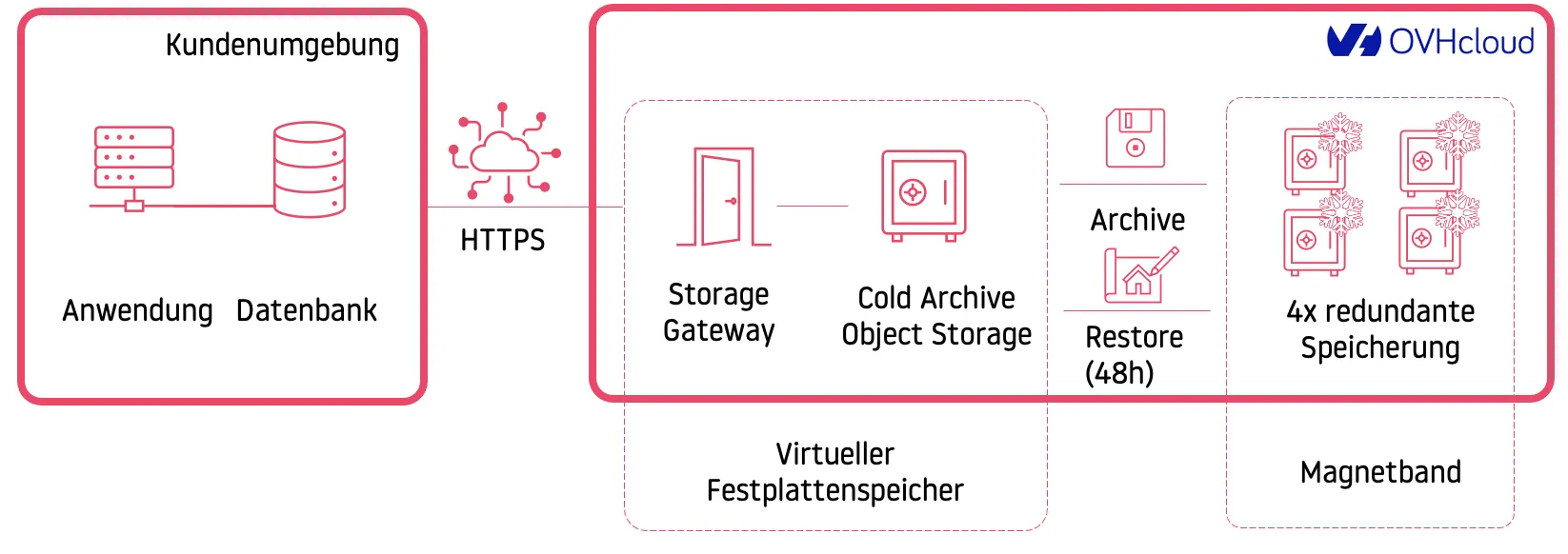
OVHcloud Cold Archive is an extension of OVH Object Storage. This means that, alongside the conventional method, any object storage can also be backed up to magnetic tape storage, whereby further parameters, such as the lifecycle, can also be defined. A magnetic tape backup refers to a type of backup that was used more in the past to protect data on magnetic tapes. Magnetic tapes were widespread in the early days of data storage and backup, particularly in data centres and other companies. Data is stored on a magnetic tape carrier known as a backup tape. This backup tape is then kept in a secure location to protect the data from loss or damage. In recent years, magnetic tape backups have increasingly been replaced by modern data backup technologies such as hard drives, solid-state drives (SSDs) and cloud storage. With Cold Archive, OVHcloud is now closing another gap with the hyperscalers. It should be noted that objects intended for archiving must not be created in the RBX region, but in the RBX-Archive archive region. This is possible via the web interface or CLI.
Benefits
Modern
Thanks to simple connection via the public cloud, it's easy to decide individually which data needs to be backed up and how. This way, any object storage can be converted into a cold archive via the S3 API.
Sustainable
Operation of cold archive represents a sustainable data backup. A typical cloud storage requires server infrastructures that must run continuously to keep data accessible. This means constant energy consumption. In comparison, magnetic tapes don't require continuous power supply, as they're stored physically. Likewise, magnetic tapes are designed for a long lifespan and require less maintenance than other storage media.
Cloud infrastructures have a limited lifespan and must be regularly updated and maintained. When hardware becomes outdated, it must be replaced, generating electronic waste. Magnetic tapes, however, can be recycled at the end of their lifespan. Cloud storage, on the other hand, generates electronic waste through outdated hardware components or servers that can no longer be used.
Secure
OVHcloud takes care of your data's security. Once archived, data and metadata can no longer be changed. A Blake3 signature is automatically embedded into metadata, ensuring completeness of a transferred object. Likewise, encryption of Object Storage ensures data is already encrypted before being transferred to magnetic tape storage. When transferred to tapes, these are stored with 4-fold redundancy across 4 data centres in France at least 100 kilometres apart. This guarantees availability even in the event of a data centre outage.
Scalable
No need to keep unnecessarily large tape storage on hand. Using Cold Archive, up to 100 containers of up to 100 TB each can be secured per project. This provides scalable storage of up to 10 petabytes.
Limitations
As good and useful as I find the idea of sustainable data storage, there are 5 limitations you need to consider when validating it:
Only one object storage from the RBX-Archive archive region can be backed up to magnetic tape. You typically don't use this region for standard object storage. This means you need to consider during design whether the data should be kept long-term or short-term.
Because data backup happens on magnetic tape, write and read access is more involved and costs arise for writing and reading the data. So only data you need just 1-2 times a year should be stored there.
The data isn't readable while it's on magnetic tape, and transferring it to object storage can take up to 48 hours. So only data you can afford to wait 48 hours for in an emergency should be stored there.
Magnetic tape storage is designed for long-term data storage. The minimum billing period is therefore 6 months. If you want to store data for less than 6 months, the full 6 months will still be charged.
Magnetic tape storage is designed for large data volumes. The minimum billing unit is 1 terabyte and smaller data amounts are rounded up to this unit.
Application example
Four simple steps are required to use a cold archive:
1. Creating a standard object storage from an S3 endpoint in the RBX-Archive region, since cold archives are only available in this region.
code: aws --profile my-profile --endpoint-url https://s3.rbx-archive.io.cloud.ovh.net/ s3 mb s3://coldarchivetest
2. Transfer of the data to be backed up
Code: aws --profile my-profile --endpoint-url https://s3.rbx-archive.io.cloud.ovh.net/ s3 cp /Volumes/Data/coldArchive.txt s3://coldarchivetest

3. Archiving the data in the container on magnetic tapes
Code:aws --endpoint-url https://s3.rbx-archive.io.cloud.ovh.net ovh-12m-archive coldarchivetest
The files are now being stored on physical magnetic tapes. This process takes a while. The status of this process can likewise be queried via a further interface:
Code: aws --profile my-profile --endpoint-url https://s3.rbx-archive.io.cloud.ovh.net s3api get-bucket-tagging --bucket coldarchivetest
As a result of this query, you receive a status code, which is further described in the following table.
Status | Description |
|---|---|
None | No archiving has been commissioned yet. |
Archiving | Object storage is currently being transferred to magnetic tape. |
Archived | Data was successfully saved to magnetic tapes. |
Restoring | A restore has been requested. |
Restored | The data was transferred back into object storage. |
Delting | Data deletion of the magnetic tapes was commissioned. |
Flushed | The magnetic tapes were successfully deleted. |
Cost structure
Cold Archive is billed according to storage used on magnetic tape and object storage, with an accuracy of 1 GB. Note, however, that the minimum unit is 1 TB. Billing is per GB/hour, based on an average of 720 hours per month. The minimum archiving period is 180 days. If an archive is deleted earlier — on any day between 0 and 180 of the contract term — the customer bears the additional costs up to 180 days.
Description | Price |
|---|---|
Tape archiving | €0.0015 incl. VAT/month/ GB |
Recovery of data | €0.006 incl. VAT/GB |
A backup of a 100 GB database for 12 months would therefore cost EUR 18.43 per year.
Calculation: (1024 GB*12 months*0.0015 EUR)
Market comparison
Cold Archive offers the European answer, a sustainable storage technology, to AWS S3 Deep Glacier or Azure Blob Archive Storage, and is also data-sovereign.
Performance | OVH Cloud | AWS S3 Deep Glacier | Azure Blob Archive Storage |
|---|---|---|---|
Tape archiving/GB/month | €0.0015 | €0.0017 | €0.00169 |
Data recovery/ GB | 0.006 EUR | 0.011 EUR | 0.00 EUR |
Minimum billing unit | 1 TB | 128 kb | N/A |
Minimum retention period | 180 days | 180 days | 180 days |
Provisioning time | Up to 48 hours | Up to 12 hours | Up to 15 hours |
Conclusion
Cold Archive meets the criteria for archiving a large volume of cold data that isn't accessed often and offers a solid, sustainable option for things like annual backups. Given the minimum retention period of 6 months and a minimum billing unit of 1 TB, regular backups aren't worthwhile. Cold Archive is therefore the right choice if your data backup meets the following criteria:
The data should be retained for at least 6 months.
You need at most 1 or 2 restores per year.
You can wait 12 hours for the recovery.
Due to the restrictions, this corresponds to AWS S3 Deep Glacier, but is around 11% cheaper and also data-sovereign.
If you need support with a sustainable backup strategy or on your journey to the cloud, we're happy to help with our cloud services. We look forward to hearing from you!
Have questions or feedback?
Then feel free to contact us directly.
- Marc Achsnich
Team Leadsynaigy
Show email address

Subscribe to the blog now and never miss any news
✔️free of charge ✔️weekly news ✔️expert knowledge
Please accept the corresponding cookies to view this embedded content.