



OVHcloud mesh network: Maximum flexibility for site distribution and data strategy
 Marc AchsnichTeam Lead · synaigy
5 min read

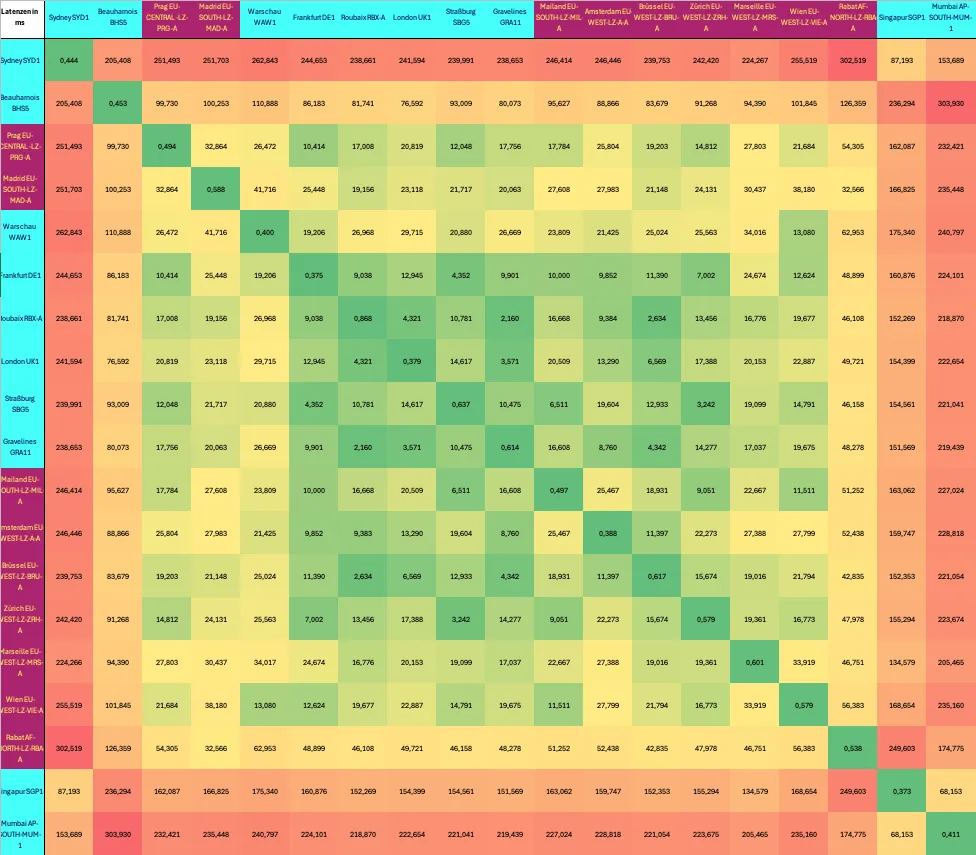
The OVHcloud mesh network offers a unique foundation for optimally designing IT infrastructures. With a large number of data centres worldwide, connected by a robust backbone network, OVHcloud opens up numerous opportunities for companies to distribute their workloads strategically. In this article we build on the previous blog post, in which we already analysed the latencies between OVHcloud locations, and now look at the complete location analysis, categorised by four central use cases: standby environments, disaster recovery (DR), backup and edge caching.
The matrix underlying this article maps the latencies between all data centres in the OVHcloud network. Each row represents a source location, while each column represents the latencies to the target locations. This structure enables comprehensive analysis in order to:
Green: identifying the lowest latencies for standby environments.
Yellow: finding suitable connections for disaster recovery (DR) and backup strategies.
Red: selecting distant data centres for edge caching solutions.
Locations marked red here are OVHcloud Local Zones
The four categories of site usage
This comprehensive analysis of the matrix makes it possible to divide connections into four categories: standby, DR, backup and edge caching. Below, we explain these categories in detail and present suitable location combinations.
1. Standby environments: latencies under 10 ms
Locations with extremely low latency are ideal for active standby systems. These systems are designed to seamlessly take over the function of a primary site in the event of a failure.
Examples of this include:
Active-active database replication.
Seamless failover strategies for business-critical applications.
Real-time data analysis for markets where speed is decisive.
OVHcloud offers the following location combinations:
Strasbourg (SBG5) ↔ Frankfurt (DE1): latency ~ 4.3 ms
Roubaix (RBX-A) ↔ Gravelines (GRA11): latency ~ 9.0 ms
London (UK1) ↔ Amsterdam (EU-WEST-LZ-A-A): latency ~ 9.9 ms
Frankfurt (DE1) ↔ Zurich (EU-WEST-LZ-ZRH-A): latency ~ 7.0 ms
Gravelines (GRA11) ↔ Strasbourg (SBG5): latency ~ 8.2 ms
Frankfurt (DE1) ↔ Roubaix (RBX-A): latency ~ 9.0 ms
Amsterdam (EU-WEST-LZ-A-A) ↔ Brussels (EU-WEST-LZ-BRU-A): latency ~ 9.6 ms
Zurich (EU-WEST-LZ-ZRH-A) ↔ Milan (EU-SOUTH-LZ-MIL-A): latency ~ 9.4 ms
Roubaix (RBX-A) ↔ Brussels (EU-WEST-LZ-BRU-A): latency ~ 9.1 ms
Frankfurt (DE1) ↔ Milan (EU-SOUTH-LZ-MIL-A): latency ~ 9.5 ms
2. Disaster recovery (DR): latencies of 10 to 90 ms
For DR solutions requiring frequent synchronisation and rapid recovery, locations with moderate latency are optimal. These connections enable regular replications and rapid access to data in an emergency.
Examples of DR scenarios:
Rapid recovery of critical databases and workloads.
Protection against regional outages through geographically separated locations.
Minimising operational downtime in case of site outage.
OVHcloud offers the following location combinations:
Frankfurt (DE1) ↔ Beauharnois (BHS5): latency ~ 86 ms
Madrid (EU-SOUTH-LZ-MAD-A) ↔ Prague (EU-CENTRAL-LZ-PRG-A): latency ~ 25 ms
London (UK1) ↔ Frankfurt (DE1): latency ~ 13 ms
Frankfurt (DE1) ↔ Warsaw (WAW1): latency ~ 19 ms
Vienna (EU-WEST-LZ-VIE-A) ↔ Prague (EU-CENTRAL-LZ-PRG-A): latency ~ 15 ms
Roubaix (RBX-A) ↔ Strasbourg (SBG5): latency ~ 12 ms
Amsterdam (EU-WEST-LZ-A-A) ↔ Frankfurt (DE1): latency ~ 10.8 ms
London (UK1) ↔ Strasbourg (SBG5): latency ~ 14 ms
Zurich (EU-WEST-LZ-ZRH-A) ↔ Prague (EU-CENTRAL-LZ-PRG-A): latency ~ 22 ms
Roubaix (RBX-A) ↔ Madrid (EU-SOUTH-LZ-MAD-A): latency ~ 28 ms
3. Backup: latencies of 90 to 200 ms
Backup strategies often don't require real-time data transfers, so locations with higher latencies are suitable for this application. These connections are ideal for regular, scheduled backups of large amounts of data.
Examples of backup scenarios
Long-term data storage and archiving.
Protection against data loss in the event of major disasters.
Backing up data at locations outside the primary continent.
OVHcloud offers the following location combinations:
Frankfurt (DE1) ↔ Singapore (SGP1): latency ~ 160 ms
Roubaix (RBX-A) ↔ Beauharnois (BHS5): latency ~ 120 ms
Madrid (EU-SOUTH-LZ-MAD-A) ↔ Rabat (AF-NORTH-LZ-RBA-A): latency ~ 95 ms
Frankfurt (DE1) ↔ Rabat (AF-NORTH-LZ-RBA-A): latency ~ 140 ms
London (UK1) ↔ Beauharnois (BHS5): latency ~ 130 ms
Strasbourg (SBG5) ↔ Singapore (SGP1): latency ~ 170 ms
Gravelines (GRA11) ↔ Beauharnois (BHS5): latency ~ 110 ms
Prague (EU-CENTRAL-LZ-PRG-A) ↔ Mumbai (AP-SOUTH-MUM-1): latency ~ 180 ms
Frankfurt (DE1) ↔ Marseille (EU-WEST-LZ-MRS-A): latency ~ 105 ms
Beauharnois (BHS5) ↔ Mumbai (AP-SOUTH-MUM-1): latency ~ 190 ms
4. Edge caching: latencies over 200 ms
Edge caching is essential for delivering content in geographically distant regions. Locations with high latency are perfectly suited to holding local copies of data or content, enabling fast access times for users on site.
Examples of edge caching:
Local delivery of content to end users.
Optimising user experience through shorter loading times.
Efficient distribution of workloads in regions with weaker network infrastructure.
OVHcloud offers the following location combinations:
Frankfurt (DE1) ↔ Sydney (SYD1): latency ~ 245 ms
Mumbai (AP-SOUTH-MUM-1) ↔ Singapore (SGP1): latency ~ 230 ms
Beauharnois (BHS5) ↔ Singapore (SGP1): latency ~ 236 ms
Frankfurt (DE1) ↔ Mumbai (AP-SOUTH-MUM-1): latency ~ 224 ms
Roubaix (RBX-A) ↔ Sydney (SYD1): latency ~ 250 ms
London (UK1) ↔ Sydney (SYD1): latency ~ 243 ms
Warsaw (WAW1) ↔ Singapore (SGP1): latency ~ 220 ms
Madrid (EU-SOUTH-LZ-MAD-A) ↔ Sydney (SYD1): latency ~ 252 ms
Strasbourg (SBG5) ↔ Mumbai (AP-SOUTH-MUM-1): latency ~ 230 ms
Beauharnois (BHS5) ↔ Sydney (SYD1): latency ~ 240 ms
Conclusion: strategic location choice for maximum efficiency
The OVHcloud mesh network offers companies a powerful foundation for strategically shaping their IT infrastructure. By grouping locations into the categories standby, disaster recovery, backup and edge caching, companies can optimally meet their specific requirements for latency, data availability and security.
Standby environments: Perfect for applications requiring maximum availability and low latency.
Disaster recovery: Guaranteed fast recovery and protection against regional outages.
Backup: Provides long-term protection and geographic separation for sensitive data.
Edge caching: Improves user experience in remote markets and reduces latency for local content.
By making use of the possibilities of the OVHcloud mesh network, companies can shape their IT strategy to be not only efficient but also future-proof. The key lies in optimal location distribution based on specific use cases.
- Marc Achsnich
Team Leadsynaigy
Show email address

Subscribe to the blog now and never miss any news
✔️free of charge ✔️weekly news ✔️expert knowledge
Please accept the corresponding cookies to view this embedded content.