



How much performance is in the new OVHcloud file storage?
Shared file storage is a central element of modern cloud architectures, particularly for Kubernetes environments and classic applications with shared data. OVHcloud positions its Public Cloud File Storage as a fully managed, scalable NFS solution with transparent performance allocation. But does the storage hold up in a practical test? We checked it: reproducible, API-based and without marketing shortcuts.
 Marc AchsnichTeam Lead · synaigy
6 min read
What awaits you: OVHcloud File Storage was tested under realistic conditions in the German public cloud region. The results show consistent, predictable performance behaviour that matches exactly what you'd expect from a modern, managed NFS service.
Small-file workloads benefit from very high IOPS
Large file workloads deliver stable, high throughput
Read and write differences are typical for NFS and constant
No unexpected performance cliffs or instabilities
OVHcloud File Storage is not a replacement for block storage, but a very solid shared storage for platform, Kubernetes and DevOps workloads.
Test setup & methodology
Both sequential and random read and write access were examined. In addition, various file and block sizes were combined in order to realistically map both small-file and large-file workloads and to comprehensibly analyse the storage's behaviour under different access patterns.
Region: Limburg
Connection: Private Network (vRack)
Client: OVHcloud Public Cloud VM (Ubuntu)
Protocol: NFSv4
Benchmark: IOzone
Connect OVHcloud File Storage via API
OVHcloud File Storage can be provisioned entirely via API and integrated into existing public cloud environments. This makes it particularly suitable for automated setups, reproducible test scenarios and use in platform or Kubernetes environments. The following section shows how File Storage can be created step by step via the OVHcloud API, connected to a private network and used on a cloud VM.
The guide is based on a practical setup and forms the basis for the performance measurements carried out afterwards. All steps are reproducible and can be used for both test and production environments.
1. Determine network and subnet
GET /cloud/project/{serviceName}/region/{regionName}/network
Choose a private network (visibility: private).
GET /cloud/project/{serviceName}/region/{regionName}/network/{networkId}/subnet
2. Create file share via API
POST /cloud/project/{serviceName}/region/{regionName}/share
{
"name": "fs-test",
"description": "Benchmark Fileserver",
"networkId": "<NETWORK_ID>",
"subnetId": "<SUBNET_ID>",
"size": 15,
"type": "standard-1az"
}
Share is available shortly after, including IP address.
3. Mount storage on the VM
sudo apt update
sudo apt install -y nfs-common
sudo mkdir -p /mnt/share
sudo mount -t nfs4 <share_ip>:/shares/<share_id> /mnt/share
df -h /mnt/share
Persistent mount:
echo "<share_ip>:/shares/<share_id> /mnt/share nfs4 defaults,_netdev 0 0" | sudo tee -a /etc/fstab
4. Run benchmark
sudo apt install iozone3
iozone -a -g 20G -i 0 -i 1 -i 2 -Rb iozone_raw.xls
Performance analysis: four perspectives
To realistically assess the performance capability of OVHcloud File Storage, performance was considered from several interrelated perspectives. Shared File Storage serves very different access patterns, which is why individual metrics in isolation only have limited informative value.
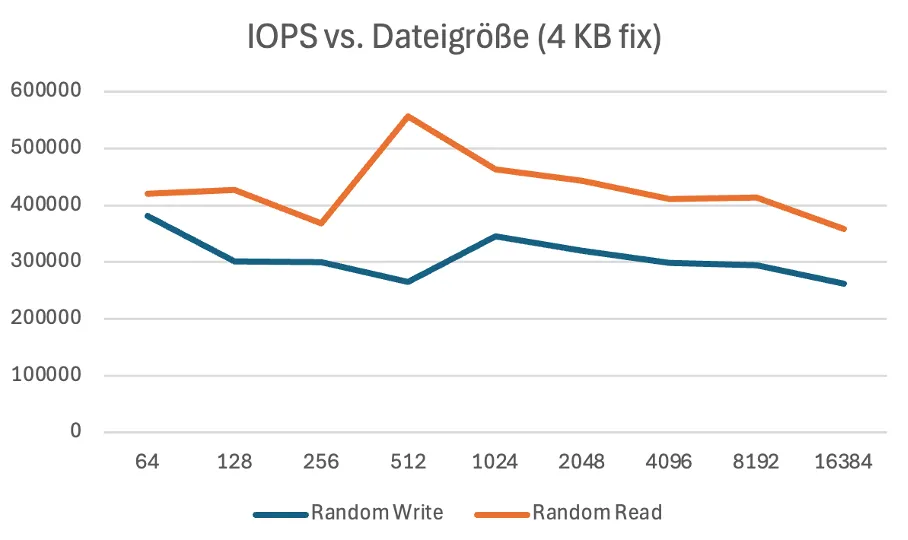
Analysis of IOPS at a fixed block size of 4 KB shows that the storage delivers very high and stable IOPS performance for small file workloads. In particular, random read and random write access for small and medium file sizes benefits from cache effects. As file size increases, the number of IOPS falls as expected, without any abrupt drops or unstable patterns. Read access remains more consistent than write access, which is typical and healthy behaviour for NFS-based storage.
With growing file size, performance focus shift from IOPS area toward throughput. Looking at sequential throughput at block size of 1 MB show that OVHcloud File Storage achieve stable and well-scaling data throughput for large file workloads. From medium file sizes, clear plateau form, showing that falling IOPS in this scenario are no sign of declining performance, but expression of more efficient I/O operations. Read access here run slightly above write access, without notable fluctuation.
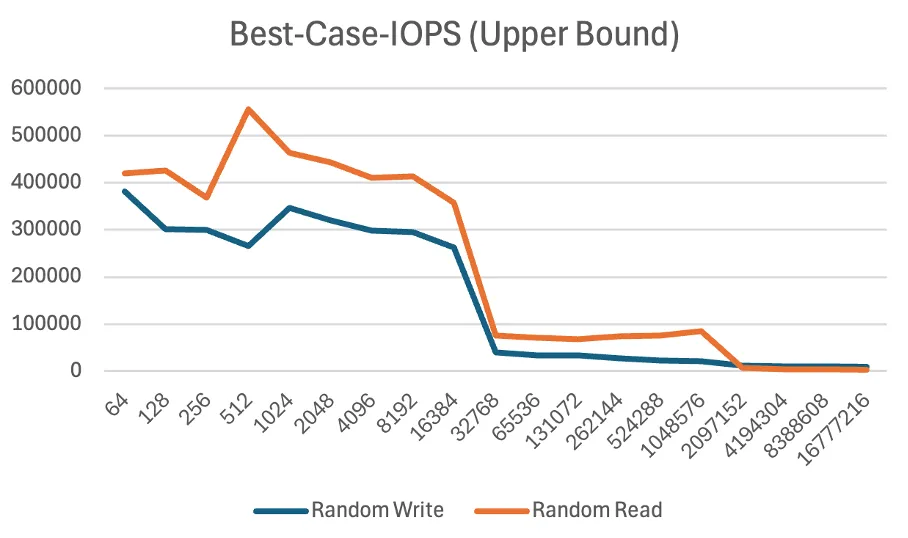
To classify the performance potential, the maximum achievable IOPS performance per file size was also considered. This best-case view does not represent a real workload, but does allow an assessment of the storage's technical upper limit. The results show high IOPS potential for small files and a comprehensible decline as file size grows.
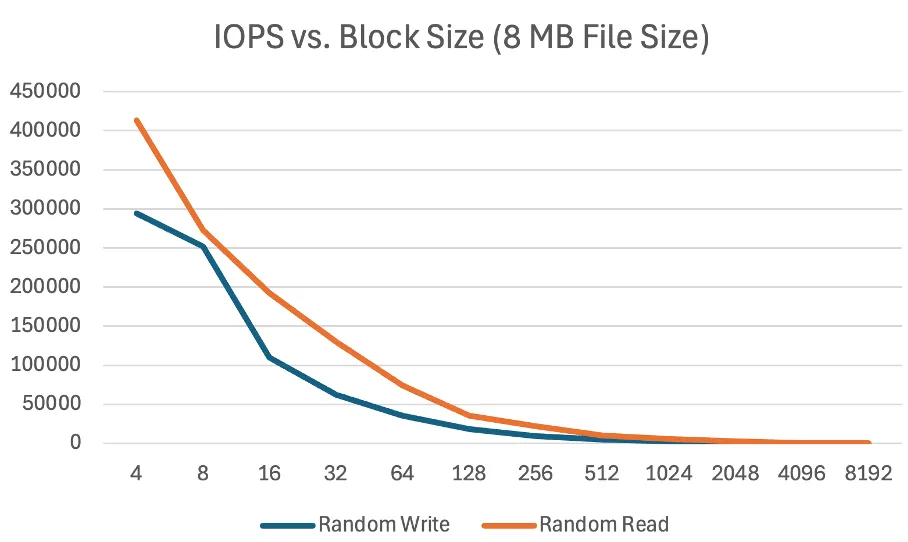
In addition, the dependency of IOPS on block size at fixed file size was analysed. Here it becomes clear that the highest IOPS values are achieved at very small block sizes. At the same time, it becomes apparent that this approach is not necessarily the most efficient for practical workloads. Block sizes in the range of 16 KB to 32 KB represent a sensible compromise, as they offer a balanced ratio of IOPS performance, efficiency and real-world relevance.
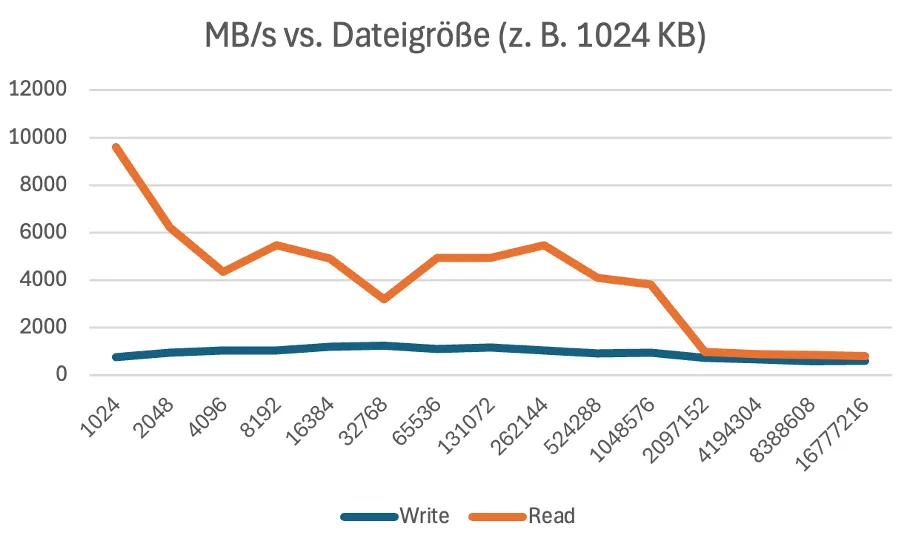
Overall, a consistent and easily comprehensible performance profile emerges. OVHcloud File Storage impresses less through extreme individual values and more through stable, reproducible results and a clear separation between IOPS-oriented and throughput-oriented workloads.
OVHcloud File Storage doesn't impress through spectacular peak values, but through predictability, stability and transparency. This predictability makes it a solid choice for shared storage scenarios in modern cloud architectures – exactly what you'd expect from a managed shared storage.
Conclusion and summary
OVHcloud File Storage is currently still in the alpha phase, but already shows remarkable stability and consistent performance behaviour. The measurement results from the practical test indicate that the underlying architecture based on OpenStack Manila is already mature and suitable for real shared storage workloads, even though the service is formally still ahead of general availability.
During the current beta phase, use of File Storage is possible free of charge. From the planned general availability in mid-March 2026, billing of 145 euros per TiB per month with hourly-based billing is envisaged. This price level currently does not represent a contractual commitment and may still change before GA.
The service is currently available in the DE1 and SBG1 data centres as well as at all GRA locations, and is aimed in particular at platform and Kubernetes scenarios. Support for Managed Kubernetes with RWX Persistent Volume Claims, as well as usage via classic NFS mounts on public cloud instances, enables flexible deployment across nodes, zones and applications.
Further technical details and current information on the development status are provided by OVHcloud in the Labs area:
For planning, implementing and running OVHcloud File Storage in production, it's worth bringing in an experienced implementation partner early on. Support with architecture, migration and operations is offered, among others, by OVHcloud partner synaigy.
We support you with architecture, migration and operation of OVHCloud :)
Feel free to contact us directly. We'll advise you fully.
- Marc Achsnich
Team Leadsynaigy
Show email address

Subscribe to the blog now and never miss any news
✔️free of charge ✔️weekly news ✔️expert knowledge
Please accept the corresponding cookies to view this embedded content.