



Introducing a PIM system – THE enabler for "digital transformation"
 Hanno KortmannE-Commerce Consultant | Data Protection Officer (DPO) · synaigy
6 min read
Successful digital transformation requires seamless networking of systems – it should be dynamic, scalable, extensible and cost-efficient. Introducing a PIM system as a central hub for product information enables optimal alignment of this business-critical area for the future. With a high-quality PIM system with a data model tailored to the company's needs, product information is built as a cornerstone of modern business processes on a solid foundation. In this blog post, you'll learn how introducing a PIM system optimises data and processes for your company's digital transformation.
There are many different reasons for a digital transformation initiative, and fast time-to-market, the availability of personalised or channel-specific information, and the integration of different systems into one cohesive whole always play a central role in achieving the underlying strategic goals.
A digital transformation should, on the one hand, create new possibilities for customer engagement, for services and/or entry into new markets and sales channels, and, on the other hand, also give employees within the organisation the opportunity to focus on the tasks that create the greatest value contribution for customers and prospects.
Often, though, it's only mid-implementation that you realise data and information are missing or very hard to access for important systems.
For information on products and services, an important prerequisite in any digital transformation project, modern PIM systems offer a class of applications specialised in automated ingestion, quality-assured enrichment and translation of data, and export for other systems.
Many sources, many destinations – one central hub
If you look at where data comes from and where it is needed everywhere, it quickly becomes clear that in a digital transformation, which usually also involves integrating existing systems for new channels and target groups, the topic of interfaces and data availability is a strategic issue.
Planning and purchasing need information on product characteristics, master data on purchasing and sales items is maintained in the ERP system, marketing and sales need text and images for the items and services on offer, logistics needs their dimensions and weights, customs information systems and the dual system require information, customer service needs data sheets and knowledge of which spare parts belong to which product – and so on, and so forth.
Connecting all these business processes and the systems they use with direct interfaces, or blowing up one system into the central system that's supposed to meet all requirements, may be effective approaches in theory, but in practice it quickly turns out that such architectures quickly become too complex or too sluggish to remain economical, and that any change to business processes, strategies or systems involves extremely high effort.
By using central hubs – in complex environments often combined with middleware that orchestrates and times the data flows – complexity can be significantly reduced, and with modern PIM systems, specialised applications are available as a data hub for product information, whose core task is to integrate data from various sources, consolidate it, and make it available to other systems.
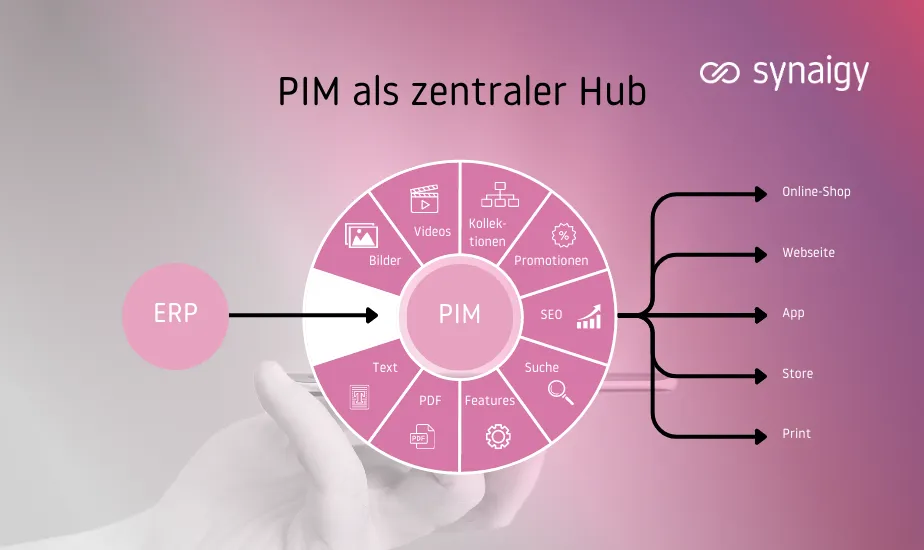
At their core, good PIM systems are workflow-driven data modelling engines that support users in creating and maintaining products and articles as efficiently as possible and optimised for the company's business processes. Connecting with other systems – whether via import functionality for data from source systems, or via exports to target channels and systems – is baked firmly into their DNA. On top of that come API interfaces that enable event-driven connections via a microservices architecture, with which even the most innovative processes and business models can be mapped.
When importing from external sources, the data is checked for plausibility, mapped to the company’s own data model, and, where relevant, corresponding data enrichment processes are triggered. On export, in turn, the enriched, consolidated data – where relevant enriched with channel-specific information – is filtered and prepared for the target and made available. The API additionally allows direct access from other systems to the PIM’s functions and existing data, whether for event-driven data queries or to update information in the PIM on an event basis.
This means outdated information, transmission errors and information gaps are a thing of the past, and instead of exchanging product information between a multitude of individual systems, its distribution is managed flexibly, dynamically and expandably from a single, consolidated, optimised point, so that even new systems and processes can be supplied within the shortest time.
Driving the Change
Within a PIM project, the various requirements that business processes and applications place on product data become clearly visible, and the existing processes for handling product information are inevitably called into question.
Not only is this a great opportunity to clear out workarounds and former requirements that no longer apply, thereby making the whole handling of product information leaner, faster and more efficient, it also offers the chance to shed light on blind spots, critically review the status quo and align it for the future.
Ability to automate processes and hand off previously manual calculations and derivations to PIM system, paired with system-supported quality and completeness assurance of data, means staff can focus on value-adding steps of product data enrichment instead of being burdened with rework and error correction. Workflow control simultaneously ensures that most important tasks for most important items can be prioritised, and that data passed to other systems is meaningful, complete, consolidated and optimised for them.
The rapid extensibility of a robust data model ensures that new processes, products and services can be supported within the shortest time, and the overview of existing product knowledge invites you to pursue new ideas and drive innovation.
Overall, this makes the whole company more flexible, enabling it to seize new business opportunities, open up markets, and integrate and run channels with far less effort, more dynamically and quickly. Where cost and rigidity previously held back innovation and frustrated idea-makers, a space of possibility is created.
Conclusion
Every digital transformation depends on the interconnection of systems not just working, but being dynamic, scalable, extensible and cost-efficient. By introducing a PIM system as a central hub for product information, this business-critical area is optimally set up for the future.
Whether as a preliminary or partial project of a change initiative – the knowledge about data and processes gained through a PIM implementation, at the heart of everyday business, helps with further planning of the next steps, supports identifying remaining gaps, and thus prevents innovation from stalling due to a lack of data availability or quality. At the same time, the PIM system forms one of the foundations for supplying the new systems – whether in e-commerce or EDI, whether for marketing, sales, logistics or customer services.
Product information is one of the pillars modern business processes rest on. And with good PIM system with data model optimised for the company, this pillar stands stable and load-bearing on solid foundation.
Selecting and implementing a PIM system is a challenge for many companies. We're happy to support you! Just get in touch with us.
Have questions or feedback?
Then feel free to contact us directly.
- Hanno Kortmann
E-Commerce Consultant | Data Protection Officer (DPO)synaigy
Show phone numberShow mobile numberShow email address

Subscribe to the blog now and never miss any news
✔️free of charge ✔️weekly news ✔️expert knowledge
Please accept the corresponding cookies to view this embedded content.