



insights! #114: AI reality, robotics revolution & China power: what really matters right now, according to Pip Klöckner
Artificial intelligence stands in middle of technological upheaval progressing faster than many want to admit. Pip Klöckner, technology analyst, podcaster and investor, spoke in current insights! episode with Joubin Rahimi about status quo, next development steps and what really matters now for companies, for investors and for everyone who wants to shape things with technology.
 Joubin RahimiManaging Partner · synaigy
5 min read
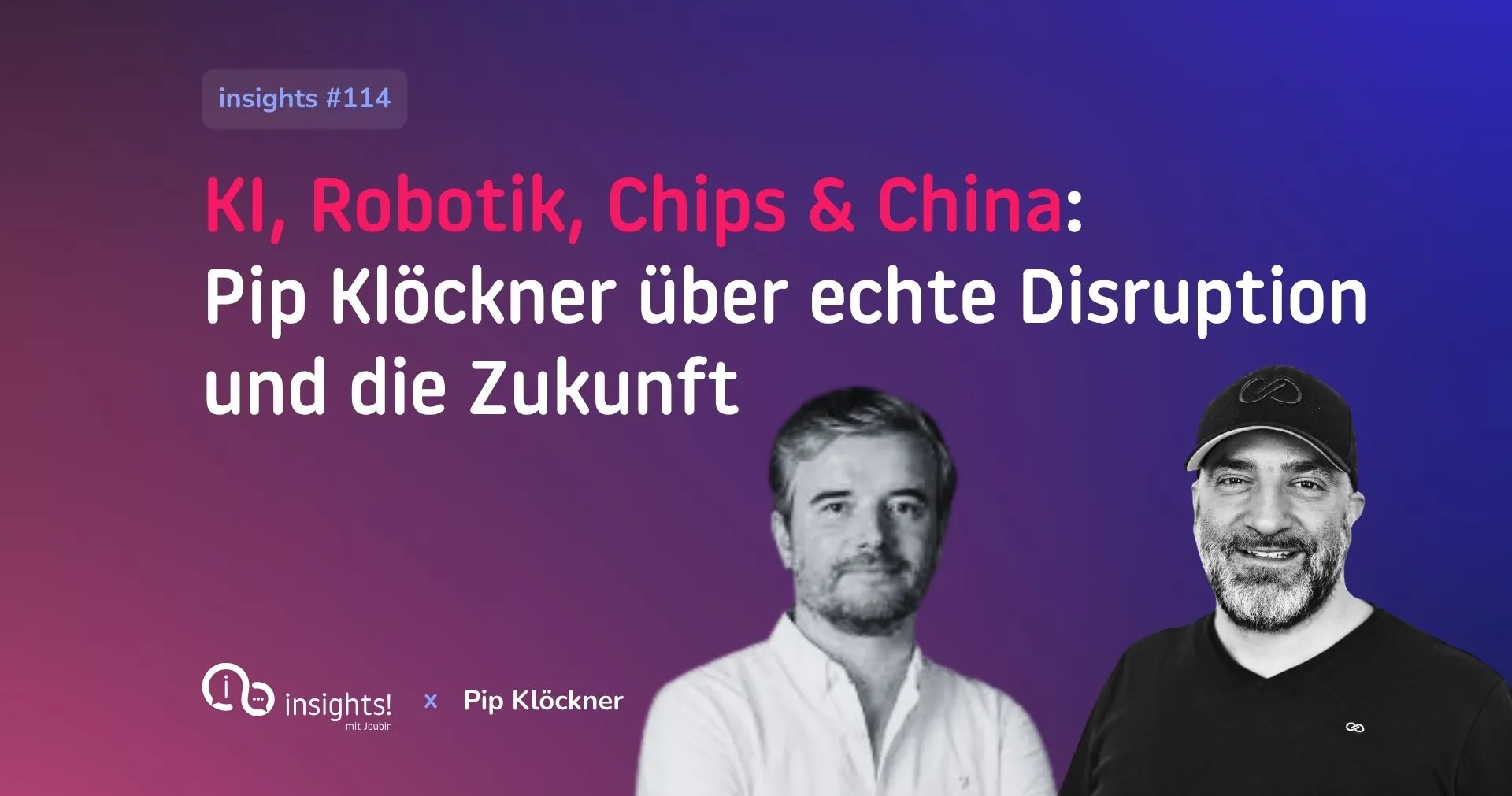
"ChatGPT is my product manager, Claude is my programmer. I give it a second model as co-programmer as well, so they correct each other. And today the news came that someone built an app entirely, and it went through Apple's App Store process. We're at the point where small apps can be built entirely with AI."
Artificial intelligence stands in middle of technological upheaval progressing faster than many want to admit. Pip Klöckner, technology analyst, podcaster and investor, spoke in current insights! episode with Joubin Rahimi about status quo, next development steps and what really matters now for companies, for investors and for everyone who wants to shape things with technology.
Progress despite scepticism: AI keeps developing reliably
In recent months there has repeatedly been talk of an “AI standstill”. Voices have claimed that development is stagnating. Pip Klöckner firmly disagrees: while there has been more scepticism in public discourse in the short term, in substance he sees a clear line - the models keep getting better, more efficient and more powerful. Google Gemini Pro has at times technologically overtaken OpenAI, while at the same time Chinese models such as DeepSeek and Quen (Alibaba) are achieving remarkable quality with, reportedly, comparatively low investment. One of the biggest changes concerns efficiency. The cost of so-called inference, i.e. running AI models, has fallen by a factor of 1,000 in the last year alone. „Many things that were economically unthinkable a year ago are suddenly possible today.“ – Pip Klöckner This development opens new doors, and not just for companies but also for individuals. AI is increasingly becoming a tool that anyone can use productively.
From assistant to co-creator: how AI becomes a productivity factor
The role of AI is changing. It's long since stopped being just a tool for text or images – it now takes on concrete tasks in development and business processes. Pip observes a new generation of users putting together their own AI team: a language model like ChatGPT for coding, a second model like Claude for quality assurance, complemented by another system that cross-checks queries and detects potential errors. This combination already makes it possible today to build fully functional software solutions entirely with AI. And at high speed: one example from Pip's circle shows how a developer built a multiplayer flight simulator with 500 prompts in one night, one that could be played by tens of thousands of people at the same time.
Next phase: from image and video generation comes the 3D world
For Pip, technological development is clearly mapped out: after the breakthrough in image generation (2022) and video production (2023/24), the generation of entire virtual worlds is now on the horizon. The games and film industries will be fundamentally transformed by these new possibilities – not through new tools, but through fully automated production processes. Within this dynamic, a clear message for companies: whoever still relies on existing processes today without realigning themselves technologically risks falling behind.
Wrong priorities? Why Pip doesn't invest in LLMs
While currently a large share of investment volume flows into large language models – the "big" AI foundation models like GPT or Claude – Pip is taking a different path. For him, this market is overheated. Training and operating costs are enormous, competition is high, and the industry's top talent commands salaries that are unusual even by Silicon Valley standards. Instead, he focuses on infrastructure: specialised chips, inference technology, and above all robotics. While 70 per cent of investment flows into LLMs, robotics receives just ten per cent – for Pip, a missed opportunity. "Far too little capital is currently flowing into robotics and infrastructure – even though that's where the decisive innovations are happening."
Household robots that understand – not just function
Pip finds progress in the field of robotic autonomy particularly exciting. Robots that don't just repeat programmed sequences but understand in the abstract what they are doing, for example how to lay a table or fill a fridge. This is made possible by the combination of LLMs and simulations, which allow robots to learn from observation.
For him, a real milestone is so-called "dexterity", the fine motor touch. A robot that can tie a shoelace has the ability to solve almost any complex physical task. This paves the way for service robots, household helpers and logistics systems that don't need human assistance.
Germany in the rear-view mirror and on the platform?
At the end of the discussion, Pip dares to look towards Germany, and unsurprisingly, the view is critical. In a future scenario where AI and robotics automate entire value chains, two things matter above all: energy and raw materials. And this is exactly where Germany has structural weaknesses. But there is one ray of hope: human capital. Germany has leading universities, a strong developer community and excellent researchers. Many of them, however, now work in the US, at Meta, Google or OpenAI. The challenge isn't training new talent, but retaining or winning back the talent that already exists.
Would you like to listen to the full episode?
Find the podcast of the interview here:
Please accept the corresponding cookies to view this embedded content.
Prefer to watch the episode? No problem!
You'll find a recording of the interview here:
Please accept functional cookies to watch this video.
Prefer to read?
Joubin Rahimi
Brilliant that you're back for a new episode of insights! My name's Joubin, Joubin Rahimi, and today with me once again, Pip Klöckner. Hello Pip.
Pip Klöckner
Hello, I'm glad to be here.
Joubin Rahimi
I'm really pleased we're speaking for the second time. Almost exactly a year ago, I think ten months, you were with us at the lake, out at the beach location. I still remember everyone was shivering because we simply went on for much longer, or you went on for much longer than planned, and the sun was setting, but not a single person left. So that was quite something. That's why you're here again.
Pip Klöckner
I remember it well, yes.
Joubin Rahimi
And thanks also for making this possible again. Back then we talked about AI and you gave your talk on a very broad range of facets of AI. Today I'd like to discuss with you what has changed in the ten months since. Most people know you, but perhaps say a couple of sentences about yourself, where else people might know you from, and what else we should take away.
Pip Klöckner
Yes, I'm Philipp Klöckner, or Pip Klöckner also known as, am technology analyst, podcaster, investor, advisor, advise private equity firms, am supervisory board member at listed companies, advisory board member, do many things in parallel, but all relate to technology and analysis in broadest sense. Hence title. Do the Doppelgänger Tech Talk podcast twice a week and am guest on many other podcasts. So much about me. You asked what developed over last year or what happened since last INSIGHTS. I'd say, on one hand narrative has become relatively sceptical over the year and more sceptical voices appeared at times. There was, I'll talk about that shortly in my talk, this AI is hitting a wall narrative. Many sceptics who said we're actually not seeing any progress at all anymore.
Joubin Rahimi
Global or more Europe, Germany?
Pip Klöckner
I'd say even globally first of all, that people, or part of the people, couldn't see enough progress for a short moment. But if you look at the year so far and the last twelve months, you see the models have actually got better very predictably. Google Gemini Pro even caught up with OpenAI again. OpenAI has still developed itself hugely too. What was new was that two very strong Chinese models were added. One being Deep Seek, which rattled the market, because they apparently beat billion-dollar models with just 6 million US dollars. I'll explain shortly what's really behind that. Alibaba built a Qwen, a very powerful open-source model, and at the same time a lot has happened in image generation. We've made incredibly strong progress in video too, now with Veo3 from Google as well. What always strikes me is that everything people declared impossible for decades a year or two ago is now happening, it feels like, within months.
Joubin Rahimi
It's just not linear, this change just isn't linear.
Pip Klöckner
And even — I showed you this slide last year — how AI scientists who themselves work with AI assess this, even they keep shifting their estimate of when certain milestones will occur further forward. So the first book that becomes a bestseller, the first pop song, the first film and so on, they say everything will happen sooner, every year even sooner than expected. So there's an acceleration, it's building up somewhat exponentially, and that's always hard for us humans to grasp.
Joubin Rahimi
We experienced it first-hand ourselves. We also thought about how we could make projects more efficient, because it's nicer for customers if the project arrives faster, at higher quality, more functionality for the same price or whatever. And at first there was a defensive attitude. That doesn't work yet, it's not great, too many errors. And then Claude came along, and then on one weekend the opinion of the team members who'd been sceptical completely flipped, on top of those who'd already been positive either way. They were like on heroin. They coded away the whole weekend, because they said they were thrilled by it. Those moments – that was in coding now, but it's probably elsewhere too.
Pip Klöckner
Difficult part of my job is explaining to people, when are we talking about future, when are we talking about present and what, with relatively high probability, will already work tomorrow or day after. And people like to use today's shortcomings, a hallucination here or a code error there from Claude, to say, all this doesn't work yet. Can't do as much as humans. Fairly, they don't even compare it with average human, but with perfect human. But if you look at development, you can actually predict quite well when certain things become reliable enough, fast enough, cheap enough. We have a very reliable improvement in hardware and through that in models, particularly querying, inference keeps getting cheaper. That's become a factor of 1,000 cheaper in just last year alone.
Joubin Rahimi
One really has to say again …
Pip Klöckner
Many things that were economically unaffordable.
Joubin Rahimi
Factor 1,000.
Pip Klöckner
Right, over a year. Lots of things that were economically unaffordable suddenly become affordable. That's why we now have all these Deep Search, Deep Seek, Deep-Think models, because reasoning during model inference has become so cheap that you can run several instances against each other at the same time. They can correct each other. That gets rid of hallucinations, for example. If you run the same query four times, you say we're only confident if the same result comes out four times. If four different results come out, it's probably a hallucination. That way you can already solve a lot of smaller problems much better. On a larger scale in companies, the project factories, like you just described, maybe they build or have their supply chain fully observed by AI first, then perhaps analyse later, build a kind of co-pilot, and right at the end maybe hand it over to AI. But especially from the start-up sector, or the solo-entrepreneur sector, you're already seeing the first people saying: ChatGPT is my product manager, Claude is my programmer. I'll give it a second model too, as a co-programmer, so they correct each other a bit. To then be sure again, did it go off on a tangent there, check again like a peer programmer, add a second AI on top. And today the news just came out that someone built an app completely on their own that actually made it all the way through Apple's App Store review process too. We're now at the point where small apps can be built entirely with AI. There's this example of someone who built a massive multiplayer online flight simulator. It still looks a bit like Minecraft and very blocky, but someone who is a programmer but had never programmed games before built, within one evening with 500 prompts, basically a flight simulator that 50,000 people could play at the same time, and already made ad revenue from it and so on. And these are just the beginnings we're seeing now. That means the flight simulator won't be blocky tomorrow, but will eventually have a realistic world. I always say, the year before last it was mostly image generation, the last twelve months mostly video generation. The next thing will be that we generate complete 3D worlds, the film industry, the games industry. In the past there were people who animated individual hairs on an animal or leaves in a forest for films or for the games industry. AI will obviously do all of that now and build entire worlds, and eventually everyone will be able to play their own game in their own game world.
Joubin Rahimi
And what I have now, said last year too. I've been repeating this, I think, for a year and a half, two years now. With Gutenberg, the distribution of knowledge was democratised; with the internet, social media and so on, the distribution of information. So one person could, and still can, reach the entire world. And now with AI, the generation of something is being democratised. And you've already mentioned that industries are changing. If you now look at it as an investor, where are the fields where you'd say you'd invest more, versus the fields where you'd say that's difficult? So we're an IT services company, I'd say we need to reinvent ourselves. That's hugely important. Agency. We need to reinvent ourselves, just like the video screen designer who also has to reinvent himself. From a tech and analyst perspective, where does it get exciting?
Pip Klöckner
I talked about this recently on the podcast. The interesting thing is that around two-thirds of investment really flows into this LLM foundation model space, simply because they consume so much energy and compute time, and therefore money, to train and to run. There's a huge war for talent going on right now. So programmers or researchers, the top AI researchers, earn hundreds of millions a year in some cases. That means everything costs so much money. That's why an incredible amount of investment flows into these LLMs. I don't believe in that. I actually want to invest in AI infrastructure, so either physical chips, hardware, things like GROK or Cerebras, these are companies developing the next generation of inference chips. And I'd invest almost blindly in the whole robotics topic. I'm a bit worried that in the end it'll all go to China anyway, but I consider that a big... And comparatively only about 10% or so of investment, in the broadest sense of AI, goes into robotics and infrastructure and hardware, while 70% goes into LLMs. So I'd think somewhat countercyclically, more towards hardware and robotics. In my opinion, too little money flows in there. I'm looking to build up a bit of exposure there too.
Joubin Rahimi
Yes, I think with robotics, robotics combined with AI will change a great deal. Caring for people, household help at home, doing even more in companies where people used to be involved. That will explode. Quantum computers on top of that. Do you have a view on how that and this computing power will shortly change things further?
Pip Klöckner
Maybe just briefly on the robotics topic, because that's exciting too. In the last twelve months, I didn't mention this earlier, but it's also really important, something important happened. Namely, we've had industrial robots for decades that can do the same thing 10,000 times a day with super precision. Super efficient, super precise. But what's been made possible this year, in particular through LLMs, is that robots can find their way around completely new environments and carry out activities they've learned purely through observation. You simply show a robot 10,000 different people washing up, or maybe even simulate it. You can build a computer game where you show artificial figures washing up, and robots learn from this synthetic data. And the new thing is, there are robots, household robots, that no longer need to know the environment, instead you push them into flats they've never seen before and you say to them: mop the floor, or tidy the fridge, or clean the plates, and they can do that in an environment they've never seen before, because they abstractly know what a plate is, abstractly know how washing up works. And that's a huge breakthrough that we only had in early stages twelve months ago and that's now spreading very strongly.
Joubin Rahimi
And that will change a huge amount too.
Pip Klöckner
That's the absolute game-changer. That's the path to the household robot, that's the path to the care robot. There's a lot of talk about so-called dexterous hands. So the last big challenge is dexterity — that means fine motor skill. So if you talk to someone in logistics now, they'd always say, exactly, grasping things like that.
Joubin Rahimi
That you can really touch it without breaking it.
Pip Klöckner
A logistics person would say, moving large parcels from A to B, robots can already do all that, robots do that already, but a plastic bag with a shirt in it, processing a return of a white shirt like that, folding it back up and putting it into a plastic bag, that's still relatively hard, but there's been progress on that in recent years too, a new Google model where Google used two robotic hands to tie a shoelace, so to speak, and you know, if you can tie a shoelace, you can probably do almost anything. Then you have the fine motor skill, and there too we're making great progress. You mentioned quantum computers. That's not yet... I haven't looked into it that much, honestly, but of course I've followed that Microsoft, Google and so on are all building their own quantum chips, and they say, purely in theory, they're still relatively fuzzy, which is a bit of a teething problem, or rather you're actually doing a bit of the same thing as with LLMs there. That is, the qubit is a bit fuzzy, how shall we put it. It can take on many different state values, not just 0 and 1. And assessing that correctly, what state it's actually in, isn't that precise yet.
Pip Klöckner
But you can do the same thing there, accepting the error and simply performing the same calculation operation four times. And only when all the qubits give the same result do you trust this potential state it's currently in. That means you make a lot of progress there.
Joubin Rahimi
Why do I have a reservation there? Let's say, otherwise, the computer always has zero and one, and I mean, NVIDIA has lots of zeros and ones and simultaneously. And with quantum computers, I don't have zero and one, but something between zero and one. And that corresponds much more to generative AI, neural networks and so on. And so I thought there definitely has to be a push on that too, how intensive or how computationally intensive the performance will be.
Pip Klöckner
This will be similar to AI, again a kind of foundational technology that boosts a great many things. It started with science. We talk far too little about that. That means it will accelerate science. There are many things we can't calculate today, don't have the capacity for. Weather models and things like that, we're still relatively far from the ground on those. Much more precise, much more elaborate calculations, with quantum computers. Cryptography, cyber security are of course cases people worry a lot about. So are there still any secure passwords, or how do you protect the blockchain in the end. That's where it'll matter. But of course also the further development of artificial intelligence, which is ultimately driven by compute time. So if you manage to combine matrix multiplications with quantum chips, you could most likely achieve significantly more even with existing AI technology or existing AI models, or even build models that are better tailored to these chips, and then reach a completely different level of potential.
Joubin Rahimi
And Moore's Law — you said last year, I believe, that it's been overridden, right?
Pip Klöckner
There are various signs. Cerebras, this company that built this super chip, by no longer building chips individually but turning the entire wafer, so the whole semiconductor disc, into one chip. As a result, communication between the different cores is much faster, because it goes via light. So then the topic of, so to speak, data transmission at the speed of light within chips, LightMatter and so on. A lot of research is going into that right now. In the end you'll probably have super chips that are essentially a complete wafer, communicating with each other at the speed of light. Meaning they can also exchange data much faster. That will probably put us on a higher trajectory on the clock curve we've had so far, where it started somehow with the 486 or 386, the 286 and so on. There's a logarithmic curve that points relatively clearly upwards. And we see that Cerebras, with this mono-wafer chip, is already above the curve. It then grows again at a similar speed, but they've essentially jumped up a level. And I think, through light-based communication, it could get even faster again.
Joubin Rahimi
These are all international projects and advances. Where do you see Germany? Where do you see Germany's strengths? Where would you say we could simply do more, to really be active in this rapidly changing market?
Pip Klöckner
I'll start with the pessimistic view. So in a world where we have human-level machine intelligence, AI as smart as humans, that will happen in the foreseeable future, maybe 18 months, maybe five years, but certainly not 20, I think. And where we have what's called full automation of labor, meaning robots take over human activities, physical activities, there are really only two ultimate resources, namely energy, to run AI for example or to run the robots, and the raw materials to build the robots. Because once I have robots, robots can build cars, robots can build robots, robots can somehow provide services, can produce food, can do farming and so on. That means ultimately it just comes down to electricity and raw materials, rare earths, steel, so iron, maybe coal.
Joubin Rahimi
And neither of us is exactly ahead there. Right.
Pip Klöckner
The clear winners from this development will be Russia and China, because they now have huge landmasses with massive resources; perhaps the Gulf states too, a bit, as they are well supplied with energy. That means, to start with, it doesn't favour us. We have high energy prices, no resources of our own, not good. What we have is incredibly good human capital. We have many top universities with top AI researchers in Tübingen, at RWTH, TU Munich, TU Berlin, KIT in Karlsruhe. If you look at the patents from the AI world, almost all of them come from China and the USA. But if you read the names, very often they're German researchers working at DeepMind, or at Meta's FAIR research lab, or at OpenAI. That means we actually have the people. We just need to manage to make them want to found companies in Germany. We have deep, vertical value creation processes. The USA is much more geared towards domestic consumption, marketing, that sort of thing. We actually have value chains, so to speak: automotive manufacturers, tool makers, the steel industry and so on. That generates a lot of industrial data which could be valuable for developing an industrial AI, Industry 4.0 or 5.0, whatever you want to call it. I think we have a reasonably stable political system and still a welfare system, although in the past that hasn't exactly proven capable of retaining scientists.
Pip Klöckner
It has certainly helped a bit that foreign scientists in particular are increasingly feeling uneasy in the US. France is running campaigns to win people back to Europe. We should perhaps do that too, but ideally not let people go to the US in the first place. So this kind of human capital is, if anything, our hope. We have a great many developers, male and female, in Germany, a great many students who are leading in the IT field or often in AI research. And with that we actually have everything you need. As for energy, we could say that if we hurry, we can, with the resources still available to us, build relatively affordable renewable energy and storage technology, nuclear too if you like, if that can be comparably affordable. We will not solve the raw materials problem, we will have to buy those in somewhere. But I would say the ship has certainly not sailed yet.
Joubin Rahimi
And that's a great key phrase, to say the train hasn't left yet, but we need to act now so that we can get everything …
Pip Klöckner
Exactly, that's definitely five past twelve. But you can still call out the train. Another train is coming.
Joubin Rahimi
Yes, but we'll see if we can still reach him somehow. Pipp, thanks for the insights. I'm looking forward to seeing you on stage again shortly. And thanks for watching. If you have questions, you'll probably answer them as usual via social media. Thanks.
Pip Klöckner
Thanks also
Have questions or feedback?
Then feel free to contact us directly.
- Joubin Rahimi
Managing Partnersynaigy
Show phone numberShow mobile numberShow email address
Subscribe to the blog now and never miss any news
✔️free of charge ✔️weekly news ✔️expert knowledge
Please accept the corresponding cookies to view this embedded content.