



#160 - 850,000 work hours saved: how robots and AI are transforming German SMEs
In the new insights! episode, Joubin Rahimi talks to Toralf Feuchtenhofer, founder and managing director of Crest Digital, about the reality behind the shiny digitalisation promises. It's about why tenders often destroy value instead of creating it, why digital sovereignty is now becoming a board-level topic, and why every company ultimately has to be a software company if it wants to stay relevant. You'll learn what customers really need, how AI doesn't fail because of the technology but because of a company's own data and processes, and why a single example from the automotive industry frees up 850,000 units of work value.
 Joubin RahimiManaging Partner · synaigy
6 min read
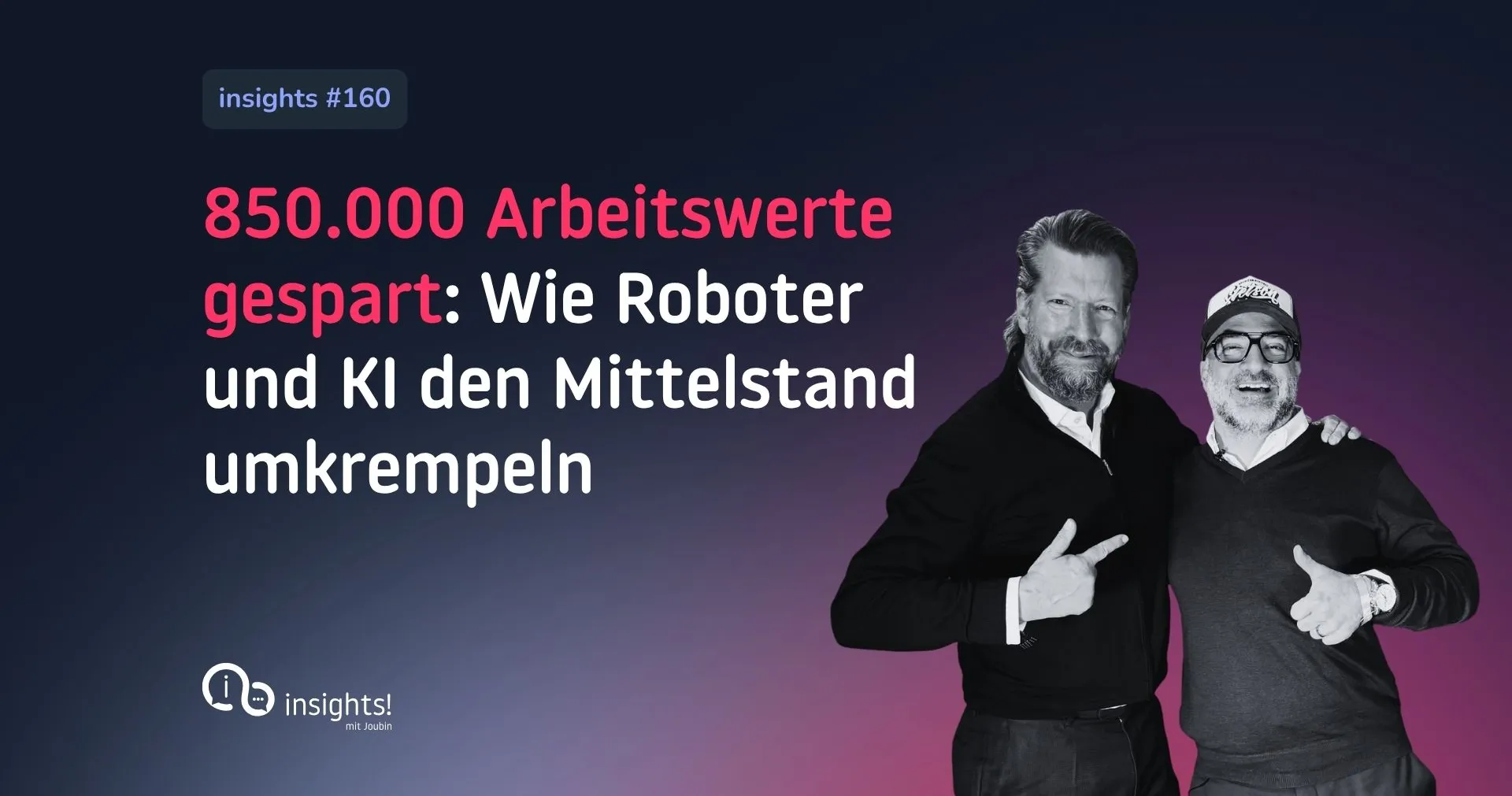
"In my view, every company, whether it's a screw dealer from Wuppertal or an agricultural machinery dealer from Seevetal, will become a software company in the short or long term. No industry still functions without software. And especially with AI even more so: you should bring many things into the house within your knowledge structure, otherwise as a company you lose touch."
Digitalisation without bullshit: why your AI project won't fail because of the AI
If you've sat in a board meeting anywhere in the last two years, you know the script. Someone mentions ChatGPT, everyone nods meaningfully, a pilot gets kicked off, a few months later someone asks why no value creation is actually coming out of it. Toralf Feuchtenhofer, founder and managing director of Crest Digital, has a very clear diagnosis for that. It's not the AI, it's you.
More precisely, it's down to data, processes and knowledge that in many organisations aren't in a state where modern tools could meaningfully connect at all. That's the honest version of the digitalisation story, and that's exactly what we talk about in this episode of insights!
Tenders: why they often do more harm than good
Toralf's first provocation has real bite. For him, tenders below a relevant scale are economically nonsensical. His argument: many companies formulate questions in tenders that they shouldn't actually have. What gets asked is supposedly standard, instead of clearly defining what business problem actually needs solving.
The result: service providers pitch against each other, burn through consulting hours, and in the end a project lands that might look cheap but misses the actual pain points. If you're currently preparing a tender, it's worth asking beforehand whether you really know what value creation is meant to result at the end.
Customers in the fog: when too many options paralyse
Toralf distinguishes between two types of clients. Some come with a clear brief and need someone to help sharpen it. Others come in what's called the fog. They have hundreds of possible initiatives, every department wants money and every topic sounds plausible: CRM expansion, logistics upgrade, AI pilot, cybersecurity programme, compliance project.
That's the point where companies bring themselves to a standstill. Toralf calls that a denial-of-service attack against your own organisation. The solution isn't more activity, but prioritisation. What creates the most value right now? Where is the pain greatest? Where are the fastest results possible?
Concrete guiding questions you can ask yourself:
Which of my initiatives solves a real customer problem, and which only an internal need?
Where are we measurably losing value in value creation today?
Which two initiatives would we cut if we had to say no?
Where can we show visible results within 90 days?
Digital sovereignty: uncomfortable truth about your data
In the age of AI, one topic becomes vital that many companies still underestimate. Digital sovereignty. Toralf puts it plainly: if you don't know today how your own data is being used in connection with AI tools, it's leaking out. Imagine you're an international logistics group and your competitor openly asks a chatbot about your purchasing terms. Sounds absurd, but it's reality.
Anyone who takes digital sovereignty seriously doesn't think in terms of individual tools, but in terms of orchestration. Which AI tools are allowed to see which data? Where does a request go into an open cloud, and where into a closed model? And above all: who in the organisation decides that? In 2025, that's a board-level issue, no longer an IT detail.
Every company becomes a software company
One of the episode's core theses, and one I agree with 100 percent. Whether screw dealer in Wuppertal or agricultural machinery dealer in Seevetal, in five to ten years you'll be a software company, or you won't be around at all. That's not a threat, it's an observation.
What does that mean in practice? You don't have to programme everything yourself, Toralf made that explicitly clear. But you need the knowledge structure in-house. You need to understand how your processes, your data and your services interact. You need to develop product thinking, not just project thinking. And you need to accept that the customer relationship is carried digitally, even if your actual product is made of steel, metal or wood.
From machine builder to service provider
One example has stuck with me. A manufacturer of industrial sewing machines wanted to introduce predictive maintenance. Technically feasible, commercially attractive. The problem: they set it up as a project, not a product. They treated it like an IT initiative, not what it actually was: a new service with its own business model.
This is exactly where the difference lies between a nice tech demo and a cash cow. Anyone who thinks of predictive maintenance, remote services, consumption models or digital add-ons as genuine services, with a pricing model, customer management and service level, builds long-term customer relationships. Anyone who treats it as an IT add-on builds tickets.
When 25 minutes become 850,000 units of work
The quiet highlight of this episode is a little story from the car industry. A mechatronics technician needs a spare part, walks to the small-parts warehouse, runs into a friend from the weekend, grabs a coffee on the way back, chats briefly, returns to the lift. 25 minutes of non-billable time. Sounds like nothing, but scaled up across a large operation, it's a fortune.
The solution was as elegant as it was simple. Robots that take over the route to the small parts warehouse and bring material directly to the workstation. Goods to the person instead of person to the goods, a principle we know from e-commerce. Result: 850,000 units of work saved in the first year. This is not AI in the narrow sense, but exactly the kind of process redesign that is becoming possible in every industry thanks to AI and automation.
Would you like to listen to the full episode?
Find the podcast of the interview here:
Please accept the corresponding cookies to view this embedded content.
Prefer to watch the episode? No problem!
You'll find a recording of the interview here:
Please accept functional cookies to watch this video.
Prefer to read?
Joubin Rahimi
Brilliant that you're back for a new episode of insights! My name is Joubin Rahimi and joining me today is Toralf Feuchtenhofer. Hi Toralf!
Toralf Feuchtenhofer
Hi Joubin!
Joubin Rahimi
I'm really pleased you're here, because in fact 4 weeks ago we didn't know each other at all, and now actually again, we've subscribed to each other, we've met or spoken every week now, and now here on the sofa, I meant to say, on the chair. Why is that so exciting? Why do we talk constantly? Maybe just this once for you: we start with synaigy and with TIMETOACT at a certain level with digitalisation, and we come more from the technical side and also have consultants at, I'd say, tactical to slightly strategic level, and you operate purely at the strategic level, so I thought it'd be great for us to exchange views today and tease a bit out of you in terms of insights. But maybe you'd like to say 2, 3 sentences about yourself first, Toralf.
Toralf Feuchtenhofer
Exactly, so first of all, thank you, Joubin, for having me as your guest. We've found we have an incredible number of things in common. Neither of us is 100% from Germany, but we both live in northern Germany – well, I do at least, and you also grew up here at one point. You had a lot to do with seafaring through your father. I sail a lot too, so first of all, thank you for having me as your guest here.
Joubin Rahimi
Absolutely happy to.
Toralf Feuchtenhofer
To get started on our shared topic, I myself, the business you do with TIMETOACT GROUP, I know very well, because I did that myself for 10 or 12 years of my life too. And whenever we came to customers and won big pitches, we always saw that they weren't yet at the stage where they could actually do what they'd commissioned us for. So we specialised in first getting customers into shape so that they could work with someone like you, a TIMETOACT GROUP or other competitors or digital service providers.
Joubin Rahimi
And what do you mean by that, first getting mature enough?
Toralf Feuchtenhofer
Well, basically we have—
Joubin Rahimi
The client will say, I'm ready now, I'll run a tender. Yes, yes, exactly, the typical thing.
Toralf Feuchtenhofer
So firstly, tenders — we're also often asked to organise tenders for our clients. If you want to ask us about that, we don't run tenders under a few hundred thousand euros, because we consider tenders, from an economic standpoint, not a good tool. It simply takes time away from digital service providers, who then pitch against each other somehow and waste resources that way, resources that could be used for better things.
Joubin Rahimi
Well, I don't know if you can hear it, it's fairly loud here, right? If we stumble over words, it's because the bass is sweeping us away. Why is a tender such economic damage? Actually it's supposed to help companies make a better decision.
Toralf Feuchtenhofer
Yes, but when companies, and we experience this very, very often, we experience very, very often that companies sometimes want something or ask a question and, fundamentally, they don't need it. So what they're asking for, they don't fundamentally need. They might need something completely different. And that's why we categorise the customers who come to us as those who have a very clear brief. They say, I want this and this and this and this. Right, and then we help them formulate the topics even better, so that whoever is going to implement it hits exactly the right point. Then we have companies where, actually, everything is more in the fog, they have a complete fog. They don't even know, they're more like a denial-of-service attack. They have hundreds of things they could do. I have a customer who told me, I could do a logistics extension here for huge sums. I could put even more money into a CRM tool here. I could do this and that, and everyone, he's CFO of the company, everyone wants me to approve these things. But doing a lot doesn't generate very, very, very much value at that point, it just creates a lot of activity, but fundamentally not much else. We're very, very value-oriented in what we do. So we want the customer to genuinely create value from what we build together with them.
Joubin Rahimi
So you help him choose the right introduction path. Exactly. And then there are the customers, the customer isn't just one customer, there are various departments with various currents. Which then need to be streamlined.
Toralf Feuchtenhofer
Exactly, and above all also to say what actually creates the most value for me in which area of my company's digitalisation. And at the moment so many topics are coming at customers – AI, cybersecurity, compliance topics, market changes, entire business models collapsing completely – that customers often don't even know where to start. And that's where we act more like a guide, a companion who says: okay, let's just get this organised, let's work out the strategies with them, and let's also help them get very good at saying no, so they focus on the right things.
Joubin Rahimi
Now you said digital transformation and digitalisation haven't been a topic for just 1, 2 years, but for much longer. For 2 years AI has been on everyone's lips thanks to ChatGPT. What, has it really been 2 years already, or only just? I'm just thinking about that number, it's so surreal.
Toralf Feuchtenhofer
Well, for 2 years AI has been on everyone's lips thanks to ChatGPT, or in everyone's fingertips, but the actual algorithms behind it are much, much older.
Joubin Rahimi
They're so good, but the market hasn't caught on yet.
Toralf Feuchtenhofer
Well, if you look at the market now, in many things, we've experienced where things that are more machine learning topics and the like, then, well, in industry that's already the case at many points.
Joubin Rahimi
Exactly, a bit like that. At my employer down in the Black Forest, we also had some machine learning going, done together with Karlsruhe University, KIT, back then. It was even called Living Agents. But that hadn't really taken off yet, though now there's a real spin on it.
Toralf Feuchtenhofer
Absolutely.
Joubin Rahimi
How does this change, from your view, for the clients you support, now regarding digitalisation?
Toralf Feuchtenhofer
Well first of all, a great many opportunities arise for things that otherwise took a very, very long time. So we, I'd say, the time to value has shortened. So between people like us coming in, working with the customers, developing the right strategies. And then the customer always reaches a phase where you know how complex customers can be in their infrastructure, in their legacy systems, that is in the customer's existing systems, in their data. And many of our customers, or many customers I see out there, and companies, are basically, on the basis of their current infrastructure and their data, not yet in a position, I'd say, to use modern tools like AI tools. We see that a lot. But in the past it was always the case that we had to do an enormous amount of groundwork before we could even start creating value with the customer. And then the time until you actually get something implemented here is endlessly long. And then the customers also ask: yes, but we've discussed everything. Can't we now—
Joubin Rahimi
Why isn't it finished yet?
Toralf Feuchtenhofer
Why isn't it finished yet?
Joubin Rahimi
Have you seen the demo yet?
Toralf Feuchtenhofer
Yes, yes, seen that already. Why not finished yet then? So, that's one thing. What we see is, we also see dangers through a... If customers today don't know their approach to their own data with AI tools, will also very, well we talk about how many too, about digital sovereignty, will also very much happen that data unfortunately leak out. So I also don't want, if I'm worldwide logistics group, don't want my competitor ask chatbot, what are my pricing conditions, how does my purchasing conditions work? And there we also see, we must look very, very closely how do I orchestrate these different AI tools within my group.
Joubin Rahimi
The processes are also still changing, right. I find that with digitalisation you often started by digitising a process 1:1. There was a saying: a shit manual process remains a shit digital process. With AI this changes significantly in the process, because processes automatically have to become different, roles are also shifting.
Toralf Feuchtenhofer
Absolutely.
Joubin Rahimi
How important is organisational consulting, leadership topics, to catch that too?
Toralf Feuchtenhofer
So what's important from our perspective is that you don't just have a black box where you throw in your, as you nicely put it, rather suboptimal processes and get out, oh look, a great new result, but what's important from our perspective is that you already know what your processes are, how you can work with them, and also that you can take them apart in a way that lets you put them back together into better new processes. But today we also see a lot of, it's a bit of expectation and fulfilment ending in disappointment. Why? We're doing AI now, so surely everything should just work. Then we come along and say, even today, to get good results, we absolutely need humans in the loop. So not just to train AI systems, whether external or internal, and give them good learning knowledge, but we also need them to be supported as a tool. So, and we also have a customer where the interface to their customers is still people, but we pack a whole lot of tools in behind it, to essentially, let's say, supplement the speed and workload of the people.
Joubin Rahimi
I'll phrase it in a way that gives you a bit of time to think about it. You've seen so, so many projects or programmes, with successful clients and with less successful clients. If you simply think back over the history, what are the 1, 2, 3 things that stood out to you, that really good clients of yours did differently from others who didn't do it so well?
Toralf Feuchtenhofer
Really genuinely good clients of ours, we come in order to leave. They trust us, they give us responsibility, but we always need the internal counterpart. So on the client side we need people who engage intensively with what we do, who really want to learn, who really internalise these exact topics we describe within the client. And from our point of view, that goes right up to senior management. For us, because we deal a lot with change, whether that's AI, you name it. That really has to be connected with deep knowledge right into senior management. We're not just the ones who drop by and do something now and then. We have a client where we started working, and senior management didn't believe in something in that market, we didn't either, and there were two people in the company. Now they employ a 300-person team within the company. They don't even need us any more, because they can really do all of that well internally themselves. So a great deal of internal knowledge to build up modern processes and technologies.
Joubin Rahimi
Then you say okay, that's strategic, do it yourself and don't outsource it.
Toralf Feuchtenhofer
I'm not saying that— no, I'm telling you, I'm not saying, don't release it.
Joubin Rahimi
I say, or if you don't have it yet, you have to work for it so you can do it.
Toralf Feuchtenhofer
You don't have to code or do or handle everything yourself. You just need to have the structure in your knowledge. From my point of view, every company, whether it's a screw dealer from Wuppertal or an agricultural machinery dealer from Seevetal, every company will become a software company in the short or long term. And that's why, and now even more so with AI, you should bring many things into the house within the knowledge structure.
Joubin Rahimi
Let me pick up on that. Every company will become a software company. Yes, I share that view, but why do you think so?
Toralf Feuchtenhofer
Because I experience it. Because I live it, because — well, there are companies far, far more predestined for this, or where you have much more of it, but I work — my life is, we talked about this earlier, my life is Sendung mit der Maus unplugged, so to speak, I see so many, let's say, different industries. None of these industries works without software anymore. And that can be, you name it, from logistics, automotive, spare parts, after sales — nothing works without data and software anymore.
Joubin Rahimi
I'm with you there, but that's a bit like IT. Why I say every company also has to become more of a software company, because you can digitalise the processes more and more, internally, but externally that's the first difference. The second is, you can now build digital services that otherwise wouldn't have existed at all. We have a client who makes sewing machines, industrial sewing machines, and at some point they said, okay, we want predictive maintenance. It was about recognising when a machine is going to break down. Or fine, they have industrial parks, to see which machine has a problem when and when it needs to be replaced, so that a batch of jeans doesn't get ruined, for example. And a service grew out of that. But they always ran it like a project and then found out somehow it didn't work the way they wanted. Because they ran a project, they didn't say, okay, this is a service we sell, we treat it as a product and so on. They didn't treat it like their sewing machines, but rather like an IT service provider. That's why I liked that phrase so much, you have to think like a software company, because it's more than just IT.
Toralf Feuchtenhofer
Exactly. Because predictive maintenance and spare parts anyway one of my favourite topics, but aside from that, and you see there too, there are very many industries, so if your sewing machine manufacturer can't produce anymore, because half machines broken, and could've fixed beforehand, and there's across hospitals, across, there's relatively many topics where this apply, must look at value streams too, at making money too. If you start there just providing service or even giving away your performance for free and make money on software behind, or make money like in licence models, then your business model becomes very, very good business model.
Joubin Rahimi
Exactly, then you can earn very differently than just from the product itself.
Toralf Feuchtenhofer
And you have, it's just that you're no longer just selling a sewing machine, you're simply selling a customer relationship. So they stay with you longer too. We know that more money is made in after-sales. But then no new machine manufacturer comes along and sets up a machine.
Joubin Rahimi
And you're part of the value creation, so the operational value creation. I have the machines, so sell and run, but I'm still there.
Toralf Feuchtenhofer
Right.
Joubin Rahimi
What would you tell medium-sized companies that haven't progressed so far in digitalisation yet? What are the next steps?
Toralf Feuchtenhofer
So I'd first look at, where do I actually stand today? I'd also check, where do I stand in my market? I'd look at where do— so I don't see companies just as a closed entity either, I look at where are my suppliers, how are my customers, what do my customers need, how does my business model actually contribute to my customers' value creation. And then I'd look at, then I check, what role do I take on, to put it in IT terms, we'd say we I'm like within a value creation world a service, like a microservice. And I look, would then—
Joubin Rahimi
There's an IT person again.
Toralf Feuchtenhofer
There's an IT person talking again, but you can also transfer this to a business model where you ask, what am I offering in this industry and what value am I creating? And then I look at what I need today, i.e. where am I losing value in production today? We have a customer who told me, with the same employees, AWs, that's the car industry, one unit of work is 5 minutes, I need to produce twice as many AWs with the same employees, and have them billable. And that's our goal. That means also formulating goals in this way, as an entrepreneur looking at where I have the biggest pain points today and where I get the quickest results. Because it's also very important, internally, for employees, for customers, and also for stakeholders, say from an investor's perspective, that value is created through what we do.
Joubin Rahimi
Absolutely, otherwise it wouldn't make sense. Because the thing with the ATs I find exciting too, because that's the 5 minutes, but it's a fixed value. So tyre change, if the apprentice takes longer, doesn't matter. You've predefined how many ATs that is. That's how it works.
Toralf Feuchtenhofer
I can tell the story briefly. What did we do there? We had a very large branch, and there was an employee, a mechatronics technician, who, when he needed a spare part, walked to the small parts warehouse. On the way he'd bump into a friend from the weekend, so there go 2 AWs, 10 minutes. Then he'd grab a coffee, another AW gone, 15 minutes. Then he'd go to the small parts warehouse, get the item fetched, another 2 AWs gone, 25 minutes of non-billable working time. Then he'd walk back. At this business we introduced robots that fetch items from the workstation to the small parts warehouse and, so to speak, handle spare parts supply at the workplace. And within, I believe, the first year we saved 850,000 AVs. So, the robots drove around and brought the small parts to the workstation. You know it from e-commerce, it's either goods to person or person to goods.
Joubin Rahimi
Great, thanks for the insights. We could definitely discuss this at length too.
Toralf Feuchtenhofer
We've now got a subscription tied to each other too.
Joubin Rahimi
Exactly, we have a subscription. Would you like to show it, or is that secret?
Toralf Feuchtenhofer
No, it's not secret, but it's a tool I carry with me, and I also use it to record.
Joubin Rahimi
Exactly, and that's actually quite exciting too, that something like this changes. That saves you personal time too, your ARs.
Toralf Feuchtenhofer
Yes, my AWs, that saves me about, I think, 2 days a month of writing protocols and the like.
Joubin Rahimi
And with that in mind, I say keep your eyes open, so much is changing. I'm always glad that I learn something here every time. On many different levels. Thank you, Toralf, for the time.
Toralf Feuchtenhofer
Thanks.
Joubin Rahimi
And if you have questions for Toralf, we'll see you on LinkedIn as well.
Toralf Feuchtenhofer
Right.
Joubin Rahimi
You can of course contact them directly or leave comments under the post.
Toralf Feuchtenhofer
Thank you. Thanks. Great.
Have questions or feedback?
Then feel free to contact us directly.
- Joubin Rahimi
Managing Partnersynaigy
Show phone numberShow mobile numberShow email address
Subscribe to the blog now and never miss any news
✔️free of charge ✔️weekly news ✔️expert knowledge
Please accept the corresponding cookies to view this embedded content.