



insights! #81: ROI optimization through B2H, AI and inbound marketing
In the latest episode of insights! I welcome Frank Miller, CEO of the inbound marketing agency straight. What follows is an in-depth conversation about digitalization, marketing strategies and the role of artificial intelligence in modern business life.
 Joubin RahimiManaging Partner · synaigy
4 min. read
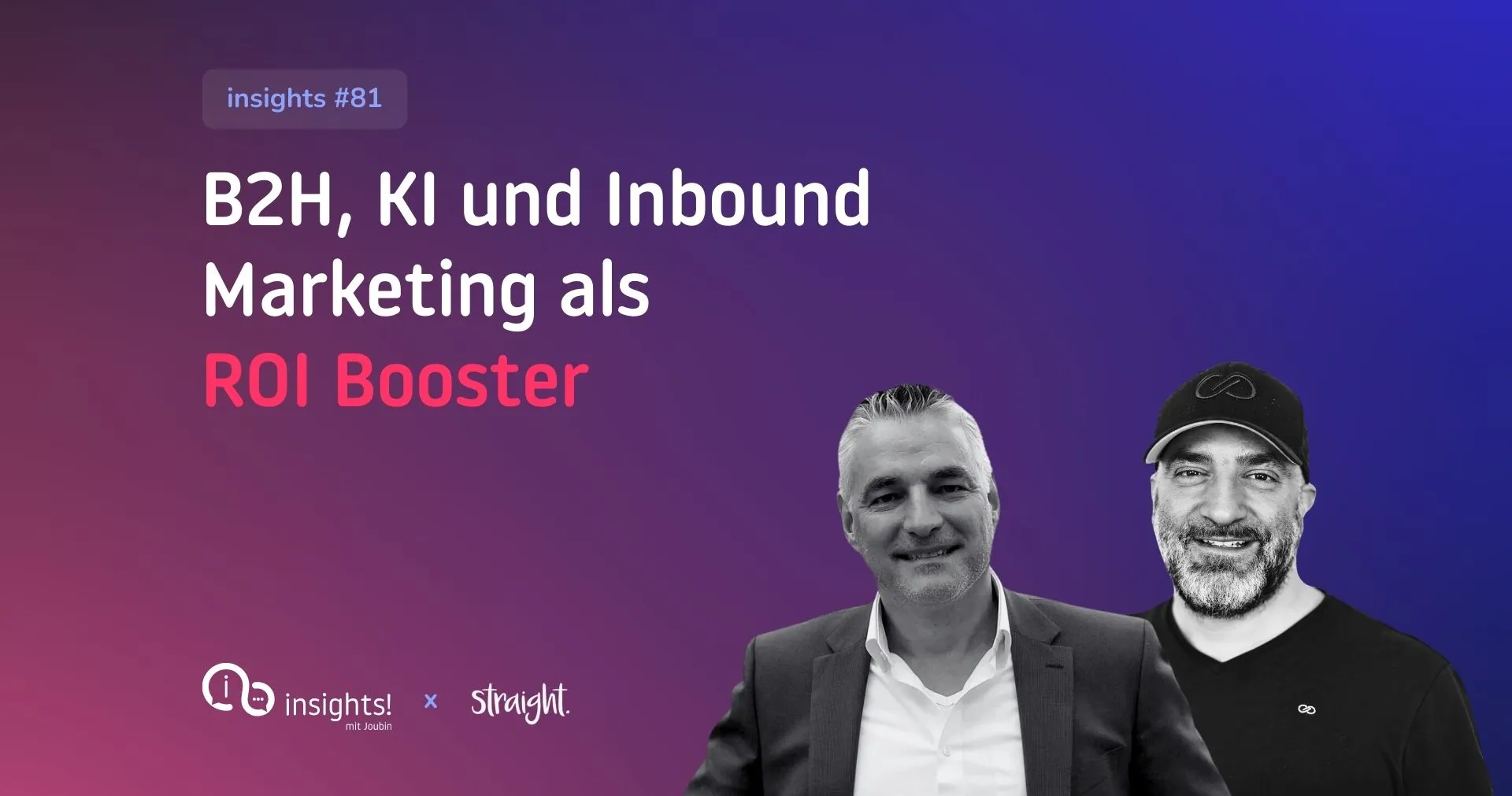
These days, products are all similar in their features, if not identical. It's the brand that creates the differentiation – and ultimately the service behind it.
For Frank Miller and his team at straight, digital transformation is a central mission. „We work every day to establish inbound marketing in Germany and Europe. It's about delivering the right content to the right people at the right time“. This focus has helped straight position itself as an expert in digital transformation, particularly for mid-sized companies in the construction industry. Through years of experience, straight has developed a deep understanding of the specific needs and challenges of this sector.
Challenges in the construction industry
The construction industry faces major challenges, especially in times of economic uncertainty. Even in stagnating markets, it is important to create digital efficiencies. It's about simplifying processes and optimizing methods such as lead generation and lead qualification in order to maximize ROI. In difficult times, companies have to find innovative ways to stay competitive. Digital tools and strategies play a decisive role in this. Especially in the construction industry, where projects are often long and complex, digitalization can help streamline processes and cut costs. By using data analysis, artificial intelligence and automation, companies can respond faster to market changes and use their resources more efficiently.
The shift from B2B to D2C
A significant change is also taking place in the shift from B2B to B2C strategies – Frank calls it B2H (business to human). Companies that traditionally sold through specialist retailers should now communicate directly with end consumers. Thanks to the internet, consumers today have access to more information than ever before. They make informed decisions and expect brands to communicate with them directly. This change requires companies to realign their marketing strategies in order to address consumers directly and understand their needs (D2C). Through direct communication, brands can build a closer relationship with their customers and tailor their offerings more precisely to their needs.
Social media plays a decisive role here. Platforms such as Facebook, Instagram and LinkedIn are no longer just for personal communication. They are important tools for reaching and influencing consumers. Through targeted social media campaigns, companies can get in touch with their customers directly and strengthen their brand. These platforms can spread targeted brand messages and build a direct relationship with consumers. The challenge is to stay authentic and offer customers genuine added value. Only then can trust and loyalty be built over the long term.
Artificial intelligence as a game changer
A particularly exciting part of the conversation revolves around Daisee, an AI-based tool developed by straight. Daisee stands for „Data-driven Artificial Intelligence Solutions for Expert Enablement System“ and helps creatives and marketing experts produce relevant content efficiently. AI will fundamentally change the way we work – not by costing jobs, but by creating new possibilities. Those at risk are the ones who systematically refuse to work with AI. Daisee enables companies to create creative and targeted content that fits their own brand. It shows how AI will shape the future of marketing and digital transformation, and it allows users to gain deep insights into their target groups' behavior through intelligent algorithms and adapt their marketing strategies accordingly.
The future of marketing
Finally, Frank emphasizes the importance of digital transformation for the future of marketing. Digital transformation is not a luxury, but a necessity. Companies that are not willing to adapt will fall behind. Seize the opportunities of the digital world by systematically integrating innovative technologies such as AI in order to stay competitive. It's not only about using the latest technologies, but also about creating a culture of innovation and flexibility. Only in this way can companies succeed in a constantly changing business world.
The conversation with Frank Miller offers valuable insights into the challenges and opportunities of digitalization and modern marketing strategies. It underlines the need to adapt to changing market conditions and to use the advantages of new technologies in order to stay competitive. The future of marketing is digital and will be shaped by artificial intelligence. Companies must be ready to accept these changes and adapt their strategies accordingly. Only then can they succeed in the modern business world and meet their customers' needs in the best possible way.
Would you like to listen to the full episode?
Here you'll find the podcast of the interview:
Please accept the corresponding cookies to view this embedded content.
Would you rather watch the episode? No problem!
Here you'll find a recording of the interview:
Please accept functional cookies to watch this video.
Would you rather read?
Joubin Rahimi
Fantastic that you're joining us again for a new episode of insights! My name is Joubin Rahimi and today I have the pleasure of welcoming Frank Miller. Hello Frank.
Frank Miller
Hello. I'm delighted to be part of insights! in this episode.
Joubin Rahimi
Yes, that's great. We first met at a mega, mega, mega great event hosted by NFQ. We got to know each other in Bangkok. We'd had no points of contact before that, but I still remember our conversation, in the evening at 11, 12, it was very late, but long, about the future of e-commerce, of digitalization, and especially for
Industrial companies, and I thought to myself: „We need to talk to each other – but so everyone knows who they're dealing with here: maybe you'd like to say two or three sentences about yourself?
Frank Miller
Yes, of course, gladly. I remember our first meeting very positively. That was in January, back at the start of this year. And in a flash, we're already in the summer. My name is Frank, Frank Miller. I'm CEO of the inbound marketing agency straight. We're based in Munich and yes, digitalization, digital transformation, mid-sized businesses – that's one of our big missions here, above all with the inbound marketing methodology that we try to establish every day, especially in Europe and Germany.
Joubin Rahimi
And there are quite a few inbound agencies out there. But what I really liked about you was the focus on industrial companies in the construction sector – is that right, that you have that focus? You don't only do that, but you do focus on it quite strongly?
Frank Miller
It's a focus that we sort of slipped into, not least through many years of working with one of the leading manufacturers of electrical appliances here in Germany and Europe. Yes, you end up somewhere like that because that's where you've built up your expertise, and many of our customers really are directly or indirectly connected to the construction industry. When a lot is being built, they have plenty of orders. When little is being built, as in these times, things don't look so good. That makes it all the more important, especially in times like these when orders may fail to materialize because certain developments aren't happening the way they should – also because the demand for new construction is definitely there – to create efficiencies through digital mechanisms and methodologies that perhaps weren't available before.
Joubin Rahimi
And I find it exciting, of course, that you bring that up. The situation isn't easy – if you say you're tied to construction, interest rates have risen for financing new buildings through loans. But costs have gone up as well. So not what people had hoped for, that costs would come down when interest rates go up – instead, both went up. Why do you think companies should still advertise a lot in such a shrinking market? Because the market is smaller, after all.
Frank Miller
Well, it's not just about the advertising we do. We don't really do advertising in that sense anyway. Straight is an agency that originally emerged from dialog marketing back in 2001. Today we work along the inbound marketing methodology, in our case with the addition of creative inbound marketing, because the creativity we need to bring certain messages to people – messages that satisfy needs – is essential. And to answer your question: especially in stagnating markets that come to a standstill for political or macroeconomic reasons, it's important to look at things from the perspective of digitalization: Where can I create efficiencies? Where can I simplify processes – and digitalize them, in brackets? Where can I establish methodologies that – let me use terms like lead generation, lead nurturing, lead qualification – ultimately make lead marketing, and in brackets sales spending, more efficient, so that with a stronger focus on ROI I get back what I invested up front? And that's less about classic advertising, or advertising the way we knew it back in the 90s or 2000s, and much more about digital methodologies for creating efficient ROI perspectives.
Joubin Rahimi
In B2C we're used to it. Now you have companies that don't sell directly but rather through a three- or even four-tier distribution chain to the person who actually uses the product – kitchen manufacturers and other areas in that environment, or other trades in that environment. Why should a kitchen manufacturer … I'm just using that as an example. There are probably windows too and all the others – window manufacturers perhaps even more extreme, where the non-specialist typically didn't decide at all, but maybe that has changed. Or why do they advertise to end customers even though those customers don't buy from them – it's maybe the wholesaler?
Frank Miller
Thank you for that question. That's actually something we've been able to witness over the many years of digital transformation, especially at companies that are directly or indirectly attached to construction, to the building industry. We work for one of the leading manufacturers of electrical appliances, for one of the leading kitchen manufacturers. Electrical appliance manufacturers for the kitchen and kitchens themselves belong very closely together. But we also have customers for windows and doors, and we have a
Flat roof manufacturer in-house. So wherever building happens, we're involved. And what do they all have in common? All of them work more or less through at least a two-tier distribution channel. That means there's still a specialist retailer involved who either sells the kitchen, or sells the windows and doors, or advises on flat roof planning about the optimal setup for my building project – whether that's the little house people build or, later on, within the housing sector. End customers – and we've all learned this over the past 15 years, not least through social media activities – have learned to form their own opinion very clearly and very intensively about what suits their own needs. Which brand, which product. Precisely because of the internet, because of Google, because of all the mechanisms we have today – I don't want to go into detail here – I, as an ordinary mortal, can inform myself very well in advance and make a very clear purchase decision beforehand. And we call that, or the industry calls it, direct to consumer. That means manufacturers are adopting a stance of speaking directly with consumers. That was a major, essential part, or rather it's still part of the transformation today, to change the target group perspective from purely B2B to B2C. I also like to simply call it B2H, business to human, because in this big corridor we're all people with certain needs, always coming from a different context, of course. And that's what it comes down to in the end. Context, relevance – I have to connect the two, and then the communicative message works too.
Joubin Rahimi
That's great – in our pre-talk too, I hadn't even thought of it. We did a D2C study with the Institut für Handelsforschung and exactly that came out of it: that younger people in particular already think about which kitchen, which windows and so on they want. And then they don't just tell the tradesperson: „Just get on with it“ and let them do it – they already have a clear idea very quickly and say: „I want to be involved. I have a nice picture in my head.“ In classic, earlier B2B communication, you handed product information, product features, brand values and brand-relevant topics to the specialist trade. The specialist trade went out and passed these messages on to the end customer to the best of their knowledge and belief. I walked into the store, I got advice.
Frank Miller
Take kitchen planning as an example. I don't just quickly plan a kitchen over the internet. There are a lot of parameters involved, where I also need a certain amount of personal advice. The architecture, my space and so on. Quite a few points come together. Right up to the selection of the perfect electrical appliances or home appliances for my needs. The dynamic has shifted a bit, because the specialist trade – and we've all more or less experienced this at some point, and I don't mean this disrespectfully toward the specialist trade, partly due to the complexity – at some point could no longer give clear advice: What does this brand actually stand for? What exactly are these product features I have? What's the real added value? And why am I selling this or that appliance, this or that kitchen, rather than another one? We've often even observed that in the end it was simply pricing features, where the specialist retailer said, I get a higher commission on that one, so that's what I'll sell now, even though it may not have matched the end customer's needs at all. And that's what I'm getting at: the end customer's need isn't necessarily always to save money, but rather to get the optimum in the features they want. And who can explain it better than the manufacturer itself, if it explains it properly? And it's not about explaining the features in detail, but about communicating needs-oriented added value – why this kitchen, this window or this home appliance is the optimal one for me, so I can do certain things I couldn't do before. It's supposed to solve problems. If I bring the specialist trade along, that's good. But if I manage to prepare the end customer far enough in their purchase decision that they actually want the brand, and the specialist retailer is ultimately there to close the sale for me and possibly also to install the appliances, the kitchen or the windows, then everyone sticks to what they do best, namely delivering exactly those things within their own services. And the specialist retailer no longer necessarily has to sell features they may not have wanted to understand in detail anyway, but can instead focus on installation, or on fitting, or on the topics they actually cover.
Joubin Rahimi
The kitchen planner – we built again a few years ago, we renovated. My wife took that on. We went to the relevant kitchen planning studios and at some point she said she'd quite like to keep planning it through with that particular person, because he understood her best and we felt well advised. But of course he knew, because we'd walked in there, that we had a need, we also had a compelling reason to act, as I always say. The new home needs a kitchen, and then he knew there was an opportunity, and based on the size he could also assess things. But I don't just walk into a kitchen manufacturer. How do they even reach me? Because I don't see kitchen manufacturers advertising in Cologne's pedestrian zone either. And otherwise, how do they reach me and then impress me? Because at that time – it's two years ago now – that didn't happen. Maybe I just wasn't at the right events, I don't know.
Frank Miller
But of course that's a particular challenge for industrial companies that otherwise come from a B2B sales background and now suddenly have to do D2C, and then D2C is made even harder because they don't even know where they should be looking. But maybe I'm remembering that too.
Joubin Rahimi
Yes, exactly.
Frank Miller
So there are several points. You could of course consider: Do I build an inner-city event showroom for a kitchen manufacturer in a downtown location? I can do that. Then I need staff, then I need the location. All of that costs money. And whether that actually works in terms of lead generation so that at some point I have a sensible ROI would have to be calculated in a business case. We really do focus on the digital world, and we know that people, especially with the idea „I need a new kitchen because I'm building a house, or I'm moving, or I want to renovate“ – especially in times of Corona, when people stayed at home a lot – we know this – investments were made, people made their homes nice. And in those times in particular, people thought about it: „Yes, a new kitchen, that would be nice right now. Plus the matching electrical appliances. One of those self-cooking devices, there are various manufacturers in Germany, would be pretty cool too. I've seen advertising here and there, or read something, read things in forums.“ So people are informed, they talk to each other, they research, they google or use search engines to get to certain content. And that's where we come in with the inbound marketing methodology. What does the methodology say?
It's built on three elements: attract, engage and delight. The whole thing ultimately revolves in a kind of flywheel around the person, around the needs-driven person. And precisely this attracting is what kicks in to generate content where people have an idea: „I have a need: I'd need a new kitchen now with cool electrical appliances.“ That includes brand communication. A brand itself then creates the differentiation among us. These days, products are all similar in their features, if not identical. It's the brand that creates the differentiation – and ultimately the service behind it. Is the service there, is the trust there that you just talked about? And all of that needs to be communicated, reaching people where they are in their research phase, or drawing them to me, to my own website, through my blog articles, through my magazine elements, through my product guides, product configurators, planning tools, whatever you need – depending on where I am in the customer journey of my purchase decision, and there are various stages, I can then pick people up with the right features, pick them up digitally and bring them into an interaction. Second point: the interaction takes place, and now it becomes important, which is where the specialist trade may come back into play. That's exactly where we've implemented some very nice solutions, as we discussed beforehand, for mid-sized manufacturers here in Germany and in other countries too. I bring the specialist trade along. The moment a needs-driven person, through their interaction, through entering certain features they'd like, through certain details they provided because they consider something important, has made those entries, I pass those details on. Having of course obtained the user's consent to store the data, I hand them over to the specialist trade as a complete lead package. The specialist trade receives it and can now of course start the consultation pre-conditioned. They're briefed. They know exactly what needs the person already has. They just have to read it through and can then make a suitable offer much faster and in a much more targeted way. In my experience – I've had the pleasure of buying a few kitchens in my life – the better you brief the specialist retailer in advance or at the first meeting, the more they enjoy the planning and the faster and more efficiently they meet your needs and wishes afterwards. And you can even get quite a lot, even though there's often a budget limit built into the need. If the specialist retailer has less planning effort because they have to search for lots of planning examples, and I come well pre-conditioned, I get there faster. And those are exactly the elements I spoke about earlier. Through the way we qualify and through the methodology, we simply create much stronger efficiency and thereby a better impact – for the specialist retailer as well.
Joubin Rahimi
But where do you find that person? Where would you identify someone who says: „I'm interested now“ – for a kitchen manufacturer, for example, or doors and windows, how do you identify them? Do you do it through ads, where you say search behavior is changing and we then have digital twins?
Frank Miller
It's a combination of both. Old saying: „Go fishing where the fishes are". But where are the waters where the fish are? I have to identify those, of course. On the one hand, that's more like doing outbound advertising, booking Google Ads. Yes, we do that in a supporting role, because the Google machine, or search engines per se,
Work through organic search results and paid search results, and bringing both together ultimately produces the optimal essence in terms of impact. Of course we also go out communicatively with appropriate advertising materials where it makes sense, when there are certain highlights, but the background hum for finding people is more of a different model. It's not the go-fishing-where-the-fishes-are model, but rather: create something beautiful, create an environment where people come to you. A nice example I have for that is the oasis model. I create an oasis, wait until word has spread out there in the desert, where the hungry and thirsty animals are, especially the thirsty ones – they come to my oasis and see there's shade, there's water, and they tell the other animals and they'll come too. That takes a bit more time. That's why inbound marketing is always somewhat more sustainable or longer-term, but also more sustainable for that reason, because once the oasis is there, people will come – the animals in the desert – and will then also sip the water with pleasure, to stay in that imagery.
Joubin Rahimi
Nice. And you're building your own oasis yourselves. First of all, thanks for the insights on that. Now, I learned about Daisee through one of your newsletters that you just sent out. And I find that really exciting. Daisee is something you developed yourselves, using artificial intelligence among other things. And my first question would be a general one: How do you see AI? How is it changing your business model too? And how are you responding to it? And is Daisee a response to it?
Frank Miller
I'd like to work through that set of questions with you. Exactly. I myself am a trained engineer for media technology. Innovation really is in my genes. I don't even know whether those kinds of engineers still exist in Germany. I think I'm one of the last generations. I was able to graduate in the mid-90s. The world of AI, or artificial intelligence, has occupied me for quite a while. Not least, but more intensively, after it became suitable for the mass market, of course. AI is on everyone's lips. AI is also – and I have a very clear opinion on this – at least as much of a revolution as the invention of the internet, if not something bigger. And I was able to experience the invention of the internet live as well. In a certain way I was part of it, and I'm hugely happy that I now get to be part of AI as well, to take part in AI development, with all the opportunities and all the risks that go with it. For us as a company, as an organization at straight, we've of course also been dealing with it for quite a while, and Daisee isn't necessarily a response, but rather an offer to our customers and our potential customers, especially in the mid-market, to make getting started with artificial intelligence, with digitalization, easier.
Joubin Rahimi
So what does Daisee actually stand for?
Frank Miller
Daisee, D-A-I-S-E-E. It's not a lake in the daytime, it stands for Data-driven Artificial Intelligence Solutions for Expert Enablement System. A complicated term – you can also read up on it on our website. And „Daisee“ was built to support us creatives, marketers, sales people, yes, digital experts, in feeding in brand-relevant content, adding tonalities and essentially shortcutting the detour via the usual tools like ChatGPT or whatever they may be called, in order to get brand-relevant, product-relevant creations out – something we've been doing for several, I'd almost say years, anyway. And it's a really exciting system that's meant to invite everyone to join in, to develop and work on it with us. It's out now in a beta version, and the system also learns every day along with us, and of course we'll keep making it better.
Joubin Rahimi
And what do you hope to get out of it?
Frank Miller
Well, our mission is to digitalize mid-sized businesses in Germany – not only those, all companies in Germany – in a certain way and thereby also enable this „powered by AI“. My experience over the past year and a half is that companies still find it relatively hard to make contact with artificial intelligence, or indeed to take digital transformation, digital maturity per se, seriously at all. It's not enough to have a website with an email address on it and say: „I'm digital." It really goes into business processes, it goes into organizational structures, it ultimately goes into the way I address people – hyper personalization, just to name one example. And Daisee is meant to be a companion in that, a support assistant, to lower the barriers, and of course also to position us as a company in a certain way and show that we can do this. The entry wasn't infinitely complex either, and we're offering you the chance to work with it and ultimately to put your data in with us. With us means in Daisee. Daisee is hosted separately, so the data isn't fed into any OpenAI models. We do use OpenAI's AI model, the LLM, the large language model, but the data itself stays inside the application. And yes, that in particular is a secure point. It's an important point in Germany: security, data security, IT security. And that's part of the answer to all the topics we have there.
Joubin Rahimi
First of all I think it's great that you, as an agency that often trades time for money, are developing a service that simply makes what you do faster. I think that's also the approach for the future for all of us, and good for customers too, because it becomes faster and cheaper and, I think, better overall. There's one hook in it for me. I share your view, but I'd really like to know why. You said AI will change more than the internet did back then. And check – but I'd like to understand why you think that.
Frank Miller
AI will change us holistically – and we notice this in companies like ours, but also at our customers – it will change us holistically at an organizational level. AI certainly won't cost jobs, not directly, but of course it will substitute, in a certain way, the people who don't want to engage with it. And Daisee has several parameters here. Daisee is meant to take away the fear of working with an AI. Daisee is meant to actually create added value, because I can work with it. You get added value immediately. I enter certain prompts, the prompts are pre-formulated, the prompts fit my product, my brand, my service, whatever, depending on how the model is trained. And I get results out very quickly that, by the way, are good as well. So I can really work with them very quickly and intensively. So it's a removal of fear. It's a trigger for rethinking within the organization. Keyword digital transformation again. And another remark on that which is very important to me: if a company hasn't reached a minimum degree of digitalization, AI won't be able to help in any way. You need a basic setup, you need a basic mindset, and you need a fundamental culture for changing certain things at high speed. Daisee is meant to help with that speed of change too, and we experienced it ourselves in our own organizational life – how quickly we set it up, implemented it and trained people to work with it. And that's why it's so multi-faceted. The why isn't at all easy to answer clearly. There's something there, and we're inside it, in a world of AI, and in this world we also want – because, as I said, that's part of the passion for innovation we have – in this world we want to try things out. We want to see what added value we can deliver for our customers, for ourselves, for the market, for Germany, for digital transformation, for mid-sized businesses. And how can we then communicate this added value and also get people to try it out? And I can really only invite everyone: Let's go, let's try it out. We can fail, but if we don't even try to walk the path, we won't even get to fail. Then we have a no, and we've already got a no. So on that note: let's go.
Joubin Rahimi
Great. I agree. I think that's a really nice closing statement in this context: „Move forward, try things out, learn." Seeing that openly speaks straight from my heart, and I find it so wonderful that so many of the people I get to interview here take exactly this path. So thank you, Frank.
Frank Miller
Yes, Joubin.
Joubin Rahimi
And that's what people like you and me are for, companies like ours, where we take exactly these paths. And we have to do that together.
Frank Miller
We can't manage everything on our own. We didn't develop our Daisee entirely under our own steam either – we have a strategic partnership with an AI-specialized company here in Germany. It's a young start-up. Those are people who want to do exactly what we've done here. And one thing led to another, and that's why we did it: because we could, and because I'm convinced that it provides the kind of support we need right now. Exactly.
Joubin Rahimi
Thank you, Frank, for the insights.
Frank Miller
My pleasure.
Joubin Rahimi
That was super great, and I hope everyone who's been listening can take away the two points: what industry can do – and I think that applies to industry in every environment, including the D2C environment – why that's so important, and why AI really will change the world in a different way again than the internet already has, and that digitalization is only the foundation for more. That's the summary. Anyone who needs more information can of course write to Frank directly as always. And discussion is welcome too – down below here. We very much enjoy joining in the discussion.
Frank Miller
Exactly.
Joubin Rahimi
And thank you for listening. Thank you Frank for your time, and I'm sure we'll see each other again soon.
Frank Miller
Thank you, and we'll definitely see each other again soon. And yes, let's connect, let's stay in touch.
Do you have questions or feedback?
Then feel free to contact us directly.
- Joubin Rahimi
Managing Partnersynaigy
Show phone numberShow mobile numberShow email address
Subscribe to the blog now and never miss any news
✔️free ✔️news every week ✔️expert knowledge
Please accept the corresponding cookies to view this embedded content.