



insights! #71: Between advisory marketing, inbound and outbound
 Joubin RahimiManaging Partner · synaigy
2 min. read
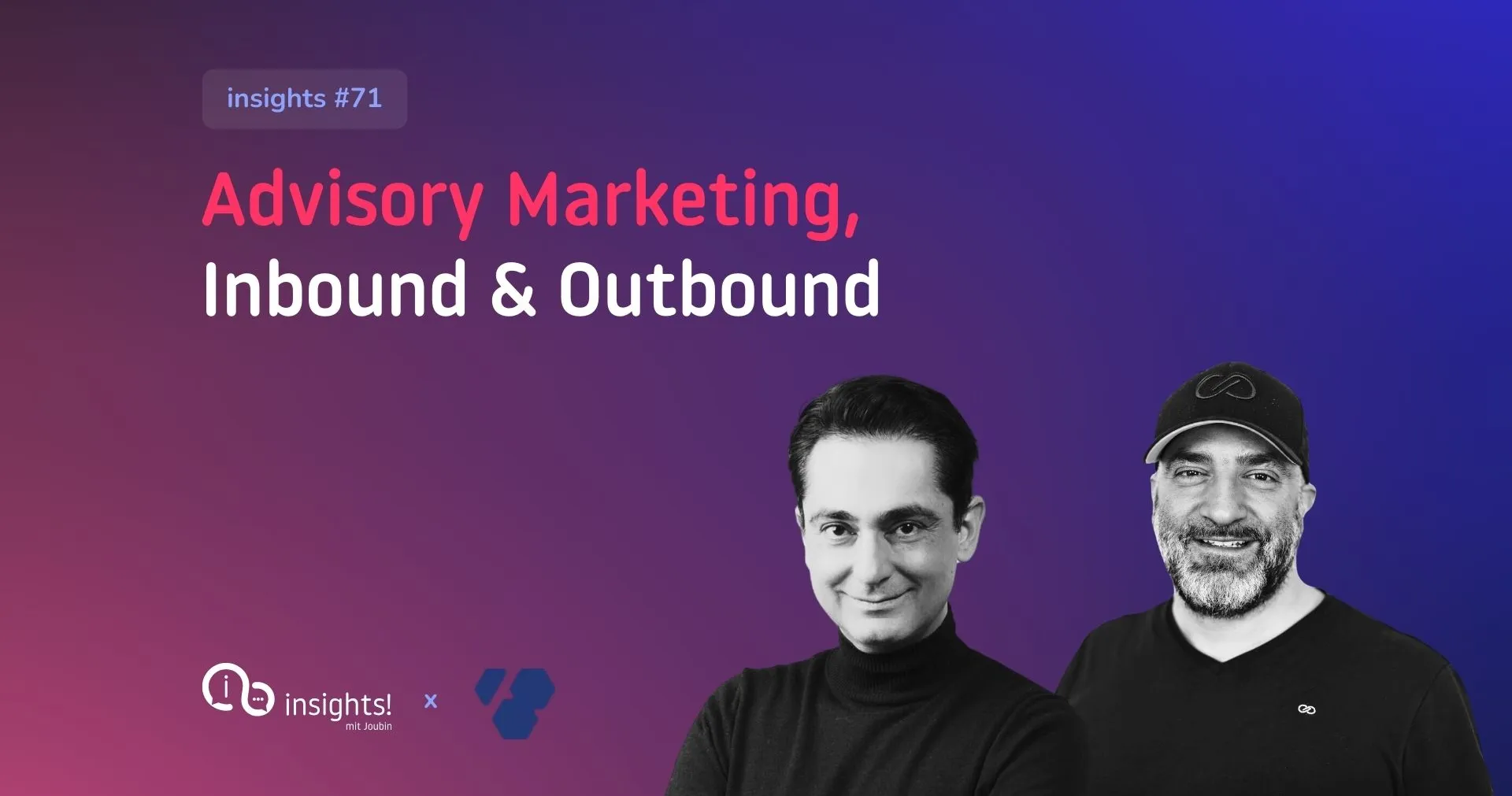
In this insights! episode, Ali Saffari, managing partner of Voyage8 Group, shares insights into effective leadership strategies within sales, marketing and customer success. Ali discusses building and adapting sales teams to changing market dynamics, as well as using data to optimise customer engagement.
Focusing on sales alone falls short. If I only optimize in one area, sooner or later I will have to pay a price somewhere else.
Netflix, Amazon and Nike – what do they all have in common? A sophisticated, perfected and automated marketing and sales strategy. How can you learn from them and put it to profitable use in your company?
The answer lies above all in personalization and the use of technology. Personalized outbound marketing strategies make it possible to approach potential customers in a targeted and individual way, which makes lead generation more effective. The Chief Revenue Officer plays a key role here by optimizing the go-to-market strategy and driving revenue growth.
Modern technologies and automation tools are equally indispensable. They increase efficiency in sales without neglecting personal contact. Clean data and the seamless integration of these technologies are also crucial for success and for management decisions.
Yet the true key to success in digital transformation is patience and commitment to adapting quickly to market changes and bringing customer relationships to a more personal level. Digital transformation is a process that demands time, commitment and a willingness to question existing processes and keep rethinking them. The pandemic showed us all that companies that switched quickly and effectively to digital sales models didn't just survive — they often accelerated their growth.
A holistic marketing and sales strategy that covers both inbound and outbound approaches is essential for winning and retaining customers. By combining different strategies and executing them excellently, you can achieve strong growth and long-term success in your company.
Nor should the importance of talent acquisition and development be forgotten. In a market competing for the best minds, it is crucial to build a team that lives and drives the company culture. Investing in employees and creating a positive working environment are fundamental building blocks for long-term success.
In this dynamic business environment, success takes more than just a good idea. It takes a strategic vision, the ability to adapt to new technologies and the building of strong customer and employee relationships. Companies that live by these principles are equipped not only to hold their own in the here and now, but also to act in the future.
Would you like to listen to the full episode?
Here you can find the podcast of the interview:
Please accept the corresponding cookies to view this embedded content.
Would you rather watch the episode? No problem!
Here you can find a recording of the interview:
Please accept functional cookies to watch this video.
Would you rather read?
Joubin Rahimi:
Great to have you back for a new episode of insights. My name is Joubin Rahimi and today I get to welcome: Ali Saffari. Hello Ali.
Ali Saffari:
Hello and many thanks for having me back.
Joubin Rahimi:
Yes, very happy to, because you are one of our top three podcast interview partners, the ones who have been watched the most and the longest. And you have to say that even though you don't have a big community behind you. That is the difference to all the others, and it simply speaks for the fantastic content you shared last time. So thank you for taking the time again, Ali, to look at these questions once more today.
Ali Saffari:
Oh, that's lovely to hear. Thank you very much. That motivates me now. So now I have a firm goal not to be in the top three, but to be number one.
Joubin Rahimi:
And in sales you always have to be number one, because number two is always first loser. And we did our first session almost a year and a half ago. With Voyage8 you have already built something up as well. But maybe say two or three sentences about yourself and about Voyage8, for those who haven't seen you last time.
Ali Saffari:
Yes, so much has happened again in such a short time. It started like this. After ten years as a CRO or in roles very similar to a CRO, I actually wanted to take a short break at the end of last year to think about what to do next and to spend a bit more time with my family. Over the years I had already held quite a few advisory roles and board mandates, and through that I also had contacts with angel investors and VCs. When I wanted to treat myself to that break, it didn't take long before those contacts approached me and said, hey, you don't have anything to do right now. Could you take a quick look at this company or that one and support the go-to-market teams a bit? And of course I was happy to do that. And what I then realized was what great joy it gave me to support these young entrepreneurs. To help them avoid one or two of the mistakes I once made and to benefit a little from my experience. When I saw how much joy that gave me, I said okay, this obviously can't stay a small side story. So I started to think big about it. And then of course it was clear I needed a name for it. You've been through a name search or two yourselves. And you know, okay, that is not such an easy thing. You had to find a domain, it has to suit you, it has to say something, and so on. But at some point, while I was thinking about it, I thought hold on, this is the eighth turn in my career. And my name Saffari also has something to do with travel. So Voyage8 was born, and I have been very happy with it so far.
Joubin Rahimi:
Great. Voyage8 is easy to remember.
For me the bridge is always Voyager, but that's travel too. It all comes from the same place.
Ali Saffari:
It actually had nothing to do with Star Trek. But now that you say it, I like it even more.
Joubin Rahimi:
Yes, great, thank you. Thanks for the derivation, but it already shows, you are in CRO roles. And before we get into the questions, the CRO role is a new role for some people. Would you describe it once? What is a CRO?
Ali Saffari:
Yes, it is actually far more widespread in SaaS companies. But I also keep seeing it in companies that aren't classic SaaS. If you picture a typical SaaS organization, you have different disciplines such as sales, marketing, demand generation through to customer success, revenue operations and so on. Now the thing is that you can no longer look at these disciplines in isolation. An optimum in one of these disciplines doesn't always have to be good for the whole company. Let me give an example. There was a time, a few years ago now, when I was head of sales, so responsible only for sales at a SaaS company. And at some point we caught on that a certain segment, very small customers, could generate very quick deals and that we could therefore reach our targets relatively quickly. So what did we do? Of course we immediately put everything into closing as many of these customers as possible. It only took a few weeks. Then I got a call from my colleague who was responsible for customer success, and he said, Ali, we urgently need to talk. These customers you're bringing us, it's not only that we will very likely lose most of them before the next renewal, it's also a very particular clientele. They insult my people on the phone, I'm losing people, I'm already having difficulties with my team. And that is a good example. When you say okay, I've reached my local optimum, I've hit my targets that way. But it is good neither for the company nor for the other disciplines. That's why I see the job of a CRO as making sure that such a local optimum doesn't happen, but that things are done holistically across these disciplines and that the initiatives are taken that are necessary for a subscription model to work sustainably.
Joubin Rahimi:
So CRO is not just a role like sales, but marketing, sales, and then really also customer success management.
Ali Saffari:
Exactly, customer success management, account management. Then, so that the whole thing also works in a data-driven way, revenue operations is part of it too, which for me is an essential component of a SaaS go-to-market team. And last but not least, a CRO also has to make sure that there is a top management team in place that not only has the competence in their respective disciplines, but also brings this holistic thinking into their respective areas.
Joubin Rahimi:
Great, great, thank you! Ali, you said that with Voyage8 you want to help a lot of companies, among other things. And you can help particularly well when you have made mistakes yourself. And the question I ask myself is, what mistakes have you made in the past that you can pass on to the audience directly today, so that the audience doesn't make those mistakes again?
Ali Saffari:
Yes, if I also picture the discussion I am currently having with some of my clients, then something comes to mind from the time when I was in a CRO-like role at a company where in the years before we had invested brutally in scalable processes, scalable teams, the right systems. And thanks to the growth we had already shaped in the years before, we had built a very scalable organization that I am still quite proud of today. Then came something we hadn't expected to that extent, this tailwind caused by the coronavirus crisis, where we suddenly found ourselves in the situation that far more demand was coming in than we had anticipated. But because we had such a scalable organization, we were able to ride that tailwind very well and consequently achieved significantly higher growth rates. So far, so good.
Joubin Rahimi:
Great. That works. Where is the mistake in that?
Ali Saffari:
That's still to come. Fortunately, at some point the lockdown was over for all of us and the coronavirus crisis was over, at least it felt that way. And then of course that tailwind died down. We all know this, it happens again and again that such unforeseen things come along. We had a plan that had this growth factored in. Now we come to what I want to pass on to the audience here: at the moment it happened, we first looked inward. It had to be down to us somehow. We turned over every stone, the processes, the people, the systems. What is causing it? And we spent far too long looking inward instead of simply lifting our heads and saying okay, maybe there has been a tectonic shift out there. And maybe we have to set ourselves up completely differently to do justice to the new situation. And even after the realization was there, in my opinion it took too long and we didn't react with the right vehemence. And that is what I try to pass on to some of my clients today. They too are facing such tectonic shifts, and I encourage them to read the signals correctly and to react to this new situation with the right speed and the right vehemence.
Joubin Rahimi:
What you're describing is a typical situation that every industry has. So it goes up now and then and then the market gets harder. I'd say in the IT and agency business it will largely be like that in the future too. But we see it with our clients, that they either say okay, when it gets difficult, I do nothing. So paralysis. I don't change anything further and don't adjust the plan and so on. Or I adjust the plan, but downward and simply cut my way back to health. That's a valid direction too. And what I also see is that companies say, okay, the market is going down, I assume many will cut their way back to health. So they don't have as much energy left for marketing and sales, and then they flip the switch to gain market share. How profitable is that? But those are the different approaches I see. Do you see it the same way, and how would you look at it from a CRO perspective if that's the case? Um, tectonic shift is what you called it. What should you do then? Just, okay, things are changing, cut the budget figures and we cut back together. Is that one option? Or? Of course, there are several. But what goes through your mind there?
Ali Saffari:
What goes through my mind is, above all, that in a situation like this it is even more important to set the right focus. Who am I selling what to, and why should this person buy from me and not somewhere else? That sounds banal now, it's practically in the introduction of every marketing and sales saying. So you say okay, what's the point of that? You might think. But precisely because they are shaped by the success of previous years, I keep seeing situations at my clients where they want to serve dozens of customer segments at the same time and are pushing a multitude of ICPs, so-called Ideal Customer Profiles, along in front of them. In part I see that they keep loss-making products alive because at some point they made a profit and nobody asks themselves the really uncomfortable questions. Saying okay, should we keep doing this? And in my opinion the time has now come for these companies to face exactly these uncomfortable questions and to set the right focus and develop a precise idea of how they will grow in the future and where rather not. I just spoke about speed and vehemence too. That is exactly what is appropriate once the insights are there. On the other hand, when things have progressed that far, we see great opportunities if you want to invest. To give an example: we also build sales teams for some of our companies. And what we are currently observing is one of the best talent pools available that I have seen in years. When we look for talent, I sometimes get profiles back that a few years ago I wouldn't have laid eyes on at all.
Joubin Rahimi:
And why do you think there is so much talent on the market right now?
Ali Saffari:
Yes, that is a very good question. I can only speculate to some extent. We have all heard the news over the past months about large companies that have cut jobs. What I suspect to some degree is that the severance programs have now all run their course and people are gradually starting to look for new jobs. But as I said, that is just an assumption on my part. But something I have definitely been able to observe is that great talents who are sitting at companies and still have their jobs currently don't necessarily see great chances of reaching their targets and are therefore open to new conversations and are simply looking around for something new. At the beginning, when all the crises were there, people were of course focused on security. And now one or two opportunities are opening up, or other talents who are also looking for opportunities.
Joubin Rahimi:
Hm.
Ali Saffari:
If I am reading the signals on the market correctly now, then in my opinion we are not far from the bottom of the trough. There are already first signs that things are picking up. Rumor has it that the Americans will lower interest rates again, and then of course the Europeans will follow suit. And that's why I already see the conditions as very good for setting yourself up anew, provided of course you know where you want to go. And those who have the ability to invest, as I already said, can build on one of the best talent pools out there right now.
Joubin Rahimi:
And you said something interesting. Setting yourself up properly? How should you set yourself up, in your view? And what does that cost? Especially the talents from Salesforce, Google and the like don't come cheap, even if they are the best. That tends to take your breath away. But how should you set yourself up first?
Ali Saffari:
That is a good, good question too. Yes, I wish I had a uniform answer to it. But in my opinion it is a very individual topic. Every company is in a specific situation and how you set yourself up varies a lot. For example, whether it is a SaaS company or operating in areas like services. In my opinion there is no cookbook recipe for that. There are some patterns I observe at the SaaS companies we work with that keep coming up. It often centers on the fact that old channels used for lead generation and demand generation no longer work as well. And the ICPs and the customer segments that were addressed are shifting somewhat, so you have to set yourself up anew accordingly. That means, if you want to use these channels or want to make a shift in these channels, you have to bring in the capabilities and the talents you need to be able to serve these segments and these new channels. From that you can then also derive the investments you need, because I believe what the driver should be is: which capabilities do I need and which talents do I need in order to grow?
Joubin Rahimi:
And you're saying I first have to set myself up in a way that fits together in a complementary manner. Now you have a great deal of experience from SaaS companies, which can, perhaps even must, do this in a highly scalable way. But what do SaaS companies do differently from non-SaaS companies?
Ali Saffari:
What I am currently observing, and I hinted at this briefly before, is that the established channels used to generate growth are not working to the same extent, especially in new business. For example, I have seen companies that have built their entire growth so far on inbound demand performance marketing. And they are now increasingly finding that they no longer get the leads at the same prices and that they no longer convert in the same way. And one thing I keep seeing is that outbound is becoming sexy again. Because companies are finding that with a BDR doing outbound lead generation, for example, they can in some cases beat the cost per lead that marketing has, and do so in a quite scalable way.
Joubin Rahimi:
Hm.
Ali Saffari:
And that is something that perhaps a few months, a few years ago was not encountered as often in this form. And then comes the situation I keep noticing: many companies have lost this ability to do outbound, they have lost that muscle. So you can't picture it the way it used to be, when people said okay, you're doing cold calling now, here's a phone, here's a list. Congratulations, you start at the top and finish at the bottom. That is not at all how it is today, and many of my clients aren't aware of how effectively you can design this. And that is a topic we keep encountering and where we also support the build-up.
Joubin Rahimi:
As you say, inbound marketing, although many of our clients also have to work on inbound marketing, so not necessarily the retail and retail tech companies. Outbound marketing is another step further, I'd say, hey, come on, go straight to outbound marketing. Is it either/or, or how would you, how would you structure it?
Ali Saffari:
No, for me the question of either/or doesn't arise at all. I am a great advocate of inbound marketing and have been driving this topic forward for years. There is even a guest appearance by me in the HubSpot Academy for people who want to take the inbound certification course. For me that is beyond question.
Joubin Rahimi:
Do you have your link?
Ali Saffari:
Sorry, I'll have to look it up, but there really is a short appearance by me there. That aside, it is above all about combining these channels correctly in the given situation and developing the ability to run both at the same level.
Joubin Rahimi:
Okay. Then does that mean I have the same structures or not, that's the question? Are those also the same people or different people? Both are really just on the phone.
Ali Saffari:
Okay, if you follow pure doctrine, the way it is propagated in books and so on, those should be different teams. That means I have a specialist for outbound, whom I have to, whom I can train in a certain way. Even when recruiting people I can put a greater focus on certain things, and the same for outbound. On top of that, inbound teams and inbound demand generation are often located in marketing and outbound tends to sit in sales. So I also have a few organizational things I have to solve there. Which is why pure doctrine says okay, you should have specialist teams.
Joubin Rahimi:
Hm.
Ali Saffari:
It's just, the question is who is already mature enough to afford that and to muster the resources accordingly to enable and lead such specialist teams? I believe you can definitely achieve both inbound and outbound success with the same team. I have often seen examples of that. It is more a question of how you train the people, how I enable them, so that they build up this muscle again.
Joubin Rahimi:
At our company it's like this: across the whole group we have around 90 salespeople, I think. Although the question is how you approach sales. So between 90 and 110 is, I think, not a bad number at that size. Within synaigy it's considerably smaller, and we have one person who does both together, also a knockout. Funnily enough she doesn't come from the industry, so not from IT, but comes from an industry where outbound, but also inbound, is completely typical business. So she sold credit, loans among other things, and financial products, where there is much more pressure. But maybe that is simply a lucky punch too. So if you're listening, this means you, Eileen. But how can one picture outbound from your point of view, saying okay, I'm going out there full throttle again?
Ali Saffari:
Yes. Very good question again, Joubin. Let me do it with an example. And so that the listeners don't get scared, what I'm outlining here is absolute Champions League. But I just want to paint a picture of what is possible. Then at the end we can briefly get into: what are the first steps? What I can undertake in this direction is, let's assume you sell a product or a service, one for conversion optimization in an online shop. Okay. So then hopefully your ICP is not all online retailers in Germany. But hopefully it is something like, let me give an example, all online retailers in Germany that have at least 500 products online and had a conversion drop of at least 10% in the last six months. That would be a really nice ICP. So, now we start. We want to approach such customers. First I start with the right list of people I am going to call. I go to a service like Similarweb and pull a list of all shops in Germany. So, first step. But now I have to find the ones that fit me better, that have the highest possible overlap with these attributes. What do I do? I could, for example, use a crawler service and say okay, go through all these shops for me and see how many pages they have online. If they have 500 or 600 pages online in their shop, then the probability is high that they also have 500 products. So they fit me better. I can just as easily buy conversion data for all these shops. So, and then I can keep reducing this list to the ones where it actually makes sense to call. Now I can take the next step. I look at LinkedIn and say okay, which of them recently had a change in leadership? A new head of marketing who has arrived at such a company wants to change things, for example. Yes, I could look at which job postings they have. Who has just posted a job on the topic of conversion optimization? There is a company in Münster, they're called SENTINEL. They can flag a lead directly in the CRM and create a task. As soon as, for example, as soon as one of my leads posts a job with a certain description online. Just to paint a picture of what is possible today and what you can make use of very easily.
Joubin Rahimi:
So signals. That's a signal like that.
Ali Saffari:
That is a signal, meaning that is a timing topic. The other thing I did at the beginning is simply: who is a fit at all? Yes. So with a list like that I can then carry out very personalized outreach. And with such personalized outreach I can, where in the past it was 1% of people I get to a meeting, certainly reach 10 or 20%. There are companies that manage that. Now we come to the last step. How do I approach these people?
Joubin Rahimi:
Absolutely.
Ali Saffari:
Yes, now I have all this data. Then of course I can do the whole thing in a very personalized way. In my opinion that is one of the biggest keys. But buying behavior has changed too. People inform themselves across various channels and also want to be approached across various channels. And this is where tools come into play that can automate this for me in so-called sequences. I start a conversation by phone, continue it via LinkedIn, and at the end I carry the whole thing on via WhatsApp. Setting up this sequence in the right order, then looking again at each step to see which template works better, which request generates better meetings. Those are quite analytical components that come on top, with which you can round out the picture of an outbound team. The team of an outbound team.
Joubin Rahimi:
I was thinking, the person who makes the outbound calls is, I believe, not the person who writes this message or this structure. Or do you say those sit very close together and I just have to source correctly and make sure it fits?
Ali Saffari:
I am a great friend of authenticity. I want people to write exactly the way they later speak on the phone. In sales it is about building trust. And an essential component is communicating authentically, in my opinion. Now, I once did this. I once asked ChatGPT, write me an email that converts as well as possible. And what came out really had very good approaches in it. But I would never have phrased that email that way. It simply wasn't me. So if I write it like that and send it to someone and then speak completely differently on the phone afterwards, that is not good in my opinion. But what we do see is that you take templates that have worked well from experience and hand them to the people who are, for example, new to it or for whom things aren't going well, and say okay, this is something we know works well. Now build your own on top of it and bring in your own note. For me that is the royal road to how something like this can work. And on top of that, you also have to teach people to use the right channels correctly. Taking a long email starting with Dear Sir or Madam and copy-pasting it into a WhatsApp and sending it off in the hope that it will work the same way. Unfortunately I have seen that. That is not the way. So teaching people to use the channel they use for communication in line with the conventions of that channel is another essential component that goes along with it.
Joubin Rahimi:
That's how it is, when I get messages like that I really notice it in myself. An endlessly long message, if the first sentence doesn't already say what the person wants, gone, simply no more interest. But the ones I find most amazing are those who then say, I've written an email, do take a look, or I've written an email. That's really important. Man, what am I supposed to do with that?
Ali Saffari:
But let me give you a really good example. I had just started a new CRO job at a new company. It was maybe a few weeks old and I got a message via LinkedIn. I had never seen anything of that quality before. This person writes, hello, congratulations on the new job. I spoke with Ms. X and Ms. Y from your old company. They were really enthusiastic about this story. They recommended I get in touch with you. I believe that in the position you are now in, you can benefit a great deal from what I have to tell you. So my current position, my current situation, the context I'm in, timing, a reference to my network, and with a very clear message. It ended not with me buying the solution there. It simply wasn't a fit. But I made the colleague there a job offer. Not to start with me now. But that is the royal road, and that is it. Those are many companies I keep seeing, and also the examples, the negative examples you just mentioned, show what a way many companies still have to go when it comes to doing outbound properly.
Joubin Rahimi;
You're absolutely right. So I said negative example, so the way you define it, if you say precisely, I'm now offering XYZ, then it can be out immediately. The chance of getting into a conversation is of course much higher if you say and do exactly what you do. You have a relationship, this situation, I work with. I get emails like that too and I distinguish between fitting and not fitting. Not fitting is, we work with companies like Cognizant, Accenture, McKinsey. We aren't. But if we were, that would be nice. Otherwise, though, if they said Valantic, Best IT and the like for synaigy now, then I would think, okay, this person is moving in our market, so what do they do? That does work, then you get curious about the conversation that gets sent.
Ali Saffari:
Yes, you also mustn't underestimate the effort you have to put in beforehand to have this data clean enough to do such personalized outreach. It is not such an easy task. That was easy for me to say, but for many companies that, for example, have customer segments that don't have as much data online that you can simply buy in, as was the case with the online retailers, you mustn't underestimate it. But whenever we have done it, we have seen the effort pays off.
Joubin Rahimi:
Yes, cool. But when I think about the salespeople, do they now need a new skill set in this context, or do they need a different framework?
Ali Saffari:
So sales, I believe the fundamentals of the craft haven't changed. And I'm always glad when I meet teams where we have these old hands who have seen it all, have heard every no and have every objection handling behind them. They are valuable treasures when you want to begin such a transition, ones who can spare you many wrong turns if you can listen to these colleagues properly. What is important is to understand who is willing and able to go along with this transition and this new way of outbound, for example, which I just gave as an example. You can just as well find many examples in inbound marketing, but going along this path, using technology for yourself and using automation for yourself, in a sensible way. And there, they can then of course be all the more successful with their experience and the skills they have built up over the years. But if they resist the change and say everything used to be much better, then that is a difficult situation accordingly.
Joubin Rahimi:
And ultimately the CRO shapes the framework, and this connects back to your first statements. What does the CRO do in this context? Or rather, he brings a great team together. But with regard to sales, what else is an important capability of the CRO?
Ali Saffari:
So the role of a CRO is extremely multi-layered. Based on the current situation I'm in, I have to determine which technologies are feasible, which automations are doable. What can my team handle at the same time, to accompany this transition and also to build a team around itself accordingly? One that brings this holistic thinking and demands and implements it in each of its units. I believe focusing on sales alone falls short. If I only optimize in one area, sooner or later, when it comes to renewals or to the development of the portfolio, I will probably have to pay a price somewhere. That's why the job of a CRO is to align the entire go-to-market organization on one goal and on one ICP, or on the ICPs you want to focus on, and to make sure the right initiatives are taken and the right team is in place.
Joubin Rahimi:
Okay, so much more of a team player. That's your team manager, coach or team manager in this construct rather than a taskmaster.
Ali Saffari:
Well. Yes, I believe the whole taskmaster thing is generally over, that's done.
Joubin Rahimi:
Yes, great. Thanks for all the insights and for the new insights on top. Through the consulting job as well, I find the answers there were much, much clearer. But you can tell you have seen so much more, and I'm really looking forward to the HubSpot link.
Ali Saffari:
I'll certainly find it somewhere.
Joubin Rahimi:
Otherwise you can certainly always be reached. For inquiries on LinkedIn people can contact you directly, and I would first like to thank you warmly for your time and the insights, dear Ali.
Ali Saffari:
Yes, thank you again for letting me be here, and I hope I have done everything to be number one next time.
Joubin Rahimi:
Great.
Ali Saffari:
In exchange for the link I'd like the view figures.
Joubin Rahimi:
Then you'll come back too. Many thanks, my dear. Thanks, thanks to everyone at the screen or on their headphones, and for any questions, comments and the like we look forward to all comments, either as a direct message or of course as a comment below the post, and we look forward to a lively discussion.
Do you have questions or feedback?
Then feel free to contact us directly.
- Joubin Rahimi
Managing Partnersynaigy
Show phone numberShow mobile numberShow email address
Subscribe to the blog now and never miss any news
✔️free of charge ✔️news every week ✔️expert knowledge
Please accept the corresponding cookies to view this embedded content.