



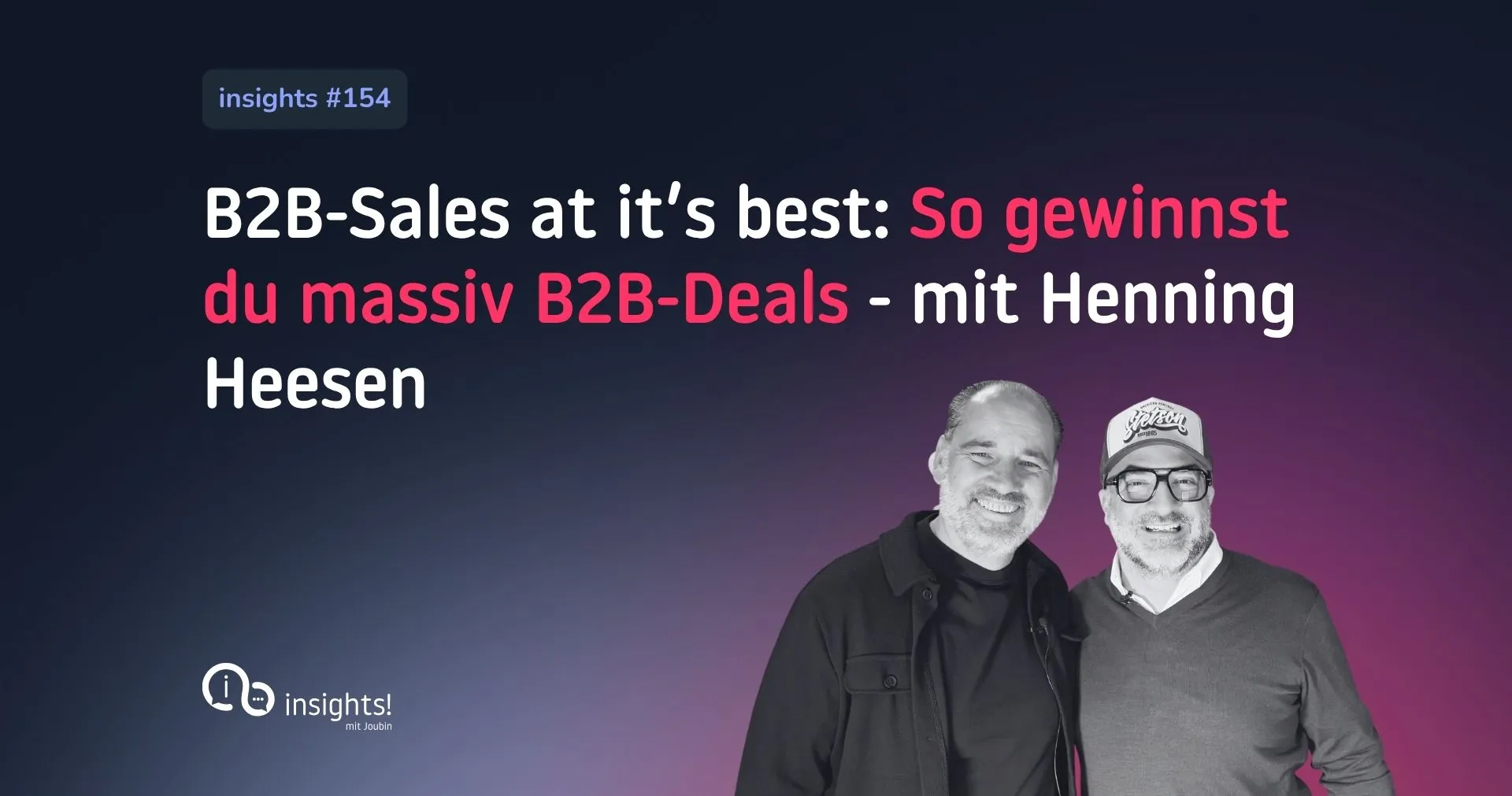
#154 - B2B sales at it's best: how to win massive B2B deals - with Henning Heesen
In this insights! episode, Joubin Rahimi and sales coach Henning Heesen talk about the truth behind successful B2B sales in the tech and agency world. Henning explains why most agencies don't work on their customers' growth but only on systems, why relationships matter more than any product, and why communication that resonates with the customer is the true growth lever. You'll learn how cold calls really work today, what chemistry-fit meetings achieve, and why good salespeople give continuously before they take.
 Joubin RahimiManaging Partner · synaigy
8 min read
Funnily enough I'd say very few agencies work on the customer's growth. They build a system, and the system maybe helps the customer help themselves. If you don't know how your customer's business model works, you're really just building a car, and whether they end up happy with it or not doesn't matter.
Your best product is worthless if nobody likes you
There's a line from Henning Heesen that sticks with you once you've heard it: Rule Number One in Sales is get your customer to like you. Translated, that means you can have the most brilliant solution, the slickest pitch deck and the most innovative architecture. If your customer doesn't like you, you won't sell anything. In B2B sales that's not meant romantically, but is a rather cold observation from decades of practice.
Henning, Senior Sales Advisor and initiator of the Agency Growth Days, describes a behaviour with this that's particularly widespread in the tech world. Many salespeople prefer to talk about their technology, their features and their architecture, rather than taking an interest in the customer's business. That's understandable, because tech salespeople often come from a technical background themselves. But it's also the reason why so many pitches fail, even though the solution is right. Anyone who wants to win sustainably in B2B sales must let go of the idea that the best product sells itself.
Why 90% of all agencies work past their clients' growth
Henning is convinced that most agencies don't actually work on their clients' growth. They work on their clients' systems. They select a CMS, integrate a PIM, build a shop. And then they hope that revenue will eventually emerge from the finished system. But if nobody asks where the revenue jump is actually supposed to come from, then, in his words, that's like building a car without knowing where the customer wants to drive.
At core, many providers lack simple discipline: understanding customer's business model. Customer in fashion sector with 40% DB1 has quite different scope than electronics retailer with 7%. Mid-sized company buying lathe calculates down to euro when it pays off. And moment you can't map that mechanic, but only talk about modules and migrations, you're out. So anyone wanting to promise growth must first learn to calculate their customer's growth.
Marketing that resonates: bait must suit the fish
Henning sums up marketing in a way that's uncomfortable. Marketing is communication that resonates with the customer. Not with you. Look at the website of any tech agency. You'll find almost the same pattern every time: a bit of excellence, a bit of innovation, plus images of people at laptops and a few logos. What you rarely find are images from the customers' world – machines, furniture, workshops, warehouses, showrooms.
But this is exactly where the key lies. Henning puts it this way: the bait has to appeal to the fish, not the angler. Applied to marketing, that means your content, your language, your visual world must work for the customer, not for yourself. A few simple questions can help you with this:
Does my website address the topics my target customers care about, or only my own services?
Do I show my customers' world in images and use cases, or just stock photos of teams at laptops?
Am I using the language of the industry my customer operates in?
Is it clear in my pitch what concrete business problem I'm solving, or only which technology I'm proficient in?
Anyone who seriously checks these four points quickly notices where their own communication misses the customer. And that applies not only to the website, but to every touchpoint, from the cold e-mail to the sales deck.
SPIN selling: from pain to impact instead of the system
In discovery conversations, many tech agencies make a subtle mistake. The salesperson asks the customer about their pain, hears keywords like fewer manual processes or revenue shift, and jumps straight into the tool recommendation in the next breath. This is exactly where Henning applies the classic SPIN model: Situation, Pain, Impact, Need. The crucial step lies in the transition from pain to impact. It's not enough to identify the pain. You must quantify what the pain actually costs the customer and what the solution actually delivers.
If your client generates 20 million in revenue and wants 10% more, that's 2 million more. But how much of that is profit? What's DB1, costs, willingness to invest? From these figures, a real business case emerges. And a business case is the only argument that holds up in a serious purchasing decision. Anyone promising growth as an agency or tech provider must be able to calculate this case. Otherwise every offer is just hope in PDF form.
Relationships beat tech stacks: the uncomfortable truth in tech sales
It sounds like a cliché, but it's data-based: people buy from people. In his first years, Henning sold steel pipes — a product you really can't pitch excitingly. He learned that in such markets, orders arise from relationships, not product arguments. It's no different in the tech world. Mostly you're not selling a finished product but a promise of a solution that only becomes visible after months of delivery. You only get that advance of trust as a person, not as a tool.
From this emerges the concept of the chemistry-fit meeting, which appears more and more often in major tenders. It's no longer just processes and methodology being checked, but also whether the teams are a good human fit. Whoever ignores this has a problem. You can offer the best solution, but if the chemistry between the teams isn't right, the project fails. And that's exactly why relationship-building, small talk and empathy are now mandatory for every sales team in the tech industry.
The 3 stages to closing: I don't know you, I know you, I like you
Probably the most useful model of the whole episode is Henning's 3-stage logic. It defines when you're even allowed to ask about business in the sales process at all. It's simple, but in practice it's constantly violated.
Stage 1: I don't know you. You don't ask about business. You're only building initial contact.
Level 2: I know you. You still don't ask about business. You make offers with added value, invite, network, help.
Stage 3: I like you. Now you're allowed to proactively talk about business as a salesperson. Often the customer will ask you themselves.
The crux lies in stage 2. This is where most salespeople fail, because they want to sell too quickly. Henning's answer to this is remarkably clear: give, give, give, give. Then you will receive. In a cold call, that means you start with value, not with the product. You invite, you share knowledge, you open up your network. Anyone who does this consistently builds themselves a sales channel that is more robust than any outbound machine.
Cold calling is not dead. You are just doing it wrong.
Many write off cold calling as dead, but Henning still sees it as one of the most underrated sales channels. The condition: you have to stop selling in the cold call. The best cold call begins with the statement that today you don't want to sell anything at all. Instead, you invite the customer to an event, a conference, a networking format that's relevant to them.
This exact mechanism is behind successful formats such as insights!, Behind Closed Doors or Digital Horizon. They work because they put added value in the foreground and sales in the background. And they work in the long term because they serve exactly the step-logic from the previous chapter. Anyone who calls as a BDR or cold-caller with the attitude of giving the other person something rather than extracting something has an advantage in German B2B communication that most people underestimate.
If you had to summarise this episode in one sentence, it would be something like this: sales and marketing are not disciplines where the best product wins. The winner is whoever communicates best with the customer, understands their business model and builds relationships that are resilient. That's a pretty clear statement to an industry that can fall in love with tools and methods.
If you carry responsibility in an agency, a tech provider, e-commerce or marketing, it's worth looking at your own sales routines through Henning's lens. Do I understand my client's business model? Does my communication resonate? Am I at stage 3 or still at stage 1? Three questions that can sustainably change your pipeline in 2026. And if you want to dive deeper, check out the full insights! Follow Henning Heesen on YouTube.
Would you like to listen to the full episode?
Find the podcast of the interview here:
Please accept the corresponding cookies to view this embedded content.
Prefer to watch the episode? No problem!
You'll find a recording of the interview here:
Please accept functional cookies to watch this video.
Prefer to read?
Joubin Rahimi
Great to have you back for a new episode of insights! My name is Joubin, Joubin Rahimi, and joining me today is Henning Heesen. Hi Henning!
Henning Heesen
Hi Joubin!
Joubin Rahimi
You know, we've known each other for a while. Yes, we once, on stage, I got to introduce you.
Henning Heesen
Right, a few years ago. Where was that?
Joubin Rahimi
Not Multichannel Day, that was at some hardware trade fair. Ah yes, from from Micha. Right, it wasn't as busy then.
Henning Heesen
Nah, wasn't that busy then.
Henning Heesen
Back then it wasn't so crowded yet. The online retailers weren't so online yet.
Henning Heesen
But on first day I had talk, somehow 10, 12 people sat there. On second day I had talk, nobody sat there. Yeah, but they had live broadcast then. I got deal out of it that was in live broadcast.
Joubin Rahimi
Crazy! So live shopping, shopping TV with Henning.
Henning Heesen
Yes, exactly.
Joubin Rahimi
What I find exciting is, you're a sales trainer, though that always sounds so small, sales is hugely important, and you've set up some kind of format, the Agency Growth Days.
Henning Heesen
Right.
Joubin Rahimi
How did you first come up with setting up Agency Growth Days as a format, when agencies by nature always promise their clients growth?
Henning Heesen
Yes, that's right.
Joubin Rahimi
And now you have, right okay, but they don't have it either. True, you have this idea, so how did you come up with it.
Henning Heesen
So how did I come up with it? As a sales trainer, you really just have to teach people communication, honestly.
Joubin Rahimi
Sales is communication. Communicating.
Henning Heesen
And in my sales trainings I always ask first: who do you think is more successful on the market? The most successful product, or the best product, sorry, or the product or provider that communicates best? What do you think?
Joubin Rahimi
Fairly clear, whoever communicates best.
Henning Heesen
And those doing badly right now, they simply communicate badly right now. So, sales or marketing is communication. And then you must know, marketing communication that resonate, and not with me. Joubin name that resonate with you? Not with me. You're 47, you born somehow... Then you born 1977. You have something with 1977. If you now want buy t-shirt with your birth year and someone say, yes, I only have 78 one left, you not say, let's do it.
Joubin Rahimi
That's also cool.
Henning Heesen
You don't. Nothing with 76, nothing with 79, with 75, 75. Exactly. Exactly, you've got something with your birth year, something with your first name. Everyone's favourite word is their first name, their own name. And if I mentioned your father's name, all the gradations you identify with, you'd respond to that. So, important to know: a purchase I identify with, whether it's a watch, a jumper, a brand, your cap. A purchase I identify with is a reward. Everything else is cost. That's why a Rolex for 8,000 is fine, for 20,000 also fine, for 50,000 also fine. Price doesn't matter there.
Joubin Rahimi
Because it's a reward.
Henning Heesen
Because it's a reward. And the reward is really just the identification. That's why I wear Lacoste, for instance, because I find Lacoste at my age, I'm 52 now, is a brand that's not too much and not too little. So, 60 for a T-shirt is actually nonsense!
Joubin Rahimi
That's a lot.
Henning Heesen
But I mean, I need that. So, I mean, I also need Nike, and then I might see some cool shoes, no name, for 60 or 100 euros, and I think to myself, ah, no name is already quite a lot, with Nike 80 euros isn't much. So we're talking about identification, what I teach people, technology manufacturers or providers or agencies, and this communication has to resonate. What would be a first name for an agency? A variation. So the variation. Agency, right? Then they say: hey, that's me! Right? What's their pain right now?
Joubin Rahimi
They have no customers.
Henning Heesen
Growth. Agency Growth Day. That's how I arrived at Agency Growth Day. So, if you're in the furniture sector and furniture makers are struggling with growth, let's say. Then you create a Furniture Growth Day. Basically, marketing, and many need to learn this, marketing is communication that resonates with the customer. And there are loads of websites that talk about we, and we have a CMS and we have some sort of PIM and so on. But that doesn't resonate with the customer. The customer has furniture or tractors or plants. And if you want to build a website, for example, that resonates with the customer, and you sell to mechanical engineering, which image do you have to show? Of your agency, with people sitting at computers, or perhaps of the machine? Look at how many agencies show images of their clients. None of them. They only talk about themselves and then expect the customer to identify with that. And the smart ones do it. But that's how I arrived at Agency Growth Day. I thought, what's the variation on the first name? Agency. And what's their pain? Growth. Now, if this were Agency AI Day, that would appeal to those interested in AI. But that's how I got there.
Joubin Rahimi
Okay, really exciting. But why not Furniture Day? So Furniture Growth Days.
Henning Heesen
Yes, exactly, because I have agencies as customers. So I have agencies and tech and SaaS providers. And soon we're also doing a Tech SaaS Growth Day. So basically this bait, the bait has to appeal to the fish, not the angler. Yes, but that's why you always have to do it differently.
Joubin Rahimi
That's no great wisdom.
Henning Heesen
So theoretically you never have any trouble with your wife if you only ever say what she wants to hear. But who manages that?
Joubin Rahimi
Who can pull this off?
Henning Heesen
Do I look good? Yes, of course, darling. And will you take the bins out? Yes, of course, darling, then you'd have zero problems. But keep going back into that reflection and asking, what do I need to say now so it sounds good to the customer, without lying and staying authentic, that's marketing done well.
Joubin Rahimi
And now you have agencies, agencies are your customers.
Henning Heesen
Yes, and manufacturer too. Exactly.
Joubin Rahimi
What I've been asking myself, agencies, we do this for our clients. We do the marketing side. We optimise the e-commerce sites for our clients. Why can't many manage this for themselves?
Henning Heesen
Yes, funnily enough I'd say very few agencies work on the client's growth. They build a system.
Joubin Rahimi
More like tech agencies.
Henning Heesen
Right, so they build a system, and the system then perhaps helps to help the customer. I don't know how you handle it, but in discovery there's SPIN — Situation, Pain, Impact, Need — and sympathy on top of that. And generating an impact from the pain. So people are asked what pain they have. And then people say, yes, we want to, I don't know, we want to reduce manual processes or do more digitally.
Joubin Rahimi
We want postponement, that's very common.
Henning Heesen
Yes, revenue shift, exactly that. And then most switch, switch to a system, say, yes, a Storyblok or whatever can do this and that. But must look at customer impact, must say, okay, reduce manual processes or revenue? My question always then, how much more revenue then? Yes, don't know. Then I'd say, that mean, if I make you offer for 500 grand now and you don't know how much you'll earn, you sign? No. Okay, want to build business case? Fewest do, since not interested in the case at customer's end. And sales is many things, right? Sales is helping your customer win.
Joubin Rahimi
Total.
Henning Heesen
And if you don't know how your customer's business model works, you're basically just building a car. And whether they end up happy with it or not doesn't matter then. That's why many agencies don't work on the customer's growth, they work on the customer's systems, so that it runs at the customer's end. And that's why in B2B it's a bit the other way round, there it's more often about a use case, because there's some SME entrepreneur sitting there who has to buy machinery, and he calculates a lathe, he works out to the euro how quickly it pays for itself. How many people do that nowadays already, that's why so few deals happen, but 2, 3 years ago, who calculated whether a Shopware shop or some big project was worth it. There was a budget of a million and that was that.
Joubin Rahimi
Yes, especially with Covid, that was my impression, an awful lot happened.
Henning Heesen
Yes.
Joubin Rahimi
And then clients just fell back into the slump again and said, what did we actually build up.
Henning Heesen
Yes, exactly. Yes, overstack. You've kitted out your whole garden, and maybe that's how it was in technology too. So, and now you think to yourself, I need to a bit— no, but I think very few agencies work on the customer's growth and have to, learn that with me too. So build a business case and actually only think within the customer's case. And you're probably wired that way too, to sometimes tell the customer, hey, maybe that's not such a good idea. So in your case, if I were you, I wouldn't do that. And that already, that already, then you're working on the customer's growth.
Joubin Rahimi
Yes, and everything we do here is also part of the whole, including our INSIGHTS conference and so on, so that people simply move forward a bit.
Henning Heesen
Exactly, exactly, so growing your customer's network and growing your customers' knowledge. And how I teach people, also giving people personal pleasures, for example an invitation to Oktoberfest or a laughing arena, simply building relationships.
Joubin Rahimi
We do quite a few things similarly there. Yes, I noticed you also invited us once. Yes, exactly, that's where relationships form that wouldn't otherwise have formed.
Henning Heesen
Exactly. And we humans actually buy from people we like more rather than less. And it's the same with agencies or tech providers. People think – that's why I asked about the best product – people think they're buying the best product. But if I don't like you, and you have the best product, no way!
Joubin Rahimi
We're seeing Elon Musk too, he was hyped in Germany at first and now not so much anymore.
Henning Heesen
Right.
Joubin Rahimi
And the figures correlate with that.
Henning Heesen
How can it be that you suddenly find the car cooler or less cool? Because the owner somehow does something and that's how you're conditioned. That's why we need to learn, in this tech world we need to learn to build relationships. So, in my first 10 years of working life I sold steel pipes. I couldn't tell the customer, look, my pipes are round. And they've got a hole at the front and back. That's where you build relationships. Invitations, football, going out for dinner, drinking in Düsseldorf, dinner. So, that's the game. And we need to learn that a bit, building relationships. And funnily enough, agency owners 10, 15, 20 years ago didn't actually found a tech agency because they loved people so much. They set up a tech agency because they loved tech. Now they have to get out there, because the mountain doesn't come to the prophet. Customers no longer come to you.
Joubin Rahimi
Crazy thought.
Henning Heesen
And now you have to learn small talk, for example, or how to communicate better, so people think you're the better solution, which is true for the team feeling too.
Joubin Rahimi
Yes, often it's not just the solution, is it? It's the software, it's the team that exists, it's the mutual understanding. And when something isn't going well, how do I get the cow off the ice?
Henning Heesen
Right.
Joubin Rahimi
And once you manage that, you know the project is now running.
Henning Heesen
And the customer buys from you permanently. That's why, in major tenders today, there are chemistry-fit meetings. It's actually about showing processes and so on, isn't it? But then the thing was called showing processes fit. Chemistry fit already means, okay, do we get on as a team? You can buy the best solution, but if the teams don't fit together, the whole project doesn't work.
Joubin Rahimi
I've never heard it called chemistry fit either.
Henning Heesen
Yes, yes, sure, I do. Yes, yes, chemistry fit meeting, yes, exactly.
Joubin Rahimi
Yes, great.
Henning Heesen
You sense whether you fit together as people, because people always buy a team.
Joubin Rahimi
Now we have a team, you said, they're actually techies. So your background is techies too.
Henning Heesen
Exactly, PO, PM, exactly.
Joubin Rahimi
Now you sound a bit like cat. We're more dogs. We up front are: Oh my way! Let's stop a bit and see what it can do then.
Henning Heesen
Right.
Joubin Rahimi
And the cats think, what do they want now? And why is he asking such a question? Yes, that's good. And that's how I always compare it.
Henning Heesen
Yes, correct.
Joubin Rahimi
They can do things brilliantly, but as far as that goes, in my view they're always the cats.
Henning Heesen
Yes, exactly, exactly. But you probably match that in meetings too, right? If you know there are 4 techies sitting there, you always bring at least 2 techies along.
Joubin Rahimi
One thing is, well, we always have a mixed team. Yes, I was originally a techie myself, but I was never just a suit. But when you talk tech stuff with a techie, then I understand, okay, this person isn't just here for the pay.
Henning Heesen
Right, they have expertise too.
Joubin Rahimi
Then that's fine.
Henning Heesen
Yes, exactly, exactly.
Joubin Rahimi
But at some point, past a certain size, it's too far removed.
Henning Heesen
For you?
Joubin Rahimi
Yes, that's also true with the whole range of topics, and you have to be even deeper into it, funnily enough, because much less gets dropped.
Henning Heesen
And what's also there, there's an age match in business.
Joubin Rahimi
But what about the 29-year-old?
Henning Heesen
The white beard and a 24-year-old lead developer or so, that can match, if he really has an old soul. But generally, if you've got a decision-maker sitting there roughly your age, you know, he sees, he's got a beard like yours, he thinks, okay, check, we can talk about Miami Vice and you both know what you're talking about. And sitting there, I don't know, maybe also a 40-year-old, another 30-year-old and two, no idea, two 25-, 26-year-olds. Then the smartest move again is to communicate in a way that matches that, so people can connect on that age level. I have a client who only sends women to clients, only women. We have a conversion rate of 70% plus, because they're less confrontational than some alpha males who then think they need to dominate the meeting and the project a bit. So, you have to think from that human angle too, in what you say, how you say it.
Joubin Rahimi
Always put togetherness first.
Henning Heesen
100%. People buy a solution from people. And in our business, people aren't buying a finished product where you can show, look, this is a table, it's triangular and so on. You're selling something on a PDF or on a screen, and they have to trust you on that right up until after delivery. Because it's only in the months after delivery that they actually see it, that's why they buy it from you. We buy from people, above all these solutions we offer, we buy those from people. That's why you are the product.
Joubin Rahimi
That's why good sales people, even those who know what they're talking about.
Henning Heesen
Exactly, there are very few salespeople left who – I still know a few in our industry who have zero idea about the product. So, if that person is the boss, it always works because they're the mood-maker. Yeah, come on, this is going well. But if you have little product competence and you're not the boss, meaning you don't have relevance within the company, then it's difficult. As the boss, you can create mood, throw a party, and then they like you and the company.
Joubin Rahimi
Because you'll have the setup then.
Henning Heesen
Yes, exactly.
Joubin Rahimi
But I want to break a lance for the BDRs too. Recently we had a call from a managing director of a larger trading company, and he said: hey, I wanted to tell you something, we talk on the phone now and then, not a call actually, it was a WhatsApp message. A woman from your team called me, asked whether I'd come to the insights event, and I don't know her name, but it was so genuinely authentic, she had such interest in the things I'm interested in too. I simply came out of the conversation happier, and that was really great. And that's what I think only a BDR or cold caller can achieve, it's not just, well, a lot of impact.
Henning Heesen
But in Germany there's no appetite for it, but the difference here is, you know, that's how you have to build the system, and you build it well. You've got the insights!
Joubin Rahimi
We have the insights!.
Henning Heesen
Have you thought about that too, the word resonates with the customer. And the other thing is
Joubin Rahimi
Behind Closed Doors, from Lars, but with you,
Henning Heesen
But it also resonates with decision-makers. They think, yes exactly,
Joubin Rahimi
So behind closed doors we don't even have Insta yet.
Henning Heesen
Yes, I know, I know, really successful, right? We're working with Lars. But the BDR part you're addressing now, the way out, and now for everyone. The way out of: I want to sell you something cold, is invitations.
Joubin Rahimi
Total.
Henning Heesen
There are two stages, three stages in business that you have to respect before you ask about business. The first stage is: I don't know you. You don't ask about business there. That's some kind of first contact. The second stage is: I know you. You don't ask about business there either. You offer, you make offers with added value for the customer. The third stage is: I like you. I like you. That's when we can talk about business. If the two of us have sat next to each other, we meet another 2, 3 times, even drinking at the Wiesn, then at some point I say to you: Joubin, you're buying this bloody sales training from me now. And then you say: Yes, let's do it! So from: I don't know you, to: I know you, to: I like you. And only at: I like you, can you as a salesperson proactively say, now let's do business. But what you'll see, and you probably know this from experience, from I don't know you to I know you, and then there's this phase, I like you. There you'll notice that a customer often already says to you, Joubin, and we probably need to talk at some point, because you've made so many offers. And you have to keep making these offers, permanently. That's why, for a BDR, the cold call in perfection is when you say, hey, I don't want to sell anything at all today. Ah, that's already good. I want to give you something. And in sales it's give, give, give, give, give, give, give. Then you'll receive. And that's why this is the best cold call, when you say: Hey, we've known you for a while, we follow you. Yes, I've seen you before too, TIMETOACT, or Joubin, your boss. And he's already thinking, they're not going to sell me anything now. Exactly. And then you say: Hey, I don't want to sell you anything at all. I'd like to invite you to insights!. Does that resonate with them? We have furniture manufacturers like you there too. There's also Ostermann or I don't know what all the furniture brands are called. And I don't think you should say: I'd be delighted, because in I'd be delighted there's very little added value for the customer. That you're delighted, okay, what's in it for me? There you'll learn a huge amount about AI in the furniture world and grow your network. I think that's quite interesting for you. And then it's a cold call where you think: Hey, actually quite interesting for me. So, offering touchpoints, with added value for the customer, that's what you do, but you have to do it permanently. That's ongoing. 1. FC Köln, I don't know, here return leg Munich, PSG.
Joubin Rahimi
We started with the new marketing approach in 2019, 2019, 8 years ago. Scott Galloway, I attended a sprint like that, started very early with it. And that's the basis, really.
Henning Heesen
Yes, that's good.
Joubin Rahimi
And that's good. We have another format, Digital Horizon, where we invite people to our place.
Henning Heesen
Home, means what?
Joubin Rahimi
Home means home.
Henning Heesen
At your place?
Joubin Rahimi
At my place at home in summer in the garden. It's also not something that gets blown up into a big deal. We always have a great act that already adds value there.
Henning Heesen
Do you have a bouncy castle or what?
Joubin Rahimi
With children, we also have a bouncy castle, face painting for children, all that, and childcare. That's a Saturday, that's really easy. We're thinking about Marten, look who's playing it now, the Breath Taking, breath training. Ah yes, the K5.0 day.
Henning Heesen
Yes, exactly, exactly. Dutch, right? What's his name again? Yes, yes, exactly.
Joubin Rahimi
That would be something too. We had Hans Sarpei with us. So different. Yes, exactly, that's cool.
Henning Heesen
Yes, that's good.
Joubin Rahimi
And you have lots of people, yes, who are simply similar. Exactly, you come to us, yes, and you meet people you can really connect with, whom you wouldn't otherwise know. And that's something really special.
Henning Heesen
Exactly. That's the game.
Joubin Rahimi
And I say trust, you say yes trust, we open the gate.
Henning Heesen
Right.
Joubin Rahimi
You can see how we live. Exactly. There's not really much more you can open up. That's where we live, and we have to make do.
Henning Heesen
Yes, exactly. And that's not manipulative either, because people sometimes think, well, building relationships like that is manipulative. Know what's really rubbish? Not being interested in you, just – do you want to buy something from me? What's appealing about that? No, not that.
Joubin Rahimi
And manipulative is immediately negative.
Henning Heesen
Right.
Joubin Rahimi
All people we ask about the events, where I say, I'm happy to talk to them.
Henning Heesen
Yes.
Joubin Rahimi
And there are also arseholes.
Henning Heesen
Yes, yes.
Joubin Rahimi
They won't be invited.
Henning Heesen
Yes, yes, yes, no, exactly. Yes, yes, no, no, exactly. So rule number one in sales is get your customer to like you. Yes, full stop. They have to like you. Yes, I know. It's not like that in the tech world, and you see a lot of sales people too. They'd rather talk about technology than build relationships. I totally understand that too, because not everyone can do that. But if people don't like VTEX or don't like TIMETOACT or don't like you, then you can have the best product on the planet and they still won't buy it. That's the model. And there are actually 3 things where you need to support your customer. One is their career, because if you mess up a project, they have a real problem internally. It's not like they'll say, wow, you really nailed that. The whole project messed up internally. The second is personal, so them personally, what you might do for example with breathwork, or maybe also if they say, hey, I'm not quite happy with that place, that joint any more, you can say, okay, should I do a bit of reach-out for you, because I know a few people too.
Joubin Rahimi
Extend the invitation, even if someone doesn't currently have a job. Exactly. Same nonsense.
Henning Heesen
Exactly. That's the personal level. So, and then there are company goals to support. But for the company goals you need to understand the customer's business model. So, and when people do impact calculations sometimes, when I practise that with them, I say: okay, the customer does 20 million and you find out, they want to do 10% more. How much more do they want to do then? Yes, 2 million. Okay, how much, if they want an ROI within 12 months, how much could they spend? Say 2 million. Sorry, is that revenue or profit, or is there still a DB1 and a few more costs? So, now you're operating in electronics, there's 7% DB1. Now you're operating in the fashion sector though, there it's 40%. There it would be 800 grand, and for the other one it would be 140,000. Then you could— and you need the customer's business model—
Joubin Rahimi
Completely different.
Henning Heesen
So, and that's a process you build up in the sales process, which leads to the customer saying, hey, at the front, in lead gen, I like you, you're a good person, you support me too, and I have the feeling that you won't be gone afterwards once I've signed, which is really bad. And you also seem to understand my business and yours somewhere. And customers decide, right? They say to you or to the other one: We feel that you understand us better.
Joubin Rahimi
Absolutely great.
Henning Heesen
That's the reason. It's also why they then say: we didn't feel you understood us 100%. You only achieve that understanding through questions. Through questions, being present and listening.
Joubin Rahimi
Exactly, a bit like the insights!.
Henning Heesen
Yes, 100%, so understanding your customer.
Joubin Rahimi
And I'd say we already have our next guest here, we can happily go into that in more depth some other time.
Henning Heesen
We deepen this in your garden on the bouncy castle.
Joubin Rahimi
Very happy to. I can picture that.
Henning Heesen
With or without beer. That goes viral on LinkedIn.
Joubin Rahimi
This is going viral on LinkedIn. So if you have questions for Henning, post them directly below, message him directly. Henning, thanks for your time.
Henning Heesen
Thanks for watching. Really pleased. Enjoy the rest of the trade fair. Yes.
Joubin Rahimi
Thanks. Cool.
Henning Heesen
Do you already have the next guest?
Joubin Rahimi
Toralf.
Have questions or feedback?
Then feel free to contact us directly.
- Joubin Rahimi
Managing Partnersynaigy
Show phone numberShow mobile numberShow email address

Subscribe to the blog now and never miss any news
✔️free of charge ✔️weekly news ✔️expert knowledge
Please accept the corresponding cookies to view this embedded content.