



Schäfer Shop: ROI increase through CX and transformation
 Joubin RahimiManaging Partner · synaigy
3 min read
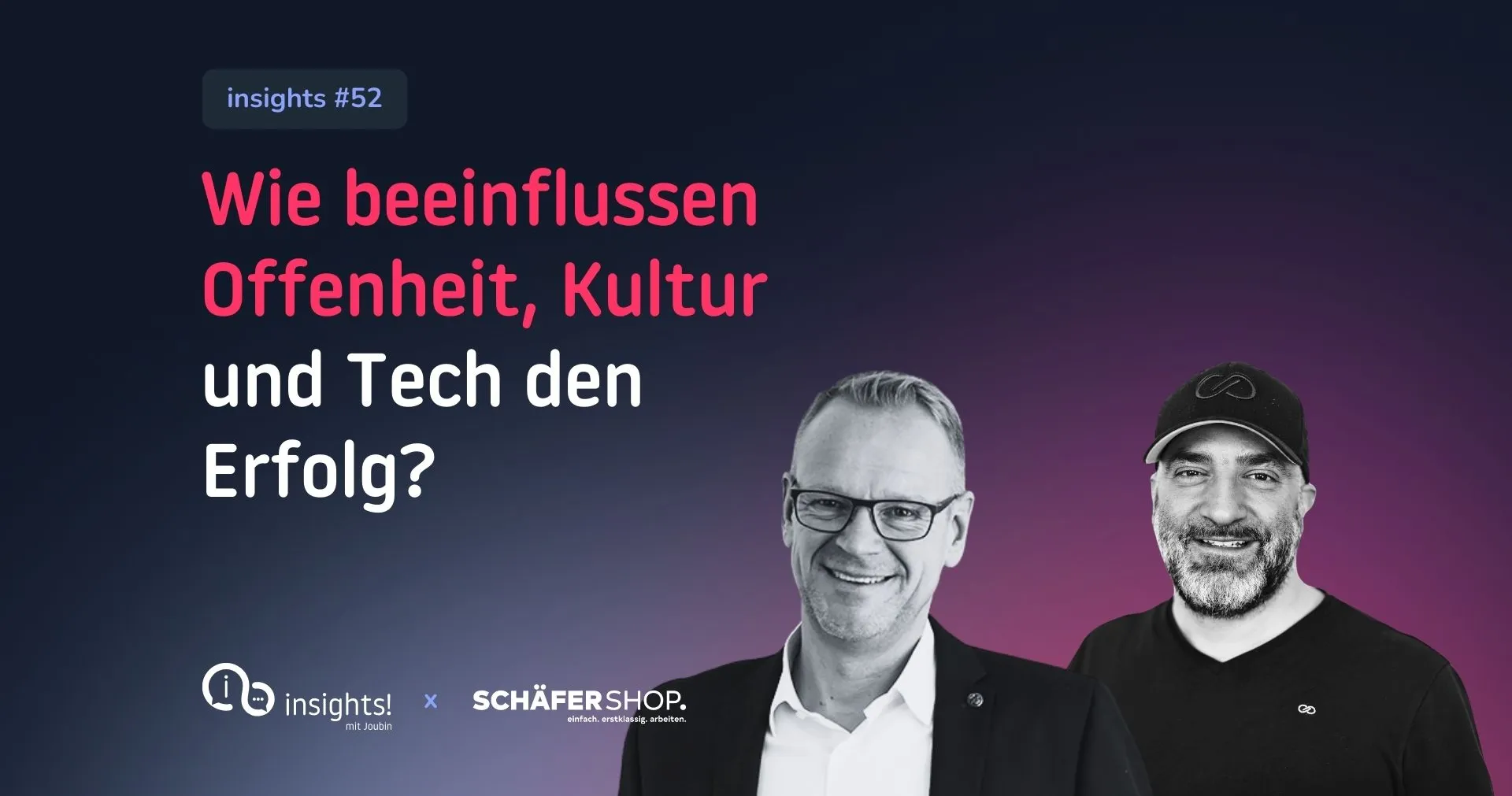
insights! episode #52: Best practice Schäfer Shop: How openness, culture and technology shape company success
In the new insights! episode, I talk with Andreas Reuter, CEO of Schäfer Shop, about the company's transformation in technology and working culture. We discuss the importance of high tech and high touch, how they use movement data to understand customer behaviour, and how they're tackling the changes brought by remote work and AI.
I enable people, show them the horizons, or they show them to me, and then we start together! I think that's where the key lies, from my point of view.
Cultural change and digital transformation in a corporate context
We cover a broad range of essential topics in the context of corporate leadership, cultural change and the use of technology, and highlight the intersecting paths of human innovation and technological progress. In doing so, Andreas Reuter provides deep insights into Schäfer Shop's transformative journey in an increasingly digitalised world. Below, we take a closer look at the key aspects of this stimulating discussion.
Megatrends and high tech vs. high touch: the discussion starts with how the two speakers met and how the book "Megatrends", along with the concepts of "high tech" and "high touch", laid a foundation for thinking in their company.
Culture change and employee retention: Andreas Reuter emphasises the importance of company culture, and how Schäfer Shop initially focused on the business model rather than on people. They realised that a sense of connection with employees matters, and how they're driving cultural change through open communication and employee involvement.
Transformation and new work: the transformation of the company driven by digitalisation and new ways of working is discussed. Andreas Reuter talks about the importance of new work and how it can strengthen employee retention and prepare the company for changes in the labour market.
Use of AI: Joubin Rahimi raises the question of how AI tools can be used successfully. Andreas Reuter stresses the importance of testing and learning, and of starting small projects and scaling step by step. He also stresses that AI adoption must be driven by employees and requires willingness to change.
Technology and employee empowerment: Andreas Reuter stresses that technology serves as a tool and that employees should be empowered to use new tools. He highlights the importance of resilience and psychological safety in times of change.
Change and challenges: the conversation ends with the point that change is often a challenge for people, but that it's important to build a culture of openness to change and experimentation.
The discussion shows the importance of openness, cultural change and continuous learning in times of technological change and a company's digital transformation. It is emphasised that successful change should be driven from the bottom up, and that technology is only meaningful when it serves people and enables them to act successfully in a changing world.
Would you like to listen to the full episode?
Listen in directly and find out more:
Please accept the corresponding cookies to view this embedded content.
Prefer to watch the episode?
No problem!
You'll find a recording of the interview here:
Please accept functional cookies to watch this video.
Prefer to read?
Joubin Rahimi:
Great to have you along. For a new episode of insights. My name's Joubin Rahimi and today's guest is Andreas Reuter from Schäfer Shop. Hello Andreas.
Andreas Reuter:
Hello Joubin.
Joubin Rahimi:
First of all, it's great that you're finding the time, so we can talk today about the topic of change and digitalisation and much more, I won't spoil it any further. And we've been supporting you for a few years now. But that's not what today is about. But I think we've had some exciting topics. But before we get into that, maybe first a couple of words, a couple of sentences about you and about Schäfer Shop.
Andreas Reuter:
Yes, gladly. First of all, I'm pleased to be here. Thanks for the invitation. A few words about me. Quite simple. I'm 52 years old, born in northern Germany, joined Schäfer Shop eleven years ago, came from an American competitor, and had the task of leading the company into a successful future. Whatever that meant. We essentially focused on three topics. One topic was our go-to-market strategy. Back then, ten years ago, our e-commerce share was under 20 percent. Today we're well over 50%. That was one part. The other was: what should the culture within the company actually look like? We engaged intensively with the company's culture. How do we want to work together, and so on. And the third topic was: how do we manage it? We're a family business, a commercial enterprise. How do we actually manage to grow profitably. So profitability was a key topic.
Perhaps briefly on Schäfer Shop: the company is now almost 50 years old, founded in 1975, from within the Schäfer family. The Schäfer family comprises three business groups, Schäferwerke, SSI Schäfer, Schäfer, and now the Schäfer Shop. And the idea in 1975 was that the Schäfer Shop would take over distribution for the other Schäfer family businesses. And that's what happened for a few years. And then we continuously developed further, brought out catalogues. We were the pioneer in B2B mail order, primarily driven by the catalogue business. And that has changed massively over the course of the last 50 years or so. We're 100% family-owned. That's nice, so no external investors or anything, that gives
Also gives us freedom to keep developing the company.
Joubin Rahimi:
That's exactly how we got to know each other, through this transformation process. And you had me, and I think it's been almost ten years, six years, seven, eight years ago, you said, read the book Megatrends, I think, and High Touch and High Tech. Yes. I couldn't make anything of it back then, but I don't want to explain it now, because you pointed me to it, and I think it's still a foundation of how you think too. According to your LinkedIn post from yesterday. Maybe 2, 3 sentences on that.
Andreas Reuter
Yes, gladly. So we actually have the book you're describing, Megatrends, from 1982 by John Naisbitt, it's an ancient book, and in this book he describes the approach of high tech and high touch, so high tech simply explained: How can I use systems? How can I use data to deliver to the customer, that's what the book was also about, high value, so deliver high value. That's only one side, so data, algorithms, technology etc, high tech. High touch is the human side. We're social beings, still need contact with other people. And for us it was about, so how do we apply high touch, is how do I reach other people? How do I communicate with other people? What happens in the interaction between two people or two groups etc. The combination of high tech and high touch is actually about making data usable to optimise communication between people. Today that means how do I get the touchpoints optimised with the knowledge I have about customers? What does that mean for us? Very concretely? I don't know. Maybe very briefly, but you wanted to ask something just then.
Joubin Rahimi:
Go for it, it's great.
Andreas Reuter:
So for us, quite specifically. I think a huge asset of Schäfer Shop is that we've been recording all customer movement, movement and behaviour data since 1995. That means we have all the data available. Our advantage is that we operate purely in the B2B environment. We know when which customers buy what, why they buy, through which channel, which product ranges, etc, and from this we can determine buying behaviour via algorithms and neural networks. We can say when's the best time to trigger which customers, how? Do they need print or do they need e-commerce contact? Do they need direct contact, etc. For us, that's lived high tech and high touch, and our asset is endless movement data since '95.
Joubin Rahimi:
That's of course hugely exciting, because you're saying you've grown the share of the digital sales channel from under 10% to over 50%. And that in a time when various companies were also hit by the banking crisis, Covid, the Ukraine war, wherever these waves of insolvency kept coming and companies got weeded out. And you said you're a family business, no outside investor. From my point of view that often means family businesses are also closer, more connected to their employees. You're not based in a big city either. I think everyone in Betzdorf can relate to that too. And so bringing employees along is perhaps a big topic too. Or is it not a topic at all, because you say, in Betzdorf everyone knows us and that's why everyone wants to work with us anyway.
Andreas Reuter:
Well, I said it just now. What did we deal with at the start, when I joined the new company? And a very key topic was culture. And culture means, well, I realised that over the years, what we focused on before 2012 was more the Schäfer Shop and the business model than the people. And I found that somehow a sense of connectedness was missing, and also, as you just said, we're based in Betzdorf, and Betzdorf is, well, it's a beautifully situated place, or a beautifully situated town in the middle of the Westerwald. And now you come from Hamburg and want to do digitalisation and say, right, let's move forward, we're digitalising, and so on, we're digitalising our business model. You can imagine that didn't make everyone equally enthusiastic straight away. Then we actually did something, and this is really anchored in our culture: at every step we chose, we involved the colleagues affected by it. That means we didn't say, we're going in this direction and you all have to come along. Instead we sat down or stood together with people, discussed what's the path we want to take, what are your concerns, but also what are the things you want to drive forward. And that's how we actually managed, on the one hand, to turn the existing staff, the existing employees, into a team that also engages with digitalisation slash e-commerce. On the other hand, of course, we also kept bringing in external expertise. That means we also brought in new employees whom we were able to convince to come to Betzdorf because the project was cool and still is. Today that's changed, but we'll come back to that in a moment. Very, very definitely.
Joubin Rahimi:
Noted that down. The change in people. We live in patterns, after all, and that came up in the preliminary conversation too. Recognising these patterns and changing them, changing them for the better, is a major challenge. Do you have the holy grail for that? Not quite, but maybe some pointers for the listeners and viewers?
Andreas Reuter:
Yes, well I think a really key driver, and this is what we had, this was really the point that made the whole story successful, was that we didn't decide in the management team, in the department leadership, what we had to do, but we actually brought people into the projects. The projects were interdisciplinary, meaning there wasn't a boss who said how it had to run and everyone else had to follow along, but from the very start there was absolute transparency, which also wasn't standard in the company, absolute transparency and fully involved. So really discussed every step with the people, with the stakeholders it affected, involved, developed together with them, planned the steps, test and learn, so tried things out, learned from them, took a step back again and then two steps forward again. That's how we did it. I think it still is, and we still do this today. Yes, that's the holy grail for me that you were just talking about. It does exist. At least with us. I believe that.
Joubin Rahimi:
Any tips where you'd say that's something leader should learn too, or as managing director, or get inspired by that, because things sound simple at first, but when you say okay, I let go, I give up control. It's certainly change to one's own person too.
Andreas Reuter:
Yes, absolutely, absolutely. I actually had it relatively easy. I came into the company from outside and still had, so to speak, a clean slate. And I came from an American company that was quite non-hierarchical, well, it wasn't entirely non-hierarchical, there were clear hierarchies, but not that many layers of hierarchy. And I think what I learned, and what I perhaps already brought with me from my mindset, because I've essentially been in retail since, I won't say since my youth, but I learned retail very early on, and for myself I've always had the principle, this will sound a bit clichéd, I actually want to lead the way I myself would want to be led, and I think the key thing is not to take yourself too seriously. So honestly, I don't see myself as the one who says where things are heading, I actually try to listen, to go into conversations with people, then to look, okay, how does this all fit into the strategy, bringing groups together, so bringing different people in the company together, and rather making things possible. So not being the one who says, right, we're going this way or that way, but listening first. I think that's the key trait. I still talk too much, but I really do believe that listening is the key trait.
Joubin Rahimi:
Yes, you listened to Toni Robbins, you'd had another post on LinkedIn again and I found it mega empathetic that you wrote that. I simply felt afraid, I don't know whether you wrote afraid. But I didn't want to be asked to say something in front of 17,000 people.
Andreas Reuter:
I mean, Tony is to a degree. Well, you talked about models earlier, and Tony is in a way, in some approaches, really my role model. Well, it's about how can I make people, how can I make people strong, how can I give people meaning, and so on, and that's part of it. So particularly there he's really my model, and he was standing not a metre in front of me. And he actually asked the audience too, because I thought, better not now. So apparently he could also read my physiology. All fine though. But that's part of it too. So how can I empower people?
Joubin Rahimi:
And that's what Tony Robbins simply does, and that's what makes him hugely exciting, because this empowerment with Tony Robbins, which I looked into more intensively afterwards, is also something. It could lead to employees saying: right, I'm setting up my new company or doing something else or stepping out, going back into risk again.
Andreas Reuter:
But how cool is that? You have to say that, if someone says wow, I've learnt so much here and taken so much away with me, I'm now setting up my own company, then for the moment that might feel like a shame, because we're missing an employee. But on the other hand. I mean, that also has something to do with the meaning of life, and I think I wouldn't have any qualms about that at all. So please, if any Schäfer Shop colleagues are listening, that doesn't mean they should all go and start their own companies now. But I think it's absolutely legitimate to also take that path, for people, and I'd say on the other hand, as a manager I can also say, well then they really had potential. And I never managed to create a framework where the employee says, yes, great, I can use this for myself and enjoy it. But we have, it has to be said, of course, we have, and it has changed a bit due to Covid and even before Covid. So we have, I said earlier, most people sat and used to sit in Betzdorf. Today, especially when it comes to, I'd say, the digital roles, we're spread across the whole of Germany. We've just brought our shop development, which we had outsourced for years, back in-house. That means we've built our own development team with DevOps, with architects and so on, and the people aren't sitting in Betzdorf, they're spread all over Germany. That's also a huge opportunity for us now. So we have to increasingly understand that New Work means much more than just fancy offices.
Joubin Rahimi:
So what does remote work mean for that then? What else for you? You're still office equipment, aren't you? It's basically double, can we ask that question? So what does it mean?
Andreas Reuter:
Let's approach this from different angles. The first angle is: what does this actually mean for us? How will we lead in future? How do we want to work together with our colleagues? And that simply means that if. If people aren't regularly in the office, but need to be led remotely, then we have to learn to lead differently. And what you can say is, we have employees who've never been to Schäfer Shop. So, so never actually at the company. How do I still manage to build a sense of connection to the company that goes far beyond just the project? We do things for that. We celebrate, we do stand-up meetings, we still have calls that aren't always about work topics. So we do a lot to ensure that Schäfer Shop really is an attractive employer too. We have, even if you look at the offices. Of course we've adapted there too. We've completely renovated the office building, refitted it and so on, we've created many more spots where people can simply meet up to talk. So not closed doors, but we have these corners where people can meet. And we're nowhere near finished there. It'll keep going. We're currently working on communication. We have our own leadership training. Coaching, that we developed just for ourselves. It's about our values, it's about how we want to lead. It's about what our employees can expect from us and so on. So we've done things like that internally and we're also in the process of developing further. On the other hand we also have to. As you mentioned, of course also ask the question: what does this change in the labour market mean. What does this changed way of working actually mean for our business model, and there we're completely open, so clearly. Today we live off what we sell, primarily. But six years ago we already set up a division, Workplace Solutions, where we already do much more than just sell products — there we're a general contractor. If customers come to us wanting to fit out an office building, then we can offer more than just furniture — we do colour consulting, floor-wall-ceiling consulting, materials consulting and so on. And this Workplace Solutions thing, we can think about that on a much bigger scale. The idea can go much, much further. But what do customers who are all standing at this New Work crossroads now actually need? They undoubtedly need a desk. They need something completely different too. And. These are the kinds of thoughts we're currently grappling with, also grappling with in management, and then thinking through together with our colleagues. What does that mean?
Joubin Rahimi:
You can see de facto how Nokia failed to make the transition from mobile phone to smartphone era. It's probably exactly the same tipping point in your industry, with things changing now.
Andreas Reuter:
Absolutely. We don't see this as a threat, because it's a huge opportunity. So, it's a huge opportunity. I mean, we're being handed exactly what we've always wanted. So, we're now making use of that too.
Joubin Rahimi:
Also pushing the positioning forward for once in the construct: if you don't do anything, you've lost. But now you have the chance to really win too.
Andreas Reuter:
Right. Remember three years ago? Rebranded. New logo. Worked on vision and mission too. Mission describe well what we stand for future: we create positive work environments that make our customers more successful. Think what that mean — positive work environments go far beyond furniture. Not just furniture or shelving or paper. Goes way beyond. Expect lot from us next months and years.
Joubin Rahimi:
That makes it hugely exciting, of course. On that note, I also think it's great that you're speaking so incredibly openly about these thoughts now, and you'd also posted about it on LinkedIn. Why do you do that? One could put it quite bluntly: you're showing your competitors what thoughts and conversations you've already had, one way or another. Or maybe not, I don't know. And wouldn't you rather keep something back? But from what I've learned about you, you've clearly thought it through, doing it so openly?
Andreas Reuter:
Yes. So why? Because. Honestly. I mean, which of our competitors isn't dealing with New Work right now? So, I hope, I wish for my competitors that they're all dealing with it. The question is, at which point in the process are we? And that we're engaging with New Work and forming our first thoughts on it is beyond question. I'm not afraid that our competitors will now say oh Schäfer Shop is doing New Work, so we'll do it too now. What we're capable of is obvious, we can talk about that. And ultimately I also find the exchange with other affected parties always better than, that's also the topic I mentioned earlier - transparency. Don't worry, so far we've made so many things transparent and it still works, or maybe precisely because of that, which I find exciting.
Joubin Rahimi:
We have a wide range of customers, and also some customers, or prospects, that are new to us. And quite early on we've now spotted patterns where we say, this will be a successful company or not. And funnily enough – I've never told you this, and I don't know whether there's really a causal connection or not, it's not scientifically proven – but the people who are transparent, who talk openly about things, get far more input, are willing to change, because digitalisation is a transformation of the business, and they win. Those who don't talk about it and keep everything under wraps go bust. So we've had insolvencies among some of our customers. And when I look into it, that's actually the main issue: am I connected or not? Am I open or not? And that's why I find it so nice, because it's not a German virtue.
Andreas Reuter:
Perhaps it's my American professional background, but that's not just me. That's all the people at Schäfer Shop. It has to be said, we've also changed a lot in the first few years, including regarding executives etc, and we've rebuilt the team, even just within the management team. There are six of us, two of us have been here a bit longer, the others have been here for about 2 to 3 years, which doesn't just mean that at some point you have to leave us. But we also looked for people who would go this transparent path with us. So that's part of the culture and it's a matter of course. And for myself I've made transparency very important, not to be replaced.
Joubin Rahimi:
Exactly. Let me pick up on another question or another point. You said technology is a means to an end, and you had outsourced it and are now bringing it back in-house. Our customers keep encountering this question too. Why are you doing that? What do you hope to gain from it, and why are you doing it?
Andreas Reuter:
I said at the start that we generate over 50% of our revenue and our order intake via digital channels, that's e-commerce, e-procurement and so on. And we'd outsourced the whole tech topic completely. That means on one hand we had a high dependency. We couldn't manage key assets ourselves. And from a strategic viewpoint I, and we, simply assessed that as extremely risky. And then we said: well, if we have people, and honestly, Covid helped us there again too, because we then said — people don't have to sit in Leverkusen in our office, or they can do what they want, they can work from wherever they want. There we said, we simply have to resolve this dependency from a risk perspective. I can't make 50% of my revenue, or over 50% of my revenue, completely dependent on external service providers. But, and this we can do, we can reverse the ratios. That means, where we now have — we have our own people who I'd say can develop about 80% of what we're planning. And then we can still bring in external companies on top. Only the ratio has to be right. And that's the reason we do this. Maybe it doesn't necessarily feed into your business model, but somehow it does, because we're now much freer in choosing the partners we work with.
Joubin Rahimi:
We've done business in every era, so that's fine too. I think I also gave an impetus for the first outsourcing. And I believe I was also allowed to give an impetus for the way back. But I think it's not about us. Like you said, you also hold yourself back, and as a company we also hold ourselves back, but the question is: What moves you forward, if you're successful we get better. And I also think we need to look at how our business changes. Our sales process will certainly change. So thanks to ChatGPT, customers and customer contacts will have significantly more knowledge and information regarding their own situation too. And you can find that annoying or see it as an opportunity to position yourself differently and then shift into second gear, or third, or fourth. And there I think AI, you're doing a lot there too. But I'd like to first ask a general question that I'm always asked too. But I don't actually want to answer it. I'm curious what you'll say about it though. The question is: how do I successfully deploy AI tools? Is it the strategy, is it the right tools. That's always already implied. I have a certain difficulty with that question. I don't know how you feel about it.
Andreas Reuter:
I get asked that a lot, actually — how do you use AI successfully? I think I said it earlier: test and learn, build up your cases, and ChatGPT is a great example. Let's be honest, AI has been pushed into a completely different focus through ChatGPT, including among end users. And we've been doing things, for three or four years now, where in our content — obviously we used to write all texts by hand — for three or four years we've had our texts written by an AI, our product descriptions written by an AI, and we find they convert no worse, and often even better, than texts written by humans. We tried that out. Start small, really small, pick small cases and then scale. Keep going. Keep going. Keep going. And we do that with everything — we also have ideas around ChatGPT, obviously, and honestly, I mean ChatGPT has only been around and talked about for about eighteen months. What will it look like in three years? In four years? In ten years? We simply have to try things out and take a few knocks along the way.
Joubin Rahimi:
I find the question difficult, because you also said it implicitly, because it's not really about AI at all, but rather I need to enable my employees so they keep an eye on these new tools that keep coming along all the time, the learning, and create an atmosphere where everyone is bold enough to say I'll try something out. And yes, often many things don't work, but I want to find the right thing.
Andreas Reuter:
Well, I think that's the crux of it, that it has to come into the company, again not as change where someone says you must use this tool, but the employees can judge that far better than we can. The biggest challenge, and I can totally understand this, we've had this in every transformation I think, is that it's extremely important that people understand it's not about their job, not about their professional existence, but about changing things. I know when we focused more on e-commerce in 2014, there was of course great fear about what happens to our catalogues, what happens to the department and so on. What we've learned since then also has to do with resilience. What we've learned is that we'll always need people, that it always takes people to operate the systems, to understand artificial intelligence and so on. And we do so much to make sure that even people who perhaps have nothing to do with it today understand what ChatGPT can actually bring them, what else is out there, there are so many other cool programs. I can now build avatars that would sit here like me and talk to you. What does that actually mean for the future? And who operates them? So from that angle, I think that's about strengthening resilience. We even run training for that. Our employees have all been through tough times too, through Corona, now through the Ukraine war. You said it earlier, what we simply do is also give people psychological safety there. That's enormously important too.
Joubin Rahimi:
That's exciting, what you're saying, because we're actually coming full circle back to the technology again and then you say, I have to enable them to embrace the change. So actually change is something we humans by nature tend not to want. With the security, at the same time, that it will turn out well. And then we're back to change, which is necessary for digitalisation, without it being imposed hierarchically.
Andreas Reuter:
Because that rarely works, let's say, and it's also often underestimated. I have a good new tool, or I introduce new software, and I wonder why nobody's working with it, why not? Not because I introduced the software but forgot to bring the people along. I prefer to go the other way round and enable people, show them the horizons, or they show it to me, and then we start together! I think that's where the key lies, from my point of view.
Joubin Rahimi:
Well, I think that's a perfect closing word. Because, as you say, that's the key. The ending came a bit quickly, but I'd like to call on people once more. I've seen you comment and reply to questions on LinkedIn too, and I'd be really glad if questions or comments come in on the post or on the podcast. And of course people can also reach out to you if they have thoughts and ideas – that might well be part of the value of this format too. And I'm really glad you took the time, that we had an exciting 30 minutes, and we'll sum up the key points below in the comments, along with perhaps a book tip or two.
Andreas Reuter:
Yes, gladly. Great, great. Exciting as always with you.
Joubin Rahimi:
Thank you.
Andreas Reuter:
Thanks.
Joubin Rahimi:
You put on the show. But it's nice that we get to share it publicly. Thanks, Andreas.
Andreas Reuter: Thanks and bye.
Have questions or feedback?
Then feel free to contact us directly.
- Joubin Rahimi
Managing Partnersynaigy
Show phone numberShow mobile numberShow email address
Subscribe to the blog now and never miss any news
✔️free of charge ✔️weekly news ✔️expert knowledge
Please accept the corresponding cookies to view this embedded content.