

Why SEO can no longer be thought of without UX today
Until now, SEO and UX teams have often been in competition with one another or, at the very least, have operated independently of one another. However, Google is getting better and better at understanding the true intent behind search queries. Therefore, an integrated strategy - one that combines SEO and UX - is essential for content creation and website design. After all, website operators benefit twice over from measures that focus on the synergy between search engine optimization and user experience - and so do the users!
5 min read

User experience starts with the search results already
For SEO experts, the positioning and presentation of relevant pages in the search engine result pages (SERPs) is naturally part of their work. But UX designers, too, increasingly need to factor this into their thinking.
Anyone who wants to create a good user experience must look at the user journey as a whole. And this often starts with a Google search: a user has a particular need and enters their query. What this user sees as a search result is often the first touchpoint with a brand or website. This search result also decides whether the user lands on the website at all. For the click decision, a page's positioning is very important, but the quality of the presentation is relevant too.
What does a good snippet look like?
Users decide how relevant a search result is based on the snippet. The snippet consists of the title, the URL and the accompanying description. Good snippets answer the following user questions with yes:
Does the search result look trustworthy?
Is the title appealing and meaningful?
Does page description promise answer to question?
Does the search result motivate visiting the page?
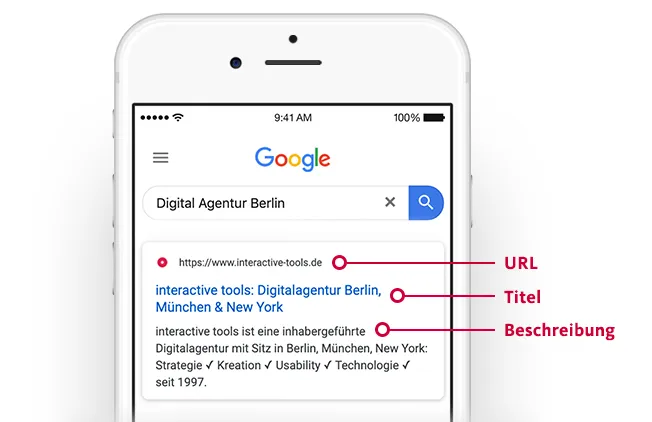
Assuming the results display is already well solved. How can the website's relevance for search engines now be increased? The days when keyword-stuffed pages achieved good Google rankings are long gone. Google has developed its algorithms and SERPs further based on user behaviour and the artificial intelligence RankBrain.
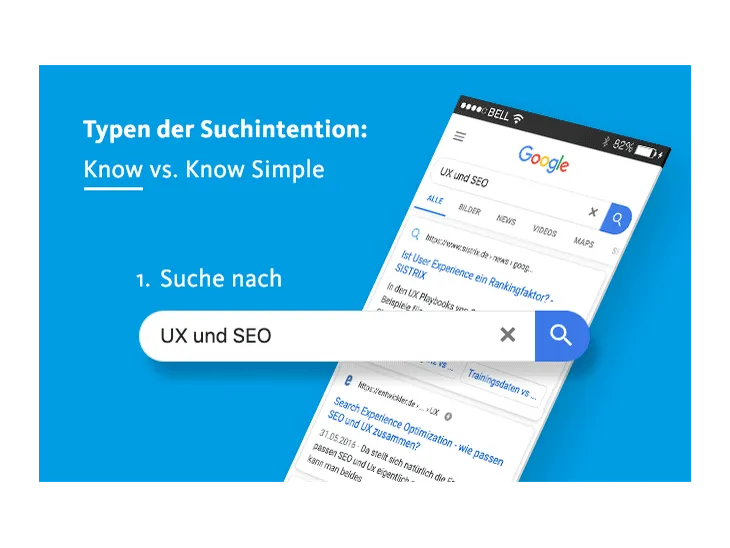
Only those who understand search intent can effectively optimise websites
Google's aim is to answer search queries as quickly and satisfactorily as possible. The key factor is the search intent behind the query and which content and formats best serve it: is it an explainer video, a short news item or a detailed article? Google then tailors the results to the identified search intent accordingly.
Google defines these 5 search intents
Visit in person
an address or place is being searched for | example: atm near meWebsite
a known website is being sought | example: ebay iphone xDo
an action is intended (purchase, download, installation, etc.) | example: buy tabletKnow Simple
Searches for information that can be answered in one or two sentences | Example: steinmeier birth yearKnow
searching for information on more complex topics | example: ux and seo
Note: mixed forms of these search intent categories also exist, which cannot be clearly assigned.
Good UX design leads to better Google rankings
SEO aims to drive qualified traffic to a website. But what happens when searchers leave that website immediately and go back to the search results? For Google, that's a sign the website doesn't properly satisfy the search query. The search engine registers this user behaviour as so-called pogosticking and concludes that the website's content doesn't provide a good answer to the query. As a result, the website slips down the SERPs behind other pages that don't trigger pogosticking. Google gives no clear statement on whether it uses this behaviour as a ranking factor, but various tests by major SEO agencies provide clear indications that it does.
If I know what people are searching for, I can optimise the page accordingly.
Why wasn't the visitor satisfied with the result on the website? Finding that out shouldn't be the sole task of SEO experts anymore. SEO success is increasingly tied to fulfilling search intent, and ranking is influenced by user experience.
Effective SEO must therefore go hand in hand with a good user experience going forward. Only those who understand what users want to achieve with their search query can deliver a satisfying answer and thus improve their ranking.
This is how search engine optimisation works today
The latest Google updates place new demands on website operators. Fundamental criteria such as mobile-friendliness, speed, accessibility and clear information architecture naturally continue to apply and remain important ranking criteria. But alongside these, there are new relevant factors for succeeding with search engines and users in future.
Checklist: New key questions for SEO
What search intent lies behind the keywords that traffic should be generated from?
Which content fulfils these search intents?
Which content formats are suitable for answering the search intent?
How convincing does your own site appear in search results?
How well does your own website fulfil search intent?
What do the top results do differently?
What UX problems exist on the website?
How can the website be adapted considering UX and SEO aspects?
More visibility and traffic through better rankings
When search engine optimisation and UX work together effectively, everyone wins.
SEO ensures that searchers find the website. Good user experience ensures that searchers are well guided and their intent is optimally answered. This in turn benefits SEO.
Many website operators still face a major challenge here. To secure online visibility in future, they need an effective strategy that successfully combines UX and SEO.
Your contact person
- Marcus Völkel
Consultingsynaigy
Show phone numberShow email address