



insights! #123: How Dietmar Dahmen thinks about AI, Swissness and the future of Europe
In this compact episode you'll learn why „solid growth“ feels like standing still in today's environment and how you can actively set the pace again. The episode shows how to build up capital, infrastructure and data in a targeted way, establish AI as a scalable ecosystem and learn within clearly defined experimental fields. The result: concrete steps toward more speed, robust learning loops and a structured transformation into sustainable competitiveness.
 Joubin RahimiManaging Partner · synaigy
5 min. read
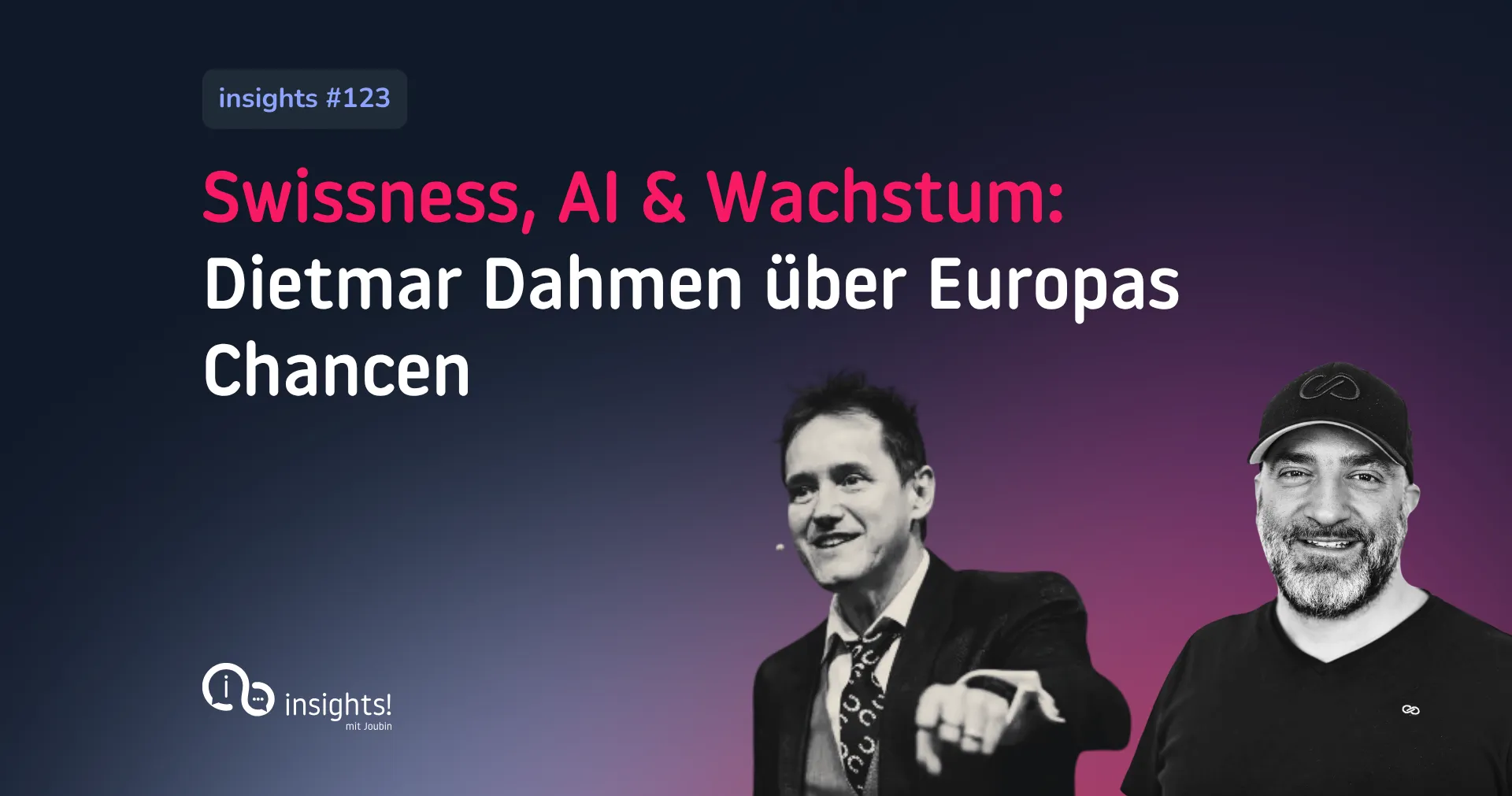
You simply have to run, because the world is getting faster. The pace no longer comes from you, it comes from outside. When Asia is marching along with 100 percent growth and you're celebrating two percent, you're falling behind by comparison. The question is: do you want to run along or just watch? Being a spectator is not an option.
The new speed of the market
The world out there isn't waiting for you. Markets turn faster, competitors grow rapidly, and while you're still celebrating solid gains, they suddenly look like standing still by comparison. Growth today is no longer an end in itself, it's a question of survival. That means the speed is no longer set by you, but by your environment. And when others set the pace, you have to decide whether you play along or stay on the bench. Germany has everything it needs – knowledge, talent, innovative strength. What's missing is the unconditional will to convert those resources into speed.
Strengthen the roots, stretch the crown
Picture your company as a tree. When the neighboring trees grow faster, they take away your light. Sawing them down is no solution – you have to reach higher yourself. For that you need nutrients: capital, energy, infrastructure. The fundamentals are there, but the supply often stalls. Slow networks, complicated processes, missing venture capital – all of that works like concrete around your feet. Even so: waiting gets you nowhere. Start with yourself. Make sure your organization uses energy better, that your data flows more efficiently and that you consistently modernize your own infrastructure.
Capital is more than seed money
Many startups get that first boost without trouble. But when things get serious and it's time to scale, they leave the playing field, because the confidence for large investments is missing here. The money would be there, but it often flows into the wrong channels. To really attract capital you need convincing business models, clear stories and a robust plan. Investors don't jump on an idea, they invest in markets that have shown they can become big. So your job is to make yourself investable – not just likeable.
Courage instead of excuses
There are industries that like to tell themselves it's all too late. But anyone who really wants to can close the gap. It's not about dominating the entire market right away. Often it's enough to occupy a clearly defined niche with full force and be the undisputed specialist there. You should ask yourself: do you want to have a say or do you want to shape things? Nobody remembers the ones who only comment. Success goes to those who grab their own category and become impossible to overlook in it.
AI grows like a garden
Artificial intelligence is not a tool you install once. It's an ecosystem that has to be cultivated. Your employees are probably already using AI – sometimes secretly, because clear rules are missing. That's where your opportunity lies: create an environment in which AI is allowed to grow.
That means: opening up data spaces, breaking down silos and establishing feedback loops. As a leader you don't need to be able to write prompts, you need to make sure AI takes root in your company. It's not the best programmer who wins, but the best gardener.
Regulation as a guardrail
Rules matter, but they must not slow you down. Imagine cars being regulated so that nobody could drive faster than walking pace. Sounds safe – but it's standstill. You need a clear framework that creates safety while still leaving room to move. Plan with parallel experimental fields: safe sandboxes where you can test while the core business stays stable. That way you learn fast without losing control.
Problems are not stop signs
„That won't work“ is a sentence that gets you nowhere. Far more productive is the question: „What exactly does the hurdle look like?“ As soon as it's named, you can develop solutions. Other ecosystems show how it's done: pin down the problem, test a solution, keep going. A small routine can help you: • State the problem in one sentence • Think of three possible solutions • Commit to a test within three days • Learn publicly from the result That's how a blockade turns into movement – and movement is the beginning of progress.
Transformation means rebuilding, not polishing
When your market changes, it's not enough to fiddle with the tires. Imagine wanting to take your car out onto the sea – a new wheel won't help. You need a boat. Transformation means rethinking processes, roles and structures. Where are the „seas“ in your business that can't be crossed with the old vehicles? That's where you have to build differently. Start small, learn fast and then bring the solutions that work into your main operation. That's the only way to stay relevant. The opportunities are lying in the street. You just have to pick them up. Growth doesn't come from waiting, it comes from consistent action. Whoever dares to pick up speed, modernize their own systems and understand AI as a real ecosystem will be out in front. In the end, the question isn't whether you want to take part. It's whether you can afford not to.
Would you like to listen to the full episode?
You can find the podcast of the interview here:
Please accept the corresponding cookies to view this embedded content.
Would you rather watch the episode? No problem!
You can find a recording of the interview here:
Please accept functional cookies to watch this video.
Would you rather read?
Joubin Rahimi
Great to have you back for a new episode of insights! My name is Joubin Rahmi and today Dietmar Dahmen is with us. Hello Dietmar.
Dietmar Dahmen
Hi, Joubin. I'm glad to be here. Sensational.
Joubin Rahimi
Yes, so are we. You actually live in Vienna and now you're here in beautiful Dortmund. Thank you for taking the time to come here. I associate something fairly long-standing with Dietmar. Dietmar just doesn't know it yet. Seven or eight years ago I saw your first talk and I thought the slides were amazing. Not just the slides, but the story behind them too. There was this phase where you said: Oh, I only have half an hour, but I still have 150 slides. I'll speed up a bit. It doesn't matter whether you can keep up or not, but the world is turning fast. Bang. How fast is the world turning, Dietmar?
Dietmar Dahmen
Yes, I think what's great about your example is that when the world turns faster and you have those 150 slides – so in your case maybe you want to serve 150 customers, want to keep 150 jobs – then you can't say: Sorry, I'm not doing that. You simply have to run. You simply have to get faster too. That means the pace is set in a world outside of you. You no longer set the pace. And we have to ask ourselves: who is setting the pace right now? And quite clearly, in my opinion, Asia is setting a pace that is really, really picking up. And when someone else sets the pace and Asia explodes and you're still growing, but only like this, then at some point you're not growing anymore, you're falling behind – compared to Asia. Compared to yourself you may be growing and saying: Hey, we have two percent growth, yay, but if the others have 100 percent growth, just to name a number, then in reality you're falling behind. And you have to consider: do you want to run along or don't you? We're in this thing not to be the spectators. Germany is not a spectator. Germany is a doer. And that means we have to increase the pace, and to do that we probably need resources and thinking and political support, economic support and so on and so forth.
Joubin Rahimi
I'd like to pick up on that growth point again. It's such a nice image. If we're all trees and some trees grow up very quickly and we as a small tree grow up slowly, at some point we stop getting sun. Yes, exactly. Or then we stop growing altogether and die off. Or does the image not fit?
Dietmar Dahmen
Yes, the image fits sensationally well, somehow. It's a really great image and that's exactly how it is. And we simply have to look around us, the other trees are growing. And the other trees aren't you. You can't do anything about it and you can't saw them down either, or at least we don't want to. And that's why there's one thing you have to do: grow yourself. And to grow yourself you basically need a few things. On the one hand you need what I'd call fertilizer or soil or nutrients. For us that's energy, for us that's money. On the other hand you have to be a great tree yourself, and for us that's all the scientists, the university graduates and so on and so forth. And when I look at Germany, I actually come to the conclusion that we have the graduates, we actually have the knowledge, we actually have the expertise, but everything around it is missing. What's missing is capital and what's missing is infrastructure.
Joubin Rahimi
And who could provide the framework? Can I as a company say: Okay, I have to wait for it? That's always a shitty idea to do. Yes, yes, yes.
Dietmar Dahmen
Waiting is always a bad idea, especially when the others are accelerating. There are basically two things that matter: On the one hand, politics will probably have to do something. We actually need an infrastructure policy, and a single company can't do that. And with politics it's a matter of them thinking through – and that's exactly the point you made with the tree – how fast can we realistically, but still purposefully and with power, and if we bring in excavators and so on, make the infrastructure good enough that our tree can grow along reasonably fast. That probably won't happen overnight, but if it's in ten years, it's too late, then we're dead. That's simply how it is. Which means we basically have to start doing it now. That's the first thing we need. But what I also see, and this is what companies can do and what basically everyone else can do too, is deploying capital. When I look at North Rhine-Westphalia, for example, I see that there are loads of great startups with great ideas. And in my view only the seed financing ever works, the first 100,000 or whatever. But at some point you need 100 million.
Joubin Rahimi
Series A, B, C.
Dietmar Dahmen
Yes, and so on. And then people bail out and then the startups go, I don't know, to Switzerland or maybe to the USA or somewhere else, because that's where the money is. If you look at the sums being invested, at NVIDIA now basically saying to OpenAI: You know what? Let's do a partnership and put a few billion on the table. Then OpenAI says: I need, what's it called, iPhone, Apple, I'm buying that company for a quadrillion. Those are sums that are unbelievable. Where do those sums come from? On the one hand certainly from investors within America, but – and this is very important – also from investors outside America. There are certainly Germans who hold Nvidia shares and so on and so forth. And the question is simply: can't we manage to make this such an attractive location that external capital gets invested in Germany again?
Joubin Rahimi
Because per se the money is there. Yes, exactly. So it's not that there's no money. The money is there.
Dietmar Dahmen
Exactly, the money is there and it basically just has to come back. And people have to have the confidence that the money I invest will yield some kind of profit in so many years. And that confidence probably has to be created by the government, but also by companies. Every company has to ask itself – and to break this down to company level – am I in this race just to take part? You took part on the sidelines too, and you get one of those nice thingies. Or do you want to stand on the podium? And if you think about NRW again: I look around, I drive through the Ruhr area and you have all these, I'll call them emotional images of old mining shafts and old steelworks and so on and so forth. And those weren't just any old mining outfits or whatever. Those were top three in the world, I assume.
Joubin Rahimi
We're in a building like that too.
Dietmar Dahmen
Yes, this is the absolute top building. And I thought to myself, back then you didn't buy a steelworks for 100,000 deutschmarks either. Huge investments flowed into that too. Capital flowed in from companies. There was political will. There were all these things that made it possible. And today you have to do that too. Do you want to be up front? Do you want to be there at the front or not?
Joubin Rahimi
And now, which topics are really taking off? It's AI, it's robotics, it's quantum. Digitalization isn't a topic that's taking off, that's something people simply have to do. There's an interesting study here. In Germany companies spend only 1.4% of their revenue on digitalization. Austria, for example, is at four. And that's certainly too little in that context.
Dietmar Dahmen
Yes, absolutely. You can't think you'll become world champion with 1.4%. And that means, it sounds to me a bit like just swimming along. I have to swim along somehow, take home the honorary participation, so to speak. And that's not the thing. And the probability – if I ask anyone now: will there be more AI in five or ten years? Right? They'll say: Yes. Will there be more quantum stuff? Quantum computing? Yes. Will we need more energy for those things? Yes. Will we need more servers? Yes. Which means basically everyone knows the market is moving forward and you have to make a transformation, and the transformation is oriented as a goal toward the future and not toward the past. You have to cut off the past.
Joubin Rahimi
And we see that too. I mean, classic automotive is having a really hard time. Electric automotive, seen globally, is taking off like crazy. I'd say: China has launched 100, 120 new brands. We're nowhere in that.
Dietmar Dahmen
Yes, but what I find there, at least now after the IAA and so on and so forth, is that there's a challenge mindset. There's no longer that thing of: too bad, now we've missed out on that as well. Which is really an attitude. We very often have this attitude: we've already missed that one anyway. What can you still do about it? The race is over. The race was never over at all. AI started three years ago. Well, of course earlier, but I mean generative AI, LLMs and all these blow-out stories. The race is just starting and you can't say: Sorry, we've already missed it. You simply have to hit the gas now, and the gap keeps growing. If you don't start running now, that's bad. And I think in the car industry there really is a challenge mindset, that at least the German carmakers have said: Now let's see. Of course the Chinese are far ahead at the moment and of course Porsche has even been delisted and so on and so forth. So tragic things for the German car industry. But on the other hand they've recognized it and they're starting to act. And they're starting to act with that thing, a challenge mindset, let's see about that. Now we're really pushing. And not what I said before, a fear mindset. Already missed it, sorry, now there's nothing we can do.
Joubin Rahimi
Briefly on Porsche. We said we're going electric, and now they're rowing back? Yes. What's your assessment of that? You were at the IAA, or rather you took a look at it.
Dietmar Dahmen
Yes, exactly. In my opinion a niche market strategy. They certainly didn't do it out of stupidity. And there's probably a tendency where somebody basically said: Well, in the niche we're still number one and we're really a niche product anyway, so let's go a bit further into the niche. Niche strategies have an enormous number of advantages. The advantage is that you can be what's always called the category king, the king of your niche. And Porsche will certainly be king of that niche along with Ferrari and so on and so forth, but of course less so measured against the total market. Which means you're basically deciding: I'm no longer playing in the total market, I'm going into the niche and being category king there.
Joubin Rahimi
Which is probably completely valid.
Dietmar Dahmen
Yes, exactly. They'll have thought about that too.
Joubin Rahimi
And for companies in general who then say: Okay, what do I do with AI, with robotics? How do I bring people along?
Dietmar Dahmen
A really important point I find here is, if you think about how AI generally works. We all know that in general you don't program it – you don't program AI, in English people say „you grow it“. So you grow it. You simply take data and the AI then trains itself, so to speak. Which means it's not necessarily programming expertise that you need. And if you break that down to companies, I'd say the CEO doesn't necessarily need to understand AI. The best one isn't the one who understands AI best. The best one, in my opinion, is the one who builds an environment in which AI can grow best in the company, where you simply allow people to use AI, where you promote it and where you don't build little silos but really bring it into the company so that it grows. In Austria it's like this: 75% of employees in Austria use AI at work, many of them secretly. So that means the employer switches it off and then you just reach for your phone and do something. Almost the same. Exactly. But that means you can't escape it. It's simply being done and you now simply have to create an environment in which you steer it and in which you use all those forces. And those forces certainly come when AI is integrated everywhere and when there aren't just smaller silos.
Joubin Rahimi
The EU immediately found a regulation for it too, the AI Act. What's your assessment of that law?
Dietmar Dahmen
Well, what I find good about laws is when laws provide guidelines, so directions and guardrails and so on and so forth. And we all know that AI can have disadvantages, like everything, and AI can have advantages, like everything. That's simply always the case with everything. And I think the important thing is that you simply have to make sure the advantages don't get slowed down too much. So you basically have to know that there are some things you then also have to make illegal and so forth, but you can't stop the whole thing now. Just like with cars, since we were talking about cars earlier, of course there's an accident now and then. You can't say, because there's an accident every now and then, that there are no more cars. But of course you have to make sure the accident becomes illegal or that there are legal rules for it. So as a steering system I think it's good. The only thing you have to be aware of is that it must not slow us down too much. And I believe that precisely in the current times, with the current situations and the current pressure that we feel all over the world on so many topics, there's an insight: „We can't slow ourselves down any longer. We simply have to go full throttle now.
Joubin Rahimi
I can even tell you about this from my own company right now. We had a customer situation. The customer wanted to go with us. We were always over his budget. But he had another provider who fit his budget, and was significantly below it too. But we can't go down. The other one buys that, we don't, we don't buy that. And at some point he said: I want to go with you, I don't want to go with the other one. That's going to be crap. Then I said: Well, then raise the budget. And we kept writing back and forth, exchanging WhatsApp messages. Then I was: Okay, I have an idea. The idea is, we use everything AI has to offer. You'll be our first prototype for building an AI factory, but you don't put any sticks in the spokes about data protection. You're not allowed to do that, you're not allowed to do that, you're not allowed to do that, you're not allowed to do that. We do everything fully blown that's generally possible. Of course we agree on it, but we give it everything and we run a hackathon beforehand. Ran the hackathon, we had significant savings there and even the critics on our side, because software development is changing, said it's amazing, and with that we've now started. Now comes the irony. In the middle of it we said: Okay, change requests for example. Whether something is a change request or not – the system can recognize that really well. And you don't have to train AI systems extensively for that. It already exists from others, for example. And I'm like: No, you're not allowed to use that. Within our group, that is. Why not? We have other customers and then you're not allowed to use it. We wanted to be innovative, and internally in the company itself, because of course we have a data protection officer, an information security officer and so on, we said: Okay, let's build a parallel world. And that was really the trick: Okay, we first have to build in parallel so that you're fast and then you can merge back in. But that was our experience.
Dietmar Dahmen
But it's still the case, we all know the wonderful example of the chain and the weakest link. If you always have to orient yourself to the weakest link, you'll never have to make a proper chain. What you did then was: You know what? We'll simply make a different chain and then we'll slot it in somewhere. Yes, we make a different chain and push it out front? Exactly, exactly.
Joubin Rahimi
And at some point we can replace things. But do you see things like that at other companies too, or other techniques for dealing with it, because you always have that.
Dietmar Dahmen
So what's the good … Let me say what the good thing is. Or let me start again from the beginning. At an awful lot of other companies I see that there's a blocker. People immediately think of what they don't want, why it won't work. That it won't work. Exactly.
Joubin Rahimi
That's easy, too. Exactly.
Dietmar Dahmen
That's easy too. You just have to say: Open the menu, I don't like schnitzel.
Joubin Rahimi
There's a law, it sounds like …
Dietmar Dahmen
Anyone can say that, it's simple … So not liking something, not thinking it's good, not wanting to do it – that works wonderfully easily. You don't need any expertise for that. The expertise you need is: okay, you don't like it, it won't work. So what can we do then? And I find, I work quite a lot globally. And if you look at the general American approach, for example, it's always … Let's see about that. And then something else occurs to me. There really is this lived thing: the problem is not a stopper, the problem is a hurdle and I'll get over it somehow. And in Germany, culturally, there are very, very many people who automatically say: problem equals stopper. So if you say hydrogen, for example, a hydrogen vehicle, then it goes: won't work because. Instead of: we need this, we need that, there's a problem. Because whenever you know a problem and can specify the problem and say, there's the problem, you can basically figure out how to solve the problem somehow. Better than if it isn't solvable anywhere. And what I find sensational about what you did, and every company should really learn from it, is: Okay, I respect the problem, but don't give up. Don't say well then not, but you know what? We'll build a parallel set-up. Tick, tick, tick, let's see, then we click it back in. Sensational, brilliantly done.
Joubin Rahimi
But the … Thanks, that's not what I was getting at, rather …
Dietmar Dahmen
No, but that's the thing. It means we all have these problems where we basically say: Won't work because … and then at an awful lot of companies it's Won't work because …, „Bam, bang, stop.
Joubin Rahimi
Over
Dietmar Dahmen
Over. That's a killer argument. That's not a killer argument, that's a growth argument. That's a thing for growing and growing differently than you have so far. There's a plant standing here. We talked about trees earlier. No tree says, as it goes upward, it would actually be much better over there, damn, that I'm here – instead it goes „Mmm“ and basically grows like this. There's the sun. Yes, exactly. And leans toward the sun. That's basically what you have to do too.
Joubin Rahimi
This mentality – you said it's a German mentality. Where in Europe do you see other countries that have more of an active, forward-leaning mentality?
Dietmar Dahmen
Ah yes, Switzerland. Right? Full throttle Switzerland. Switzerland is always an innovation champion somehow and so on and so forth. In Switzerland there's clearly this thing – if we're talking about AI, for example, we all know Switzerland has now done Apertus with ETH. And Apertus is of course a highly scientific thing, it comes from the university. But even so, the approach wasn't: Now I'll build an AI like the others too – instead I'll make it open. It's the first open system. I have the processes open, everyone can program along with it, a kind of Linus world, only for AI.
Joubin Rahimi
Can you say a bit about Apertus?
Dietmar Dahmen
Apertus is an AI from ETH Zurich that runs on, I think they're called Alpine servers, on its own servers in Switzerland, which are extremely secure and which can also deliver, let's say, enough power, so enough computing capacity and so on and so forth. And ETH's core idea was not: How do I copy OpenAI or DeepSeek or any of the others? – but how do I make something that is highly relevant in the future and that is a real innovation? And this highly relevant, real innovation was to build open systems for the first time in AI. Which means ETH worked on this thing for a very long time. Very long meaning, I don't know, two years, so not 50 years anymore, and has now basically released it recently. If you use Apertus now – everyone can use it, everyone can look inside, everyone can program it – you notice that at the moment it's certainly still what I'd call an academic product. So it doesn't look like a marketing product now. It's not as slick as ChatGPT for example, but you can tell it's for the first time a thing that actually revolutionizes operating with AI in a completely new way. And it was made public, if I remember correctly, maybe, let's say, a month ago. Which means we're very young and now everyone can program along, everyone can shape it, similar to Linux back then. So it's a completely new system where new possibilities emerge, so that Switzerland once again claims leadership in a certain area for Europe. And that, I think, is a sensational thing. Similar things in Switzerland. We talked about IBM earlier, lots of Nobel Prizes. We talked about quantum computing, lots of innovation. We talked about robotics. Switzerland is right up front there too. And the thing I actually see there is an extremely good mix of what I'd call an attitude that the Swiss call Swissness.
Joubin Rahimi
Okay, Swissness? What does „Swissness" mean?
Dietmar Dahmen
What used to be called German craftsmanship, probably. So Swissness basically means perfection. And I work a lot with Swiss companies and they say: Yes, that's fine, but we need a bit more Swissness too. And that Swissness is then a notch better, a notch safer. That's why Apertus runs on the server in Switzerland, for example, and so on and so forth. Which means we're now building a high-quality, innovative product. And that's completely different from a fast mass market, just joining in. The problem I see there again at the end of the day is, in my opinion, once again a financial problem, in this case maybe even a marketing problem. Marketing for ChatGPT is gigantic, which is why everyone uses ChatGPT. In Germany too we have an incredible number of highly innovative AI solutions that simply don't have the budget to make themselves known.
Joubin Rahimi
And they weren't the first either – with ChatGPT it was the first one to come out like that.
Dietmar Dahmen
Yes, exactly.
Joubin Rahimi
That's easier then.
Dietmar Dahmen
But still, if you think about it, there's also, Perplexity for example, Claude and so on. Perplexity has now released Comet, the AI agent that basically everyone can use. And what's great about it, I think, is that in this race you're again claiming a certain point. I wasn't the first with general AI, but I'm now the first with an agent and so on and so forth.
Joubin Rahimi
The race goes on, as you said at the beginning.
Dietmar Dahmen
It keeps going and you simply have to be innovative and you basically have to consider, I think: How do I define this category now? For Perplexity and Comet that's agentic AI. And how do I become category king there? And if you're not category king, then you have to be, let's say, top three. Because nobody in that race remembers who came fourth.
Joubin Rahimi
I have two lines of questioning in my head. You can decide which one you'd like. One is, we still have robotics and quantum. How does that change things, or what could come of it? So how does the environment change as a result? Yes. And the second is: companies – and I'll take an image from you – that used to be a racehorse, on the racetrack running a derby. How do they have to change? Because now it's not a racetrack at all anymore, it's an ocean. Yes, exactly. So the two … which do you prefer?
Dietmar Dahmen
Yes, let's start with that one and afterwards we'll do the other. Yes, exactly.
Joubin Rahimi
So how do companies have to change now? Because so much is changing. Do you have an idea of what a good direction is for all the companies that are now …
Dietmar Dahmen
Well, the important thing is, every company makes its profit in the market, not within itself.
Joubin Rahimi
For someone, right?
Dietmar Dahmen
They don't pay themselves, someone else pays them. And that someone else is outside of you.
Joubin Rahimi
I find that really interesting. It's sometimes forgotten at the larger companies.
Dietmar Dahmen
Yes, yes, exactly. An awful lot of companies say: No, we operate for ourselves and we do something in our own system. And that's also what we said earlier: then the companies celebrate: We have two percent growth anyway, and don't notice that the others are already in exponential growth. So you always have to look at what's happening outside of you. And the market has certain requirements. And now you're a company and they can, for example … Let me invent a company that has built a car and the car drives sensationally on land. And now you suddenly arrive at the sea and you say: You know what? Now I'll drive my car in the sea. And it won't work. You can't drive a car in the sea. Then you say: Car, why? Don't you have wheels anymore? Sure, I have wheels, driver. Don't you have a steering wheel anymore? Sure, I have a steering wheel. And yet the thing won't work. You have to rebuild the vehicle and you have to transform yourself into a boat, so to speak, in order to travel the sea. And if you don't make that transformation, you go under. And even if out in the world, on solid ground, you had the fattest car, maybe even a Jeep or some huge thing where you say: I can drive in any environment – in the sea you can't anymore. Which means we're in a world today that has become much more liquid. It has completely different requirements and you have to look at: What does the world want? What does the world look like and how do I then serve it? And how do I have to rebuild myself in order to be number one there, to get out in front fast? And an awful lot of companies don't do that. Everyone sees it. Every entrepreneur you ask whether AI is becoming more important will say: Yes, it's becoming enormously more important. And there's a very simple tip. I live in Vienna, and in Vienna there are lots of psychoanalysts and analysis and advisors and so on and so forth. And there's a very simple tip: If you say, for example: I'd like to make a huge change in my life. Should I do it, yes or no? Then the analyst says: You know what? Someone was just here who had a similar problem. Blah blah blah. Describes the problem just slightly differently. What should this person do? Yes, they should definitely do it. You immediately have an answer for what someone else has to do. Which means as a company you have to ask yourself: What should another company do? Yes, VW absolutely has to go full throttle on robotics and full throttle on AI … And then you simply do it yourself.
Joubin Rahimi
That's true for you too. You decouple yourself from all those buts and won't-works, right?
Dietmar Dahmen
Yes, exactly. With your own company … Well, I don't do it myself, of course. But you can do it within your own company too. Then you can say: If you work in marketing, for example, you can say: What should production do? Yes, they absolutely have to apply more AI. And then you simply do it yourself. We have the answers within us. We're not stupid, we know how it works. We just have all these yes-buts inside us.
Joubin Rahimi
We just don't do it that way. Yes, exactly. Okay, great. Thanks for that area. Yes, exactly. And the second one was essentially: What is changing generally in the global-galactic market through quantum physics, quantum computing and robotics?
Dietmar Dahmen
If we look at digitalization, by now it's basically been the case – I'll put it this way – that digitalization has given us more brain power. We can answer theoretical questions better and so on and so forth. But we also had no muscle. That means even ChatGPT can't lift the vase. ChatGPT can tell you that it's a vase, can maybe tell you all sorts of other things, but can't move it. And before that, at some point, we basically had dumb muscles too. Those were robots that could basically do this, but no more. And now there's the entanglement, as I call it, of mind and muscle. And suddenly we have partly humanoid-looking robots and maybe other things. In any case we can give the idea and the task the necessary power to realize it in reality. We heard earlier that there are no more silo solutions – there actually never were silo solutions – but that every solution has to operate in its environment. And so far it's been the case that ChatGPT tells me something or OpenAI tells me something and I do it. And now there are two big splits. One split is: as long as it's still somehow digital, like buying a ticket or something, an agent can do that for me, or scrolling websites, which are current buzzwords, market analyses and so on and so forth. That means the agent does the digital for me and the robot does the real for me. And we're already seeing the change through robotics in some countries. So we know the market will grow. And there are sometimes very simple examples. I was recently in England at a health event, and the question was put very simply: When you're old later and you have – I think it's called incontinence, you wet the bed somehow: who should clean that up, a human or a robot? Which would you prefer? And a great many say a robot, because then it's – There's no social connection there. There's no social connection there, exactly. Yes, it's not so bad. And then someone would say: Okay, there's this robot now. Would you – and then they have yes or no. Maybe you'd then say, for the unpleasant things maybe yes. Of course you want the pleasant things, like eating, to still be with a human. That's logical, because then oxytocin flows and we have relationships. But some things machines can do. And we see in Asia, in Japan and so on and so forth, all these robots increasingly taking care of elderly people. We see lots of service robots in China working in restaurants and so on. And the huge difference in Asia is the following, in my opinion: There the innovation and the robot are celebrated. And here it's somehow seen as a threat and pushed to the margins and so on and so forth. We simply have the tendency to always see everything as a threat and not as an opportunity.
Joubin Rahimi
Would you get a household robot?
Dietmar Dahmen
A super simple question: Everyone who has a coffee machine, everyone who has a robot that mows the lawn, and everyone – it's simply exactly the same thing. It just keeps going somehow.
Joubin Rahimi
I'd jump on it straight away too if there were something like that, something that tidies up a kitchen, all that kind of thing.
Dietmar Dahmen
What's very funny there is – I know a very good friend of mine, René Vogel. In Switzerland he has lots of robots and goes on stage with those robots. I've been on stage with one of René's robots myself, a humanoid robot. It walks around, can wave, shakes your hand and so on and so forth. All sensational. René Vogel is fairly well known, and that means some companies buy themselves a robot and at some point they don't know what to do with it anymore and then give it to René. Which means the vision of what you do with it doesn't come across. I have a new tool and I don't know what to do with it. That's an incredibly alarming phenomenon. And I think it's exactly the same as if you were a farmer – I don't know when that was, 1920 or whenever it was or '30 – and along comes a tractor and someone gives you a tractor and you say: No, I'll stick with the horse.
Joubin Rahimi
I don't get it.
Dietmar Dahmen
I don't get it. So not even that minimal effort of thinking what you could do with it happens in people's heads. Terrible.
Joubin Rahimi
Okay, what can we do now, as an outlook?
Dietmar Dahmen
With the robot example you can learn a few things, I think. The first, put conservatively: Don't buy yourself a solution if you don't know what for. So you should basically know: I want to reach these goals. I'm here at the moment, I have to get there. How do I get from here to there? How can digitality help me? Similar to what you described with the change requests and the AI: How can I basically arrive at solutions that are smart? Don't just buy a solution and then see what you can do with it. On the other hand, children do exactly that and nothing else. You give a child a toy and they'll figure out 100 percent what you can do with it. And you can put a cardboard box in front of our son and he'll figure out what to do with it. Which means you simply arrive at: be more playful, be more innovative, don't always just do the predictable.
Joubin Rahimi
And I think that's a great appeal to everyone who has listened this far, to do exactly that and not let themselves be slowed down by regulations. Just as children don't either, they just build with the cardboard box and turn it into a house or a car and so on.
Dietmar Dahmen
Yes, absolutely.
Joubin Rahimi
So, if you have questions, just post them directly under our post or write to us. Thank you Dietmar for this global overview and perspective on it.
Dietmar Dahmen
My pleasure.
Joubin Rahimi
It's always refreshing. And we're already looking forward to you tuning in again for the next episode. Thanks.
Dietmar Dahmen
Okay, ciao, ciao, ciao.
Do you have questions or feedback?
Then feel free to contact us directly.
- Joubin Rahimi
Managing Partnersynaigy
Show phone numberShow mobile numberShow email address
Subscribe to the blog now and never miss any news
✔️free ✔️news every week ✔️expert knowledge
Please accept the corresponding cookies to view this embedded content.