



insights! #125: How China retains talent and what Germany can learn from it
The new insights! episode shows why you should no longer think of competition locally: China consistently copies best practices, brings top talent back and builds environments where they stay. Dubai scores with speed and lax rules but has little depth and retention. For Europe that means: talent needs purpose, freedom and strong working environments are essential. Democratic processes are slower but provide the basis for sustainable decisions, provided bold leadership drives through clear visions.
 Joubin RahimiManaging Partner · synaigy
5 min read
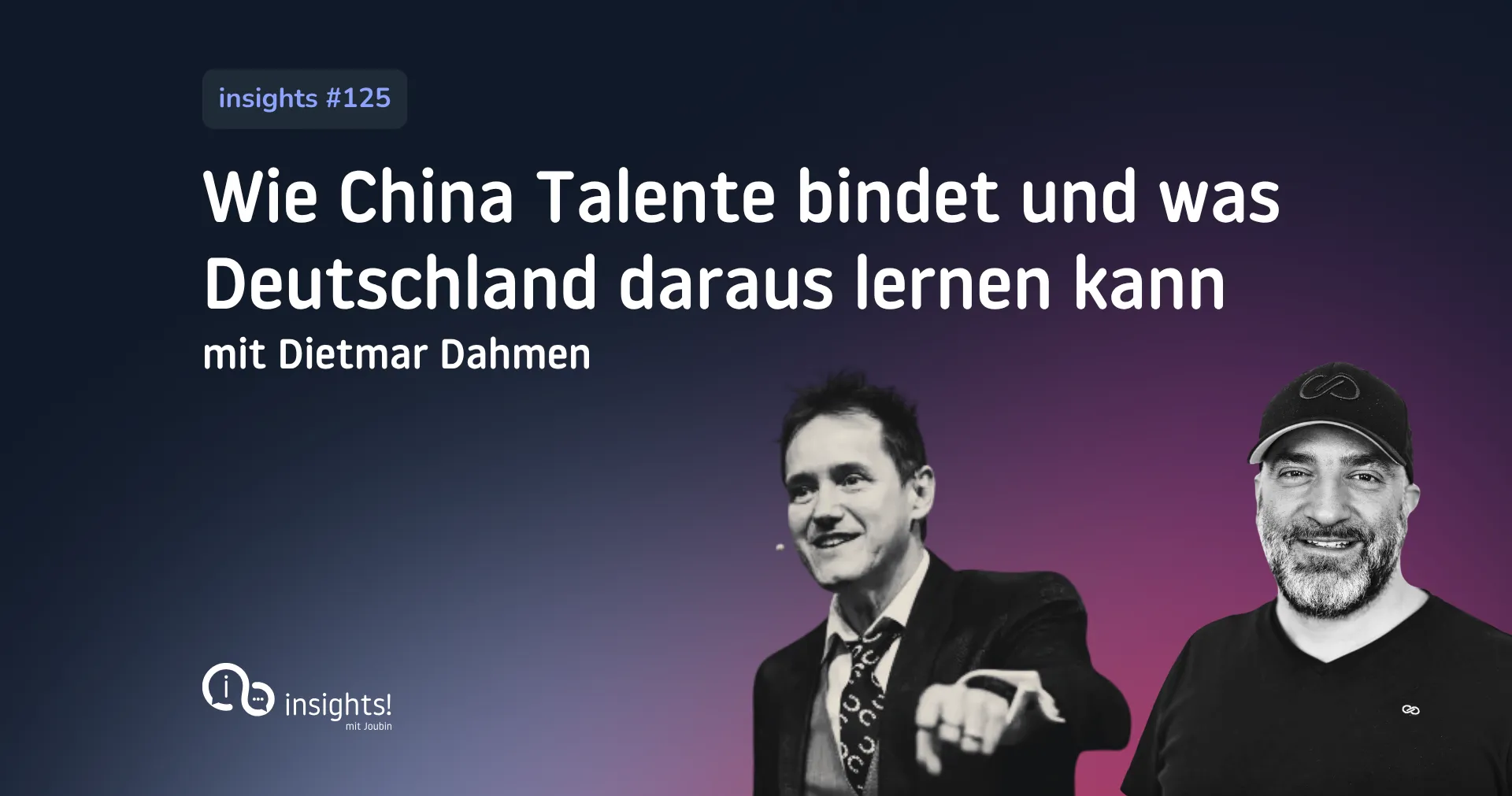
"When you bring people back, make them stay. Make them feel comfortable. And it's no magic to know what good people need. They need a great working environment, they need an opportunity to develop, and they need good leisure time. Chinese companies offer all these things sensationally – and that's exactly what we need to do here too. We can't say: yes, but we've got a fruit basket for that. That's not enough."
Global competitiveness in transition - what you need to know
The world of work is more global and connected than ever. Language barriers are dissolving, markets are merging, and talent operates worldwide. The question is no longer who our competitors are, but where they're based. They're often in China, the US or Dubai. China impressively shows what consistent innovation orientation looks like. There, things are observed, copied, improved. A Paris library is considered the best in the world? Then it gets rebuilt, books included. While Germany still struggles with skills shortages and "brain drain", China is deliberately bringing its talent back: graduates of renowned universities like Harvard or MIT are integrated into domestic innovation centres. That creates dynamism and know-how. Both are increasingly being lost here. If you bring the best talent back, make sure they stay. Talent needs more than good pay. They're looking for meaning, opportunities to grow and an inspiring environment.
Dubai: speed without depth
Dubai has developed into a global innovation hub. Flexible legislation, tax advantages and a strong drive for technical development attract entrepreneurs from all over the world. Yet for all the dynamism, one crucial element is missing: sustainability.
Many expats stay only a few years. Relationships are short-lived, structures often geared towards short-term projects. Deep roots in society, as found for example in China, are sought in vain.
Dubai's strengths:
Fast decision-making processes
High willingness to invest
Openness to new technologies
Weaknesses:
Lack of societal grounding
Short-term economic cycles
Low sustainability in structure
The example shows: innovation alone isn't enough. Real transformation only comes through long-term structures.
Democracy, leadership and speed
It is often said that authoritarian systems are more innovative because decisions are made faster there. But speed is not the same as quality. Democratic decision-making processes take time, but in return offer stability and enable sustainable development. Many traditional German companies – Porsche, Siemens or Benz – are the result of founding personalities with a clear vision. Today, this leadership strength is often replaced by consensus. But economic transformation needs bold decision-makers again, who are ready to take responsibility.
Pioneering spirit as key to the future
Innovation has always been the result of courage and willingness to take risks. In the past, it was pioneers who dared to try new things. Today, safety thinking dominates. But safety isn't progress.
China is investing in gigantic innovation zones — half the size of Cologne, but twice as ambitious. This mindset should be a model for European businesses too.
To once again be among the world's innovation drivers, we need:
Supporting start-ups with a sustainable perspective
Courage for large, visionary projects
State and economic support for long-term investments
Growth only arises when risk is once again understood as opportunity.
Panic as a driver – not as a fear reaction
Dietmar Dahmen uses a powerful image: "The bull is standing in the room – and you decide whether to look away or act."
The global economy resembles an arena. China, the USA and other countries are moving at high speed in areas such as artificial intelligence, robotics and digitalisation.
Europe is often too passive in the face of this change. Yet panic – properly understood – is not a sign of weakness but a source of energy.
Instead of remaining in fear, it's about turning that energy into action:
Detect and actively address threats
Understanding challenges as motivation
Accepting change as the normal state
Panic shows that something is at stake. And that's exactly what can become the decisive driver.
Courage to decide – secure the future instead of just managing it
The founders of the major German companies weren't administrators, they were visionaries. They acted decisively, with a willingness to take risks and a clear stance. This mindset needs to become part of German business culture again. Because whoever hesitates, loses. Whoever doesn't lead, follows. Whoever isn't bold, stands still. The future isn't created by waiting, but by acting. Courage isn't a skill - courage is a decision. Germany has everything it needs for a strong future: knowledge, infrastructure and creative minds. But knowledge alone isn't enough. It takes the will to deploy these resources boldly. China is investing, Dubai is accelerating, the US is experimenting. If we want to secure our competitiveness, we need to act now - decisively, with innovation, and with the willingness to take responsibility. The future doesn't wait. It's created where people have the courage to shape it.
Would you like to listen to the full episode?
Find the podcast of the interview here:
Please accept the corresponding cookies to view this embedded content.
Prefer to watch the episode? No problem!
You'll find a recording of the interview here:
Please accept functional cookies to watch this video.
Prefer to read?
Joubin Rahimi
Great to have you back for a new episode of insights! My name is Joubin, Joubin Rahimi. Hi Dietmar, great you're back.
Dietmar Dahmen
Hi Joubin, I'm absolutely thrilled.
Joubin Rahimi
And we have a mega exciting topic, because we both travel a lot, Asia, Dubai and much, much more. But the core question is: who are we competing with as employees these days? And if you look into it, it's becoming ever more global. The AirPods actually show this, the new AirPods, or rather the new Live Translation function. That will come into other things too. And that means language is no longer a barrier at all. And that's why looking towards China is so incredibly important. And just briefly as an aside: we had a futurologist visit us, and he'd visited large Chinese corporations. And one of these corporations has an area that's half the size of Cologne – imagine that – half the size of Cologne, and simply rebuilds famous buildings from famous cities worldwide there. So whether it's the library from France, or others, not just rebuilding the library, but also copying the books and putting them in there, so employees can say: today I'm in Florence, now I'm here, now I'm there, and have a completely different atmosphere. I find it quite amusing that they have lots of European things, like a wellness area. And of course they're trying to attract the best employees.
Dietmar Dahmen
Yes, but what I find really exciting there is what you just said: the Chinese take something, look around the world, where's the best case? The best library in the world, for example, as you just said, is the one in Paris. That's where the best books and things are. And then they say: we want that too. And every company should really look at where the best case in the world is. In China, perhaps the best electric car is being built right now, just to make a point. Now I hope I'm not treading on German toes here.
Joubin Rahimi
Or solar panels, that now.
Dietmar Dahmen
Yes, or however you want to put it. Exactly. And then you have to say: I'm doing that too now. Meaning they don't say, these are the best in the world, but we do it differently, or they're not the best in the world anyway because we actually have the best with blah blah blah, excuses, excuses, excuses — instead they say: this is the best, I'll copy it. We talked about talent. The talents basically go … Chinese training programmes are incredibly often abroad. Meaning they send the talent to the best universities.
Joubin Rahimi
Harvard, MIT.
Dietmar Dahmen
Harvard, MIT.
Joubin Rahimi
Somehow not German universities.
Dietmar Dahmen
Yes, but that would definitely need to change. But in the past certainly Aachen too, certainly Bochum too, and so on. So there's certainly something great there somehow. LMU is also a sensational university and so on. And the catch that then comes is: they go back again. What happens with us is: people study here perhaps and then go work elsewhere and make the profit there.
Joubin Rahimi
Or whoever goes to MIT doesn't come back.
Dietmar Dahmen
Yes, or doesn't come back. Or people say, well, they have no idea, studied in Munich and then go to Silicon Valley. And that's bad. So we have this brain drain and we need to bring this brain drain back, that's very clear. And at the moment we at least have a political climate that makes it somewhat easier, at least from the US, to bring the brain drain back. And we need to do that.
Joubin Rahimi
You have to see the positive side first.
Dietmar Dahmen
And what matter then, and why I find it so brilliant that you say a leisure park get built there: if you bring people back, make them stay. Make them feel good. And no magic knowing what good people need. They need a solid work environment, need a chance to develop themselves, and need good leisure time. Chinese companies deliver all these things brilliantly, Californian or American companies deliver well too, and we must offer them too. Can't say: well, we've got a fruit basket for that. Not enough. Must really push on it.
Joubin Rahimi
Don't mess up our fruit basket here.
Dietmar Dahmen
No, no. Sorry, sorry, sorry.
Joubin Rahimi
A fruit basket - we also have free drinks, but nobody's interested in that anyway.
Dietmar Dahmen
Exactly, but it shouldn't be the end of the road.
Joubin Rahimi
Yes, that's standard. People go to the US, they also go to China. You rarely hear of them going back quickly. Towards Dubai?
Dietmar Dahmen
Yes, different now.
Joubin Rahimi
It's different now, isn't it? Yes, absolutely. What's your perception of that?
Dietmar Dahmen
In Dubai it's actually the case that there are, logically, very many expats. The city is full of foreigners, that is, not Dubai natives. And the general length of stay there tends to be rather short. That is, we're talking about people who stay some three, four, five years, not necessarily 20. And the problem that results from this is quite clear: you can't build long-term relationships. I can't build long-term, deep business relationships, because my business partner and the people I work with, the whole support team, will at some point be gone again. When that happens, when I essentially have short-term cycles, through acquaintances and so on, it also becomes incredibly difficult to take on long-term projects, such as building a plant, or going deep into society, as you said about China, suddenly building things up that make genuinely gigantic changes in the real world globally. That's why Dubai actually keeps itself busy, existing in a world where a lot of innovation and so on happens, but no sustainable, deep transformation, as we see in China and as we really ought to see in the USA and in Europe too.
Joubin Rahimi
The question is: what do you actually produce? You have oil, which will eventually run out, that's why you have all the turbine stuff. Electricity you produce en masse.
Dietmar Dahmen
Yes, but they haven't essentially achieved a sustainable, deep transformation of society. So actually you still have oil people making money from oil. Then there are ideas like tourism and so on, but it's not a sustainable transformation. Anyone who wants to sustainably build a deep, gigantic business that needs factories and so on shouldn't go to Dubai. And business relationships there are, in my opinion, simply too superficial.
Joubin Rahimi
Really fascinating thought. I also find it fascinating that we talk about Dubai rather than the United Arab Emirates. And with China we talk about China. Yes, exactly. That really only this city counts right now. Even though Abu Dhabi exists, but really it's only the city.
Dietmar Dahmen
Yes, Qatar. But those are silo solutions. It isn't a mindset. Of course there's some kind of digital community and a highly innovative community and so on, but I don't see that sustainable change there.
Joubin Rahimi
What I've picked up from other entrepreneur colleagues is that some are moving to Dubai or setting up a second base there and building AI companies for corporates, because legislation there is just very, very lax and you can do much more than in China, if you want. Yes, sure.
Dietmar Dahmen
But what that means, and this is what I perhaps mean by the deep rootedness: you could send this company to Singapore the day after tomorrow. Yes, that's also the goal. Then they simply move around. That means there isn't deep rootedness like in China. In China, for example, the location, this factory that's built there, will stay there for a while. And people settle there and rootedness is created there.
Joubin Rahimi
I think that's exciting too, when as an entrepreneur I consider where my next connection points are. China is rising, Dubai is also often mentioned, that's where business is, but for what? And China then for a huge market and Dubai actually for Dubai.
Dietmar Dahmen
Yes, more like that. But I think what we could discuss, or what I'd find exciting, would basically be to consider: what can we learn from China? We don't want all our people to now go to China or all our people to go to Dubai, but we need to look at: what are the attractive things there? Why do people go to Dubai? One point you just made is laws. The laws there are looser. You obviously have to think about: how is it with our laws? Do our laws prevent that? Where are the advantages? Where are the disadvantages? That means I can't just observe it and then say: but it's different for us, I have to observe it, then have to evaluate: should that be possible for us too?, and then basically have to decide whether I maybe need to change laws, whether I need to change funding, whether I need to change capital flows.
Joubin Rahimi
Whether I have to abolish democracy.
Dietmar Dahmen
That's clear. Yes, that's a very simple, plainly stated sentence, that …
Joubin Rahimi
But that's the main difference.
Dietmar Dahmen
Exactly, the one that's mentioned incredibly often. And the story is that it's said: yes, everything's made easier there because there's this clear directive from the top and they just push the thing through, whether you want it or not. On the other hand, let's assume we're in competition with China, so in a combat situation, if I remember correctly, China has now overtaken America in military hardware, or at least it's extremely close, perhaps overtaken in some aspects. But the Americans said, yes they have more hardware, but we have flexible, autonomously operating units that can decide immediately. That means the Chinese units still have to wait somehow for these top-down things, and that's why we're better, faster, more innovative. So actually, if you translate that economically, maybe not exactly one to one but roughly, this mid-market mindset is actually a good mindset. That means we have, so to speak, more like in the American Army, many mid-sized units that perhaps just need to come together better and so on. And a democratic decision is actually a better decision, but has the disadvantage that it's incredibly often a slow decision. And then you maybe have to push a bit so that we're not too slow, that we don't stand still. But the advantages of democratic decision-making, finding downsides, optimising things and so on, those are actually obvious.
Joubin Rahimi
I'm totally for democracy, but I'm being a bit contrarian here. It's not just about the speed of the decision, it's also often a consensus decision – it is a democracy after all – but is this standard, this decision, actually enough to really compete effectively? That's the question.
Dietmar Dahmen
Well, if you look at companies now, there are an incredible number of companies that carry the founder's name, aren't there? Porsche, Siemens, Benz and so on and so forth. Why do they carry the founder's name? Because, even in a democratic environment, there was someone with a vision. Someone who just drives the thing forward. And if I look at the Magnificent Seven in the US now, you can put a person next to every single company and say: this company is this person, this is that person, this is that other person. And with us, sometimes it's the case that these strong leadership personalities no longer exist within the company.
Joubin Rahimi
That also falls out of the history, that such a leadership figure isn't really allowed to be like that anymore.
Dietmar Dahmen
Yes, exactly. And that's naturally a question for entrepreneurs: can't we have that somewhat more radically-thinking leadership figure back, someone who couldn't care less and just says, right, we're doing this now… Take Meta renaming itself, wild, bold move – and now ploughing another billion into virtual reality. Who knows if it'll pay off? But they're doing it because one person believes in it and basically wants to push it through no matter what. And that's the thing we need again. I think we used to have that, and entrepreneurship led by one entrepreneur who's driving it is surely better than always having consensus decisions.
Joubin Rahimi
And that's perhaps also a real big advantage, because as entrepreneurs we can achieve a lot here. Right. If you do that in China and say something wrong, you simply get forced leave.
Dietmar Dahmen
There you're Jack Ma, there you can be Jack Ma, there you can be as rich as you want and then whatever you want just comes along. Now you're taking up a professorship in Japan, exactly.
Joubin Rahimi
And bang, that happens really, really fast. I think that's an advantage you can really draw out here.
Dietmar Dahmen
And the thing is, though, we have to use this freedom, we have to use this courage, and we also have to embrace this risk. The people who – I'll call it pioneering work – did it with automobiles and electric vehicles, back then, they were all courageous. Nobody is a pioneer because they say: that's the safest thing there is. Exactly. And what you also did was, among the new companies in your workforce, so the people who come to you, also pioneering spirits. That means, towards the young companies, towards the start-ups, today it's the pioneers who go there, the people who think differently. A sensational example: I live in Vienna, it's the post office. In Vienna there are numerous palaces, and there's the Hofburg, and there's a special gate there. And that gate is the gate through which the couriers used to ride. Because the postal service, they were tough characters, riding one horse after another in the rain. And if your child had gone to work for the post, you'd have said: are you mad? There's nothing but enemies there. Yes, I'm going to the post office. And they were wild, sabre-wielding types who did that. Today people go to the post office because it's safe there and so on and so forth.
Dietmar Dahmen
And I'm sure that back then, the people who went to Benz and Siemens and Porsche were the ones who wanted to push forward. And at some point it grows and becomes so big that suddenly you get security thinking out of the pioneers? And then they don't want to change anything anymore. Best if we don't change anything, we leave everything as it is. And you have to bring that spirit back. And that, I think, is again what start-ups can do, what SMEs can do and what many others can do too. And we just have to say, this willingness to take risks also needs support. With the pioneers we talked about earlier, the politicians said: okay, we'll build a road. You can have a steel mill. We'll do these things. Back then, countries financed Columbus and so on and so forth. And you can't now say that with start-up funding we stop at 100,000 euros, at some point 100 million has to flow. We need to have the support, and we need to encourage these people who think differently, think boldly and think innovatively. China does that, and China always thinks big. China then says directly what you said, you know what? We'll build it half the size of Cologne. We won't even build an office.
Joubin Rahimi
Being brave is, I think, hugely important. Taking on risk too. Right now we're doing too well for that, aren't we? We have a school system and a university system where you can learn a huge amount without having to pay for it. We have a healthcare system that covers all of us. In America, that doesn't exist. Yes, exactly. There, you have to pay for everything or book extra on top. Maybe we're still doing a bit too well for the masses to say: right, let's get going now?
Dietmar Dahmen
Well, I don't think the answer is that we should all feel bad, but for me the answer is: panic. How much panic do you have? And panic actually means: what's coming towards me? If you're a matador and you step into a bullring, and then you see a bull coming towards you — the bull hasn't done anything to you yet. Now you can either say: I'm doing fine, maybe too fine. Look, my suit is clean, freshly pressed, the bull hasn't done anything yet. Or you say: damn, there's a bull, and it's about to come at me. And we're in that 'damn, there's a bull about to come at me' world right now. We see what's happening in China. China has such growth rates. America has now opened everything up. Somehow, there's hardly... There are also such growth rates. So huge innovation things, bam, bam, bam, bam, bam, bam, bam, bam, bam — the bull is in the room. And the market we operate in is the arena. It's simply no longer just the one square metre around me. The thing is there. And you can't say now: look, my cloth is still pressed and my suit is still clean — no, you know the thing is coming right at you and you need to feel that panic. And what you do then, when the bull is standing there: your adrenaline spikes, you focus, energy is there, woff, let's see about that, and then you face the thing. And I think we just need to embrace the idea — which I think is good — that we say: right now things are still going well for us, and that should stay that way, but we are under attack. There's panic, the bull is there. There's a bull standing in my office and that needs to be dealt with now. And then, I think, we basically get there. And I believe that, given the dreadfulness we're experiencing globally right now, with all the uncertainty factors, we've reached this level of panic. And what we now essentially need to do is turn the panic into a challenge level, not into a fear level — so not a freeze response. Huh? Hopefully the bull doesn't see me. I just won't look — instead: woff, let's see about that, get fit and take action.
Joubin Rahimi
I find what you're saying mega interesting, because this already exists a lot on a small scale. When a doctor tells a patient: you have heart irregularities, need to lose weight and so on, that just comes across as: okay, I need to lose weight. What happens? Nothing. But if the doctor says: do you love your grandchildren?, and they say: yes. Do you want to see them for just one more year, or maybe 20 years? If you carry on like this, maybe just one year — then you have emotion. Absolutely, yes.
Dietmar Dahmen
But panic.
Joubin Rahimi
And panic, exactly.
Dietmar Dahmen
And panic creates change. That means you actually take the energy that arises from panic to weigh your will to do something new, instead of just letting the energy fizzle out.
Joubin Rahimi
Or making it sustainable. There's Tony Robbins, don't know who knows Tony Robbins? I'd say the first life coach. He's a bit controversial though.
Dietmar Dahmen
Yes, but it fills stadiums.
Joubin Rahimi
He fill stadiums. And what's mad, and I go through it too: when you define your goals, what you want have, not about having lots energy once, but keeping it up like brushing teeth, or like sport, long term. But to achieve this change of character, he do it by picturing guided for hour and half what happen if you don't do it. So I don't move, I get fat, I don't see children, grandchildren grow up, I die, I become poor, I sit alone in front telly with crisps, and drill yourself right into it, to have that pain, then say: no, now I give full throttle and over long time, reach this goal.
Dietmar Dahmen
A little each day. But what he does is essentially describe the bull.
Joubin Rahimi
Exactly, he describes the bull and this panic.
Dietmar Dahmen
And then you see this bull and we are all at events and we all read the news, where the China bull, I would say, car industry, innovation, robotics, AI, all these things are described. And at the moment we are in a phase that has too little panic. At the moment we are actually in this phase where you give in as a victim. At the moment we are in a phase that says: yes, we missed social media, and then we missed the internet, and then we are currently missing AI, and after that we miss robotics, and then we miss quantum computers. And what we miss next, I do not yet know.
Joubin Rahimi
Nice and warm here, though.
Dietmar Dahmen
Yes, but that can't be. You essentially have to say: I'm not missing this, rock 'n' roll. And that's what he does, and we need that feeling. In other words: I don't believe the solution is that we should all be worse off. I believe we all need to recognise that the future will get worse if we don't put our foot down now.
Joubin Rahimi
And that's exactly the right mindset for it: don't wait, but-
Dietmar Dahmen
And we can absolutely smash that, brilliant. And that above all needs to happen here. We need to push hard here so we can hold our own against other countries like Dubai and China and so on. Because if we're not leading, we're following.
Joubin Rahimi
Total.
Dietmar Dahmen
If we're not dominant, we're subordinate. That's just how it is.
Joubin Rahimi
And in effect we have next challenge ahead of us: those who've done this so far are heading into retirement age or dying. So demographic change. Those coming after. We just had Gen Z event, so what can you learn from Gen Z? It wasn't about a three-day week or a four-day week, but what can we learn from those who really want to. But we have to bring them along too. We have to bring them along, so it moves forward.
Dietmar Dahmen
Absolutely. Although, I know – and you probably know too – plenty of young start-ups that have all the drive. Yes, there are more of them. They're all excellent. And you simply have to give people the opportunity to grow. In other words: every traditional company that's a huge company today – Siemens, Porsche – well, Porsche's on the list right now, but still.
Have questions or feedback?
Then feel free to contact us directly.
- Joubin Rahimi
Managing Partnersynaigy
Show phone numberShow mobile numberShow email address
Subscribe to the blog now and never miss any news
✔️free of charge ✔️weekly news ✔️expert knowledge
Please accept the corresponding cookies to view this embedded content.