



#146 - 10 to 20% more e-commerce revenue through physical stores! Thalia's success story
Thalia is not only Germany's largest bookseller, but also a prime example of lived omnichannel retail. In conversation, Director Customer and Commerce Hendrik Müller explains how Thalia is taking market share from Amazon, winning back Gen Z via BookTok, and expanding into the toy market with the new "Spielzeit" concept. A look behind the scenes of a company that shows how bricks-and-mortar retail and e-commerce reinforce one another.
 Joubin RahimiManaging Partner · synaigy
5 min read
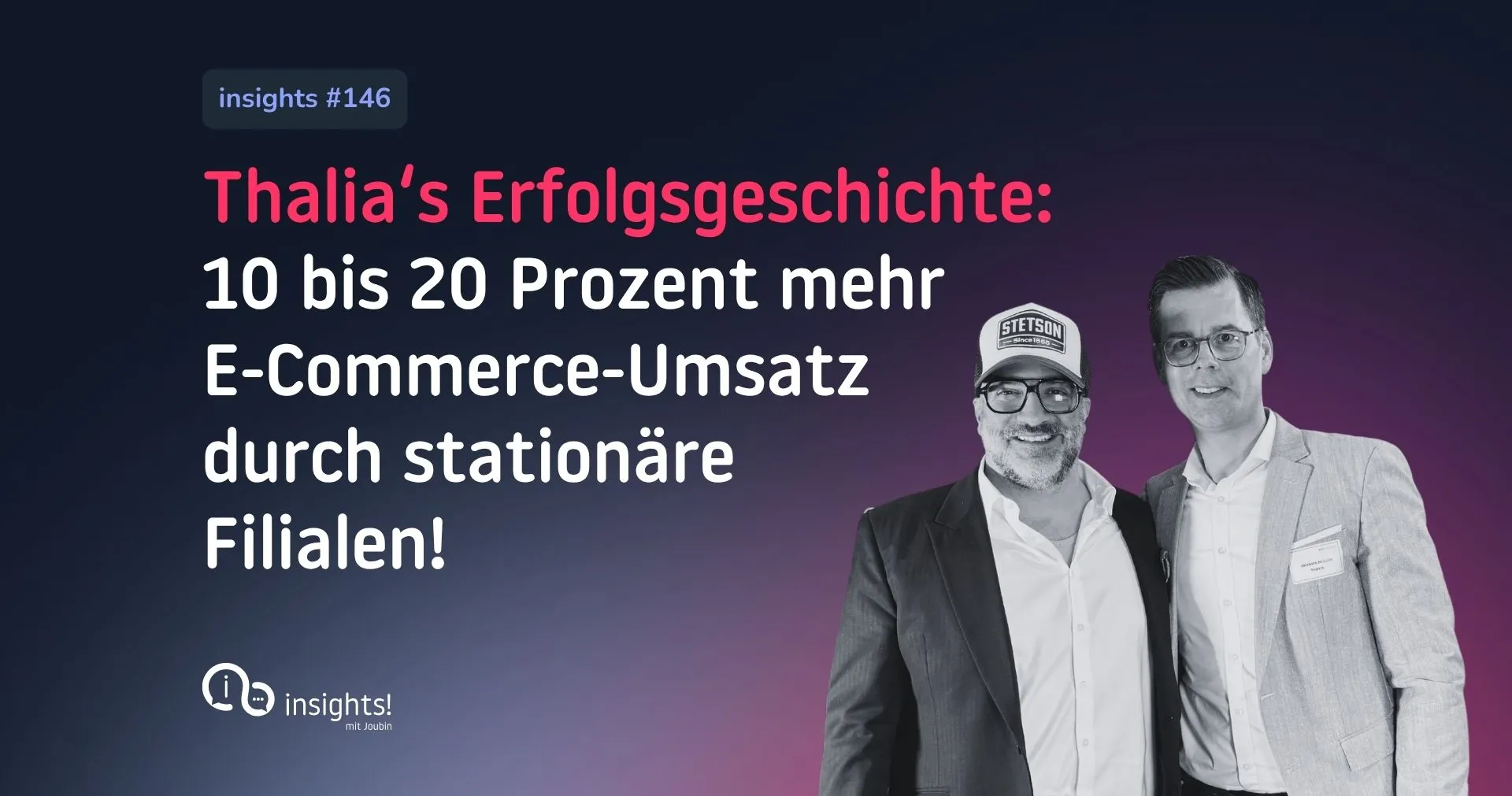
We are indeed proud that we have also outperformed the market and, even against Amazon, have not only regained market share but are genuinely market leader in the German market. What's the secret? I think it actually lies in a very honest and very structured omnichannel approach. For us, though, this isn't just a word written down somewhere – we genuinely live it.
Standing up to Amazon: how Thalia became market leader
The German book market was long seen as a victim of digitalisation. Small bookshops closed, online giants took over and the outlook was bleak. In the midst of this environment, Thalia has not just survived but risen to the top. In conversation with Joubin Rahimi at insights!, Hendrik Müller, Director Customer and Commerce at Thalia, gives insights into a strategy many considered impossible.
What sets Thalia apart from the competition isn't a single stroke of genius, but consistent work on a genuine omnichannel model. While many retailers write omnichannel as a buzzword on conference slides, Thalia has integrated the concept into every customer touchpoint. Click & collect, click & reserve, locker pickup outside the bookshop: the customer decides how, when and where they buy.
Every new store is revenue booster for online shop
One of the most surprising insights from the conversation: brick-and-mortar presence and e-commerce growth mutually reinforce each other. Hendrik Müller confirms that every new bookshop increases online revenue in the respective region by 10 to 20 percent. For e-commerce leaders, this is a remarkable insight, as it contradicts the common narrative that brick-and-mortar and online are in direct competition with each other.
The logic behind this is simple but powerful: whoever reaches the customer across both channels increases share of wallet. Cross-selling, upselling and value-added services become possible as soon as the customer relationship extends beyond a single channel. Thalia combines algorithmic recommendations with the experience and knowledge of real booksellers, and brings this expertise into the digital world too.
What sets the Thalia omnichannel approach apart:
Click & collect with a choice of personal advice or locker pickup
Digitalising bookseller expertise for online channel
Increasing share of wallet through multi-channel customer loyalty
Store ambience as a driver of brand affinity
BookTok and Gen Z's unexpected return to the bookshop
For years, the 14-to-29 age group was considered lost to bricks-and-mortar bookshops. Digital natives, always online, rarely in the city centre. Then came BookTok. The movement on TikTok, where young people recommend, discuss and celebrate books, has sparked new dynamics in the book market. And Thalia quickly understood how to translate this digital energy into real revenue.
Colour edges, signed editions, limited runs: these products are for BookTok generation what first editions once were for collectors. Thalia has set up social media cubes in its branches, where customers can photograph and share their purchase directly for their community. Result is a cycle of digital inspiration and analogue purchase that reinforces itself. Supposedly digital target group buys printed books, and prefers to do so in-store.
Book Circle: when community building is more than a marketing channel
Thalia isn't stopping at being reactive. With "Book Circle", the company is building its own community that combines digital and analogue elements. Pilot projects in Hamburg have shown that the combination of online community, in-store events and merch works. According to Hendrik Müller, the response was "incredible". The strategy behind it is clear: Thalia wants to cover the entire lifecycle of a reader. From inspiration through purchase to exchange with like-minded people. All within one ecosystem, powered by the Thalia app. And this ecosystem is growing because it's based on genuine needs rather than artificially created demand.
Playing time: Thalia's boldest bet in years
While traditional toy retailers are disappearing from city centres, Thalia is heading in the opposite direction. Under the name "Spielzeit", the company has opened its first dedicated toy store in Lüdenscheid, with 40 more planned. The idea: books and toys belong together, because children don't distinguish between reading and playing.
The gift box concept for children's birthdays is particularly clever. A child puts together a wish box, and the invited guests choose their gifts from it. Simple, charming and a genuine customer experience that can't be reproduced online in the same way. Thalia thus transfers its proven omnichannel approach, including click & collect, scan & go and digital advisory tools, to a completely new range.
Why playtime makes strategic sense:
Natural addition to the existing children's book range
Filling a gap in city centres left by classic toy retailers withdrawing
Experience stores with workshops, creative days and game tests
Transferring proven omnichannel services to toys
What digital decision-makers can learn from Thalia
Thalia's success story is no coincidence and no anomaly. It's the result of an approach that sees omnichannel not as a project but as corporate DNA. For digital decision-makers, e-commerce leads and marketing managers, the Thalia example offers three key takeaways: first, bricks-and-mortar and digital reinforce one another when the customer is consistently placed at the centre. Second, trends like BookTok aren't flashes in the pan when integrated strategically into your own business model. And third, expansion into adjacent ranges works when the core competency is right.
Hendrik Müller put it perfectly in the conversation: it's not about getting more money out of customers' pockets. It's about delighting them with value-added services, good advice and genuine experiences. Whoever manages that need not fear any online giant.
Would you like to listen to the full episode?
Find the podcast of the interview here:
Prefer to watch the episode? No problem!
You'll find a recording of the interview here:
Please accept functional cookies to watch this video.
Prefer to read?
Joubin Rahimi
Brilliant that you're back for a new episode of insights! My name is Joubin, Joubin Rahimi, and joining me today is Hendrik Müller from Thalia. Hi Hendrik.
Hendrik Müller
Hello Joubin.
Joubin Rahimi
It's a real treat to have you here, because I'm a Thalia fanboy. I'll explain why in a moment. But maybe you'd like to say a couple of sentences about yourself, your role, and then we'll dive into the topic.
Hendrik Müller
Yes, very happy to. So first of all, thank you for having me here. A really nice opportunity. I'm Director Customer and Commerce at Thalia, so in particular responsible for the e-commerce business. Everything around the sales channel, everything around digital marketing, loyalty and social media are also part of that. In parallel also for the digital product, so our software development that we run in-house, for all digital touchpoints, but also for the omnichannel services. And relatively new is also the service, because service is also increasingly becoming a sales channel and goes ever deeper into the value chain. That's also my newest hobby, being responsible for that too, helping develop it too.
Joubin Rahimi
And I'm really pleased about Thalia, because everyone who's followed a bit of synaigy's history will know. One of our first customers was WBG. It was an association, actually a really lovely one, set up to reprint books that had been burned during the Nazi era. But people said: I want to have that book, and a thousand of them chipped in together and it got printed. I thought that was a lovely idea, and it was one of our first customers, and our children love Thalia. They're from Cologne and they also love the Remscheid Thalia. That's quite different. People from Cologne easily spend an hour in there and, well, we say they can have all the books they want. We always buy books, never pocket money, and they love it, always coming out with one or two books.
Hendrik Müller
That's exactly the goal we have. Ultimately, you can illustrate this well with children. With you we hit the bullseye, because every child who walks past Thalia shouldn't walk past, but should definitely come into the bookshop. That's exactly why we put so much effort into creating quality of stay, having reading and learning corners, and also trying to build many partnerships with schools and so on. Bringing this reading back up playfully, especially for children, in connection with toys – that's exactly what we want to achieve. Bricks-and-mortar quality of stay, and I think Cologne here at Neumarkt is actually a very, very good example of this.
Joubin Rahimi
And that's not easy at all. With Amazon a lot has changed in the book market. All the bookshops have diffused away and you haven't. You made it online and made it in bricks and mortar. What was your secret? Because now the world is changing so fast. But what was your secret?
Hendrik Müller
In fact we're already proud that we've outperformed the market too, and even compared to Amazon we haven't just won back market share, we're actually genuinely market leader in the German market. What's the secret? I think it actually lies in a very honest and very structured omnichannel approach. That means, many people always tend to view that quite critically, but for us it's not just a word written down somewhere, we actually live it, and you always see that with services like in-store pickup, click & collect, where we let the customer choose whether they want click & reserve and perhaps would rather have a chat with the staff member when picking up, or if on the other hand they're more the search customer, the target customer who wants to pick up, giving them the option to pick up this book, in the end, via a locker standing outside the bookshop. Those are the different models we see there, and ultimately for us it's also about digitalising this bookseller expertise, so not just algorithmic linking, but at the same time also intellectual linking, experience-based linking from our booksellers, and then in turn passing that on to our digital customers too.
Joubin Rahimi
Let's take the Cologne branch, with the café and the rooms, the break rooms, or didn't you call them break rooms?
Hendrik Müller
These aren't lounge areas, but spaces that also encourage people to linger.
Joubin Rahimi
Have you measured or do you know how that pays into omnichannel too? So are the Cologne fans also buying online at Thalia?
Hendrik Müller
It's actually a really fascinating question.
Joubin Rahimi
That would need measuring.
Hendrik Müller
As I said, you could say that for someone responsible for e-commerce, the truth lies only in digital. That is actually different, it really is different. Every opening we have anywhere, every new bookshop we open, automatically boosts my e-commerce revenue in that region too. You can say that quite openly, somewhere between just over 10 and just under 20 percent. That is already a simple, straightforward setup that I have there. And because omnichannel is genuinely not just a buzzword for us, as soon as we engage the customer across both channels, we often manage to increase share of wallet, achieve some cross-selling, upselling somewhere, ultimately not just getting more money out of the customer's pocket, but also delighting them with value-added services and good prices, with good advice too. That is at least the goal.
Joubin Rahimi
And earlier you also spoke about the community, that's not just one word, you actually have a completely different mission. So take us through it. I don't want to repeat what I've just learned, you can say it far better.
Hendrik Müller
What we saw is that a social media channel gave us back a new target group, one we'd struggled with for many years. So exactly this target group between 12, 14 to 29 was really, really hard to tackle. And TikTok, Booktalk, BookTok actually managed to bring so much movement into it, and that digital world too, we then managed to translate that into the analogue as well. Meaning, this supposedly digital target group buys analogue, i.e. printed books, and preferably in bricks-and-mortar stores too. A huge topic for us, and ultimately community means fo
Joubin Rahimi
Let me jump in here, my children don't read books digitally.
Hendrik Müller
Not digital.
Joubin Rahimi
Yes, that's absolutely books in physical form.
Hendrik Müller
And there are these lovely coloured edges now, or the signed books or similar. For us, those are really rarities that have extremely high demand too. So I don't know if you know this, but these coloured edges - your kids might be into that too. That's actually the hot stuff right now. They really enjoy going into town for that, spend several hours in the bookshop, and also, again, the social media cubes we have set up in Cologne, for example, are then used to share the purchase they've just made with their own fan base somewhere. So for us that's a real win-win. And to come back to community, we of course also play that strongly through external communities, let's not kid ourselves, but that's exactly the goal - to bring the customer to us too, ultimately from inspiration through to purchase, through to usage, reading, listening, having everything with us in the Thalia app. And on the other side, with Book Circle we're currently building a community. We've already piloted a lot, also the year before last we built a small community in Hamburg, always in the combination of digital and analogue, so also running events in the branch with merch, feeding this whole community regionally somehow. And the response was incredible. So we had such an influx during that time, certainly always for a genre that happened to be trending at that moment. But that's certainly one of our goals for the future - to have and build our own community and ultimately bring our readers into exchange within that community too.
Joubin Rahimi
They're scaling down here right now. And you're addressing, that's younger target group you address, not older ones really, where you'd say they read either way, they're used to it, you address younger ones and bet is paying off, that's my feeling, way you put it. Now you've got another new bet on top, toys, so experience, our kids are same age and when someone else has birthday, where do they go to buy toys, if not online? Because there are hardly any shops anywhere in city centre anymore.
Hendrik Müller
And that's, I think, the big problem. Especially in the toy sector, a lot of retailers are disappearing from town centres. And that's exactly where we want to go. We see a great symbiosis between children's books on the one hand and toys on the other. And that's exactly what we want to bring together even more strongly, these two ranges, and that's why we founded Spielzeit. The first shop has already opened in Lüdenscheid, and 40 further shops are currently being converted over the coming months and years, so that we convert them as well, and ultimately it's exactly as you just said, it's about fascination too, about exactly this online and offline thinking, this omnichannel thinking, making that tangible for toys too. And the success so far certainly proves us right, creating a quality of stay there too. We see lots of fascinated eyes among the children, lots of children who love coming to us, and on the other hand also good expertise for the next perfect gift. Maybe I can mention that too. The gift boxes, I don't know if you know them. A child has a birthday party, and ultimately such a gift box gets put together, and the invited guests come along and pick out the individual items themselves. Works brilliantly, I have to say. Works hugely well. Great story.
Joubin Rahimi
Playtime isn't really aimed at the parents, but actually at the children. Parents too.
Hendrik Müller
Yes, indeed the focus during playtime is more on the children. That's indeed correct and
Joubin Rahimi
That's mega smart. I mean, think about it, children don't distinguish between playing or reading. They have fun, and it doesn't matter whether it's a game or reading, or whether they read something and then play the things.
Hendrik Müller
And this creativity from reading can often be translated well into play. If we simply manage to offer a good, valuable alternative to playing on a PlayStation or similar, then we've actually achieved a lot
Joubin Rahimi
And that's also, I think, for the listeners, I want to pick this out again, to think about this target group and think how this target group thinks. A brilliant example of that.
Hendrik Müller
Thanks.
Joubin Rahimi
Yes, we'll keep watching this. I think it'll get even wilder here with the reduction, and I'd like to suggest we do a calmer second take sometime, if you have time and feel like it. I think we could dive much deeper there.
Hendrik Müller
We'll gladly do that.
Joubin Rahimi
Thanks for the time, and then good luck with Spielzeit and everything else you're doing.
Hendrik Müller
Thank you.
Have questions or feedback?
Then feel free to contact us directly.
- Joubin Rahimi
Managing Partnersynaigy
Show phone numberShow mobile numberShow email address

Subscribe to the blog now and never miss any news
✔️free of charge ✔️weekly news ✔️expert knowledge
Please accept the corresponding cookies to view this embedded content.