



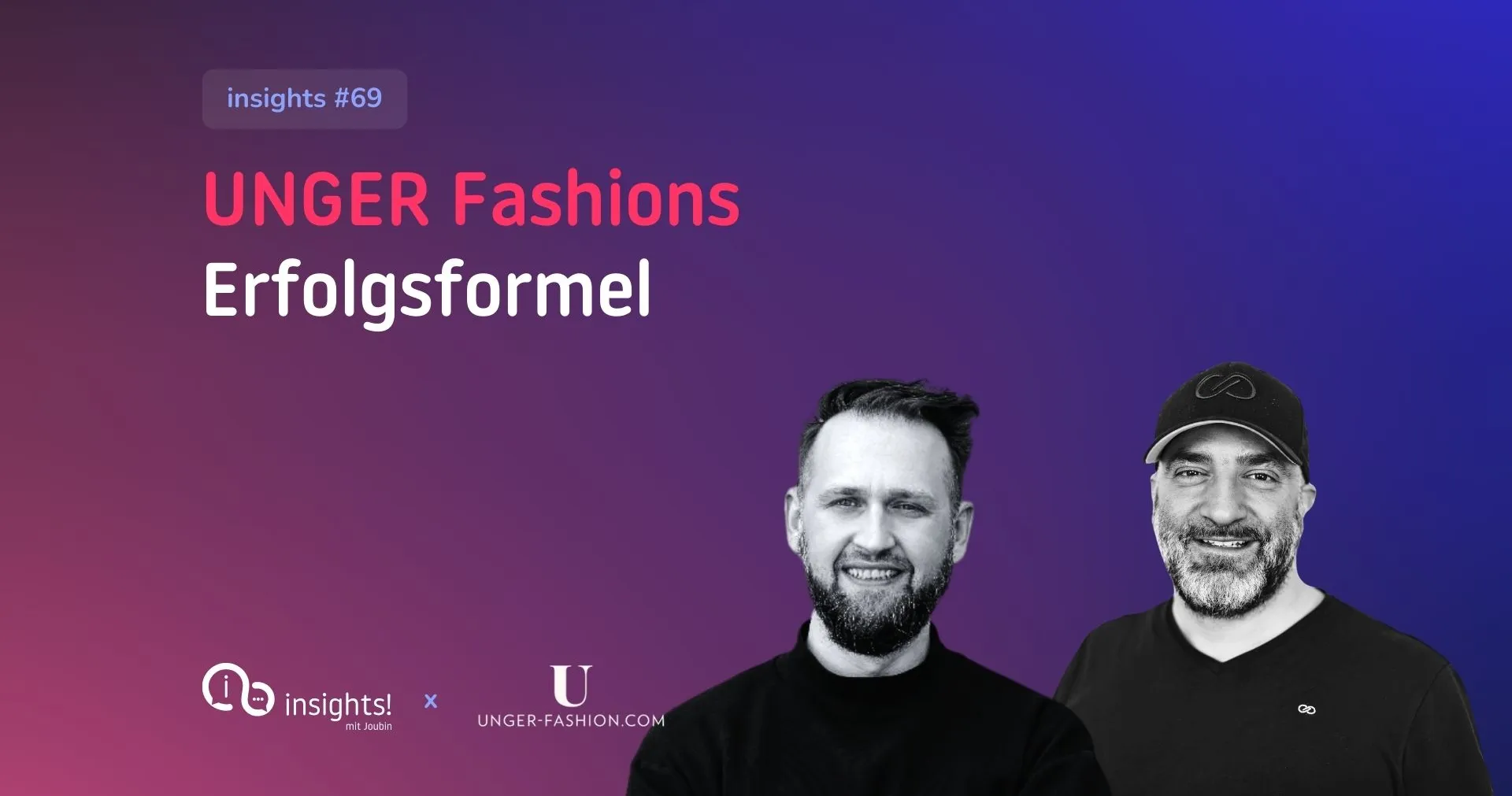
insights! #69: UNGER Fashion's success formula revealed
 Joubin RahimiManaging Partner · synaigy
4 min read
That's also the core DNA of UNGER. So, try something out quickly, see if it works, and then keep building on it.
At a time when many retailers are fighting for survival, UNGER Fashion has not only survived but successfully transformed into the digital world. In an inspiring conversation, Fabian Haustein, Chief Digital Officer at UNGER Fashion, shares how the company achieved this impressive transformation – and which strategies were particularly successful.
From boutique to digital pioneer
UNGER Fashion is far more than just a traditional luxury house in Hamburg. With a clear vision and Hanseatic persistence, the company already took the step into the digital world back in 2008. This early move into e-commerce was decisive for success in an industry marked by many challenges. The team at UNGER has continuously developed further by bringing experts on board and expanding its digital presence step by step.
Luxury is a question of staging
Luxury fashion thrives on emotion and staging. At UNGER, the in-store shopping experience is an art form – a feeling that also needs to be conveyed online. "We sell emotion and cater to emotion," explains Fabian Haustein. This philosophy is applied in every aspect of the business, whether at the store on Neuer Wall or in the digital space. The aim is for customers to feel just as exclusively and well looked after online as they do in store. A central part of this strategy is the targeted curation of the range. Product presentation must be perfect, both in the stores and online. This precision is reflected in the careful selection and presentation of products, mirroring the sense of luxury that defines the brand.
Omnichannel and personalisation as success factors
Nowadays it's no longer enough to just have an online presence. The boundaries between channels need to disappear, to give customers a seamless and personalised shopping experience. UNGER relies here on innovative approaches such as virtual sales assistants, who advise customers by video or phone, and a concierge service that delivers luxury items straight to the home. This service goes beyond mere delivery, in that customers are accompanied by an advisor who helps them with their selection. Personalisation plays a central role in UNGER's strategy. Customers receive individual care, and their preferences feed into every interaction – whether online or offline. This personalised care creates a strong bond between the brand and its customers, which is invaluable in the luxury fashion sector.
Artificial intelligence: efficiency gains through technology
Another important aspect of digital transformation at UNGER is the use of artificial intelligence (AI). Fabian Haustein is a big fan of AI technologies and sees great potential in them for increasing efficiency within the company. Whether through the automatic creation of texts and product descriptions or the editing of images, AI helps the team focus on creative and strategic tasks while repetitive tasks are automated. The use of AI enables UNGER to handle large tasks with a comparatively small team while maintaining the quality and precision that are essential to the brand.
The path to the future: keep at it and keep growing
The success of UNGER Fashion shows how important it is to stay the course and continuously invest in further development. From the targeted use of expert knowledge to constantly improving service offerings – UNGER has proven that a smaller company can achieve great things with the right strategy and attitude. The focus on excellent service, both online and offline, has proven to be the company's superpower. UNGER Fashion is a role model for other retailers looking to hold their own in the digital world. The success shows that it's possible to master the challenges of the market if you're willing to keep learning, adapting and driving innovation.
Would you like to listen to the full episode?
Find the podcast of the interview here:
Please accept the corresponding cookies to view this embedded content.
Prefer to watch the episode? No problem!
You'll find a recording of the interview here:
Please accept functional cookies to watch this video.
Prefer to read?
Joubin Rahimi:
Great to have you back for a new episode of insights! My name is Joubin Rahimi and today I get to welcome Fabian Haustein. Hello Fabian.
Fabian Haustein:
Hello Joubin. Glad to be here with you.
Joubin Rahimi:
Really great. Thanks for taking the time. And on a holiday too. So not even on a normal working day. That makes me even happier. The first Christmas holiday, so to speak. I mean, a bit still happens in the next day and a half. In some places or other.
Fabian Haustein:
But I can count myself lucky to already be out.
Joubin Rahimi:
Yes. Well, that's great. And we can go straight into that with locations where things happen and where so far there's more calm. Though I'd like to first introduce you with learning from best, because we're seeing right now in retail. Many retail companies have filed for insolvency. Yet wherever you've worked, things went well and maybe even very well. You can share that with us now. And you were at Baby One up to Fashion UNGER or UNGER Fashion. And yes, maybe you can say bit about your role and what distinguish you.
Fabian Haustein:
Okay, so at UNGER Fashion in Hamburg, or rather UNGER at Neuer Wall, I'll get to that in a moment. Why I use both terms, I currently fulfil the role of Chief Digital Officer, and through that I have the good fortune of being in, how should I put it, a strategic role, but still being very, very operational and very close to the business. Why is that? UNGER, unlike Babyone, has a smaller size in terms of manpower, which honestly isn't so bad at all. And you're faster and closer to the topics there. Which doesn't mean Babyone was or is slower. But there's of course a clear difference. Just to distinguish both, how should I say, both stations. First in terms of size. The nice thing about UNGER right now of course is: You have both the sales aspect, you have a high IT and technology part in my role, but also a certain part of, if you will, corporate development, or rather a bit more towards a strategic share. And that's of course a great role that I get to fill there, and together with the owner and CEO Florian Braun, get to keep driving the digital topics forward. Yes, that's maybe a bit of background, and before that Babyone, and there IT and digitalisation. Exactly.
Joubin Rahimi:
And that's of course always two decisions, and why you went from one to other, everyone can ask you that personally. I want, but I actually want to get at something. You then agreed on something with UNGER am Neuen Wall with Florian. Or rather, you got to know each other, and that's always mega exciting too. We know several fashion companies and I'd never want to be CDO there, like you. Found that mega exciting and maybe you can say one or two points on it. Why you say Fashion UNGER – I always say Fashion UNGER. But that's wrong. Well, it's not quite correct, but it's UNGER Fashion.
Fabian Haustein:
So, we actually see ourselves as, as a boutique luxury house. Let's put it this way, on Neuer Wall. That doesn't just include UNGER. In the end, we also have a younger store, just over two years old and very, very fresh. So you could say it's only just hatched, a children's store. So I suppose I've stayed with the children in some way. That means we also have luxury and high fashion kids clothing there, and that makes up this whole world. And I think that's what's a bit appealing about the topic. Of course the customers, but also the fact that the range is thoroughly exciting and inspiring. I have to say, I didn't know much about it either. I think I've learned quite a lot in a year regarding the business, but of course also the way you work with it. It's completely different to being in fast fashion, from our side. We're content, we're doing well. That's perhaps one point economically, but the way you approach clothing is also entirely different to, say, an Esprit. Or they do a mega good job for their segment or their target group. But with us it's much, much finer, much, much more precise. That's quite exciting, really. It's also very technical in parts.
Joubin Rahimi:
Do you have one or two examples where you'd say it gets very, very pointed and technical?
Fabian Haustein:
From the from the from the target group, of course, definitely. So not just the price. What I also had to learn is that within the luxury fashion segment you also have different currents. And we've, well, we're a very Hanseatic company. I find that lovely from a collaboration point of view anyway. I'm from Hamburg and I like this Hanseatic way of doing things. It's still practised, the handshake, and it usually fits, or actually always. It's completely mad. Contracts get negotiated afterwards. You first fundamentally agree on that, that's one thing. But that's what, because that's not actually what I was getting at, rather we operate in a corner where you cultivate a particular kind of luxury. It's called quiet luxury, so luxury for yourself. You might not see it at first glance, or only connoisseurs are aware of what you're wearing there, or not. There's little of it around, and because of that you already have a very, very narrow target group. Yes, and technologically, yes. Because UNGER has managed, over the last 3 to 2 years, to position itself very, very well, meaning it knows its customer data very well, actually always did. So in the past on index cards, today digitally, but also connecting that with the online world and already driving forward topics there where I think some mid-sized companies aren't even at that stage yet. So we have quite a good data view, have organised that very homogeneously already.
Joubin Rahimi:
That's clearly further along than with some others, perhaps. So what's special is — that's how I imagine it. Especially these days, when you said that in some places there's still a lot going on in bricks-and-mortar stores before Christmas, perhaps also between the years. But when you walk into high fashion, you're greeted quite differently. It's not passing trade. It's known. It's always about experience. It's not about price. Quality isn't in question — it's simply a high quality either way, so it's really the brand staging or brand presentation and the experience, I'd guess. Is that what it is?
Fabian Haustein:
Yes. Absolutely. So we sell emotion and cater to emotion. I think one of them will tell me off, but clothing comes along with it, you get it on the side. That's not quite true, but maybe you can put it that sharply. So it is emotions that we cater to, and accordingly, yes, there is passing trade. So I have to correct myself there, it does exist. But we have a good mix of brands that we have there, among these and in our stores. Which are positioned differently in terms of theme. And we curate very strictly. And that's perhaps the bridge back to online, to technology, too. We have to reflect that there as well. So we have, well, we have strict curation rules. I think the factfinder I currently use, they didn't have much fun with us for a long, long time, until we found a way to automate that too. This being picky, as I always call it, so at the push of a button, and it has to be very perfect and very comprehensive. You notice that in the product listings too, for example. Yes, but that's also what you do in the stores. Every day it has to look perfect, the bags have to be positioned perfectly, the clothes hanging just so. There's also not that much clothing on the shop floor, that's part of the luxury too, in the end. So lots of space for little.
Joubin Rahimi:
Yes. That's the special thing. The shops are, as you say, lots of space for little. How do you then depict that online? The feeling somehow has to come across too. Essentially the same emotional feeling. And that's certainly a challenge. That's how I imagine it. This is also part of omnichannel, having the same feeling across all channels.
Fabian Haustein:
Absolutely. And that in times when you have more and more products online. Even with the big platforms like My Theresa, you still have to look at how you can differentiate yourself from that and convey that feeling. Because ultimately you also want to sell. So that doesn't mean the same KPIs and benchmarks apply to a handbag, and the same lessons learnt as, say, for shoes, if you sell them online — that's just an expensive product, but ultimately you'll also be offering something on the page and trying to salvage a bit of that experience for people. And the line is very, very fine. And experience is always something personal, I find. Everyone experiences experiences differently.
Joubin Rahimi:
How much of a topic is personalisation for you, actually? Because if I come into your shop, and I'd bet the sales assistants are mega mega top, not just trained, but genuinely top salespeople who can quickly gauge what I like and remember it for the next time I come in.
Fabian Haustein:
And that's exactly how we need to do it online. So yes, so recognise on the site and then get you to log in, so to speak. That's already a topic, part of personalising, we already do that and will now, in the new year that's not so far off anymore, expand it further. But nevertheless we also have virtual sales staff, meaning every customer with us, or also every client, can if they want be given a personal shopper at their side, so that they accompany them while shopping on the site too, and accordingly via chat or whatever. All of that's possible. But the most common way currently is that it happens by phone or by video, that you go through the virtual shop together. That's roughly the kind of personalisation we're already carrying out.
Joubin Rahimi:
And if I do that with video, how should I picture it? Have you built a big technical infrastructure so you can see it straight away? Or do you simply say two people do a video call, they know the items, and then browse through them together?
Fabian Haustein:
That's how it currently is, I think. So we're working on that. We'd like to create an integrated experience world. There are ideas for that too. But that's still a concept. But currently you have, well, how should I put it, started very simply as video telephony. Like the two of us now. We see each other. I could present something to you, show you something. Or we go through a particular range together. That works too, in the end.
Joubin Rahimi:
Yes, that's great. I just think that's a great approach you've got there too.
Fabian Haustein:
We simply try it out to see if it's adopted, and then you can look at whether to expand it further. Yes, and that's really important too. It's part of our core DNA, so to speak: quickly try something out. See if it works and then build on it. I think someone always uses this test, learn, build bigger, build phrase. But it fits rather well here. Because you can be really fast for our customers. And they take it on board, and they give us pretty direct feedback too. That's genuinely good and very positive. We already get very clear feedback on what works and what doesn't, and we have a good feel for that.
Joubin Rahimi:
That's great of course, and the DNA was already there, so to speak, when you joined. And did you find it that way? Okay.
Fabian Haustein:
Yes, there was already a lot there. It's really cool what's been built and created there over the last two, three years. Of course, for a driver. That has to be said fairly. But the
The team on site has already done a lot of great groundwork, also with relatively smart, simple means.
Joubin Rahimi:
That's really cool. And how was that for you there? Did you already know and find that out beforehand, and that's why you chose it? Or was it more like, well, got lucky?
Fabian Haustein:
It's always the way, what gets described versus how it ends up in the end. And I'd say I actually thought, great, in the first moment, okay, there's a lot to do, put the other way round, it was said that a lot was already there and that they wanted to work on and change quite a bit. But in the end, when you're on site and talk to the people involved, talk to the teams, you notice fairly quickly, wow, cool, you've already done something here, that's already been done, a process too. So a topic like process integration is already running. How you can still set up new processes fairly quickly, connect topics together, you can do that, because it of course massively eases the work, to bring all sorts of systems together. Yes, so I knew it was cool, but I didn't know it was this good.
Joubin Rahimi:
That's brilliant. It was first and foremost a huge compliment to the team, in that sense. That's a dream, when you say okay, the DNA is exactly right and you're building up the topics. A lot is already there, which is often always a challenge, when I get to speak with someone. So what are your topics for the coming years? Personalisation, you said. Of course I always have one current question: how does it look with AI? Smiling already. Everyone asks, what can you do with AI? But do you have any particular thoughts on that, or would you say you're approaching it from a completely different angle?
Fabian Haustein:
Yes, well, the AI question always comes up. Well. I can't hide that I'm a total fan of AI or AI technologies, or as it used to be called, machine learning. So that's often what the whole AI topic is these days. Yes, well, of course over the next twelve months we're trying to use more and more of the technology, wherever it makes sense for us in the short term. Starting with product and copywriting support, put discreetly, because we already get little text material from the manufacturers. It doesn't give you much to build the texts from. With AI you can already imitate tone quite well. You could train it on a bit of our own texts and then the AI manages to help us. Those are topics like covering the whole SEO area and so on. That helps the more short-term. I think medium-term this could help us quite a bit with the whole photo content topic. So. Text, image editing, image processing, image alteration, right through to, well I don't know, creating a whole complete shoot, that's the top tier. But I think those are topics that can help us a lot, all of it also paying off efficiently though. So where does AI help us become more efficient and simply present good topics again and be fast, where others might have an advantage just because they're very large. So it makes the competitive disadvantage a bit smaller, and we're hoping a bit for that, that we can realistically achieve this AI topic, I'd say, over the next twelve months, well, apart from this fully digital photo shoot, that'll take longer.
Joubin Rahimi:
But I do think the intermediate steps too, so you say: you've freed up a photo shoot and then with AI you can design the background images or the backgrounds and the mood completely differently. Yes exactly, that's really cool. Especially that. I think that's great.
Fabian Haustein:
Also this whole post-production topic. I know how much we invest in posts, because we have our own models and our own photographers and our own post team, but also outsource a lot. And just how much that alone helps — supporting the teams so they can keep working creatively. Because AI isn't creative — it's just cool to have a good team, but you also need to know we need all this work, the annoying stuff, that's what it gets under control, and I think that's how you need to approach the topic too. Look for things that are annoying, that are tedious, and that's how you get people excited about the topic. Otherwise it's often a topic that maybe triggers fear or wariness in the team, because there can be a lot of fear and unease that something gets hurt. It won't, in our case. Also different if you say you've freed up more time capacity, you can put that into creativity, into goal-setting, and not into the really — where everyone says mega boring, would be nice if it worked like that. Yes, the text topic — our content team should focus much more on staging than on grinding out texts the whole time. AI can really help there. Right, and you can scale now, that gives economies of scale, more products etc. All that works with a consistently sized team. That's just cool. And when they can then keep applying their expertise further. Amazing.
Joubin Rahimi:
This topic is great for that. So in a nutshell, we take the efficiency gains to move away from doing something because it isn't a differentiator, i.e. because I have to do it, towards becoming a differentiator.
Fabian Haustein:
Let staging bring creativity into play, so high fashion can be lived much more intensely, because that was always more of a bottleneck. Exactly. Exactly.
Joubin Rahimi:
That's great. I think that's already the second insight today, the first one again with personalisation, so that personalisation is mega important of course and that you started early with it. And I also find the omnichannel topic mega exciting. So the cross-border or cross-channel experiences are of course important for you, and you now also have a new second store, you said, or second brand.
Fabian Haustein:
So if we have three, we have one, the main store on Neuer Wall, and then, for those who know Hamburg, in the Kaisergalerie we have U2 as well. That's a younger, so-called editorial store, a different target group. And within this complex we now also have what's called U2Kids, which is a children's store for luxury and premium fashion, also based in the Kaisergalerie. That's been done really sweetly and nicely. Very conceptual. With a good brand mix within that price bracket, at the end of the day. Exactly, that's our offline business, if you like, and it's complemented by a food and drink concept that also works there in the Kaisergalerie. That means we have a bar called Daily, plus the stores alongside it. That makes for a really great combination, and omnichannel plays a strong role there too, which we then support and carry outside, definitely not just within UNGER Fashion.
Joubin Rahimi:
I have to say, UNGER has managed to achieve something that very, very many do not manage. In the fashion sector there are also many, many smaller ones, well, you are not small, but. I have a boutique. Let me put it a bit bluntly. So, a boutique. And suddenly the internet comes along and town centres keep getting emptier and I do not survive the whole thing. I am exaggerating a bit here. There are many, many like that. The case is there. It cannot be denied. Exactly. And that is what I find so great. With you that is not the case. You have a very focused target group and you managed that shift into digital a few years ago. Now you were not there at the time, as I understand it. But maybe you still have two or three insights into how the founder and the owner, or the owning family, managed to go down that path. Because that is very often a huge challenge.
Fabian Haustein:
I think Hanseatic persistence, and what people tell us here in the north, is simply: just get on with it. So they just did it and found three or four experts from their network and built it up with them, step by step. And it just grew. To be fair, it has to be said. Organically. Further and further. And I think that's the insight. They simply started at the point when it was good to start, with a fairly simple shop system, and drove it forward step by step, bringing in one expert or another along the way.
Joubin Rahimi:
And over how many years or months?
Fabian Haustein:
2008 is the start, launched in 2008. Relatively small, has now had its third iteration released. We're now working on the fourth. Been working on it for a good two weeks now, so that we'll probably be able to launch something new in the autumn, with the clear goal of creating and personalising even more inspiration. But also linking the channels, if you like. So what we already do in terms of omnichannel service, for example something like a concierge service, meaning order goods from us and the little Smart car in the Hamburg city area. We have several of them and it comes round and brings you things at home and you can choose and maybe even discuss with the person who comes round whether the looks work, and ideally everything you need is included, or it gets brought round again afterwards. That sort of thing works well and it just needs to be expanded further.
Joubin Rahimi:
Just so I understand it again. Someone comes in. I probably call and say I'd need a tuxedo because of this and that and that, and maybe matching shoes as well.
Fabian Haustein:
Ball gown, tuxedo works. Okay.
Joubin Rahimi:
Ball gown. So, I'd need a ball gown. And then they bring round various ball gowns, and it's not just a driver, but actually also an advisor.
Fabian Haustein:
Exactly. That person can, so to speak, also advise you, will advise you too if you'd like. But sometimes it's simply handing over the bag. It always depends a bit on how long the relationship has been going. So often we know pretty well what the customer needs, and the customer knows that we know that. Then it's straightforward. But it can also happen that you haven't known each other that long, or perhaps you're staying at a hotel in Hamburg right now, or passing through on the way to Sylt, in which case we make that possible too. And then there's advice as well. Sure, right up to being able to book an appointment with us online. And if it gets a bit more involved, then we go to the hotel and prepare everything there.
Joubin Rahimi:
But I think you've named three more insights in the last two minutes. That's how it should be. Yes. Sure. That's great for everyone listening and watching. One insight is stick with it for the long haul, so do it and stick with it. It's not simply about throwing in the towel after one or two years, it just takes time. Again and again from scratch. And the second insight, or number four, would be: bring in the experts. We see that a lot too, that people talk to non-experts or try to do it really cheaply. Well, it's not about cheap anymore. That's not my pricing question, with people who have little experience, and then it usually doesn't work. So that's our experience, you're basically confirming it indirectly again. And the last thing, top the service again or make the service fit the target group, and that's simply hugely important.
Fabian Haustein:
I think, out of the four, service would be the important one for me. I just have to say that, because I can say the same about my own department. The most important thing besides all that is top service. What's your view – I mean, that's our superpower, so we need to build on it too.
Joubin Rahimi:
Great, brilliant closing words. Your superpower is in the service point. Excellent. If there are still questions, you're available to answer them. I'd assume.
Fabian Haustein:
Yes, of course, no problem at all. Always reach out. I think the fastest way is LinkedIn. Exactly. And? I actually get every question answered. Sometimes it takes a bit, but usually it always comes out.
Joubin Rahimi:
That was great. Thank you very much, dear Fabian, for taking the time especially today as well. Thanks for all the insights, and I look forward to seeing you again in person in Hamburg soon.
Fabian Haustein:
Anyway, many, many thanks from me too! It was fun that we managed to pull this together so quickly. And yes, do come to Hamburg sometime and we'll grab a coffee.
Joubin Rahimi:
That's how we do it. See you.
Fabian Haustein:
See you then. Bye.
Joubin Rahimi:
Bye.
Have questions or feedback?
Then feel free to contact us directly.
- Joubin Rahimi
Managing Partnersynaigy
Show phone numberShow mobile numberShow email address
Subscribe to the blog now and never miss any news
✔️free of charge ✔️weekly news ✔️expert knowledge
Please accept the corresponding cookies to view this embedded content.