
Service design
Designing services from customer perspective
8 min read
Please accept functional cookies to watch this video.
What is Service Design?
Marcus: Service design refers to the design of services and processes. You look at services from the perspective of users and customers and design them so that they're aligned with users' needs and expectations. This creates needs-based processes and services, and occasionally changes that can affect the entire organisation.
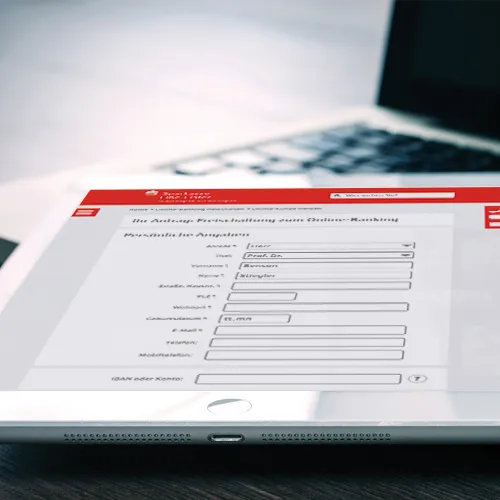
Sometimes it's simply about forms or application processes for opening an account, and sometimes about the user interface for operating a crane.
What do we actually do when we implement service design projects for clients?
Marcus: We help our customers achieve the necessary shift in perspective. That is, taking the customer's view: of themselves, of their own services, products and processes. That's not always easy – our customers' everyday life is often stressful and shaped by internal politics. We have many customers from the financial sector or the B2B space. Depending on what the project requires, concepts and designs are then created and the optimisations implemented technically.
But the most important thing is the empathetic view of user needs, understanding the why. This is only now really arriving in the working reality of many organisations.
How do we achieve this shift in perspective?
Marcus: through research methods we bring our clients together with their customers, prospects, users, applicants. We find out when these people come into contact with the company, the brand, the products and services – and why. And what it does to them. That's what our usability lab is for.
Later in the process, we develop prototypes that give everyone a picture of what's now new and different. The prototypes can be used and evaluated – nice and tangible and understandable, which helps when discussing complex products.
It's also important that we bring everyone to one table. Stakeholders, decision-makers, developers, creatives, customers, prospects. Everyone is in the lab, our protected space that lets us get creative and puts systems and processes in a new light. Through observation we discover strengths, weaknesses and problems.
What role does customer journey play in service design?
Marcus: A customer journey map takes the customer's perspective on one hand, and on the other compares measures, services and processes from the company's perspective against it. The customer journey is made up of the touchpoints with the company. A customer journey map illustrates these and shows which phases the customer goes through – before, during and after purchase – what needs they have at which stage, which touchpoints they engage with, what experiences they have, what difficulties and problems they encounter, etc.
The company perspective is reflected in the service blueprint, i.e. the blueprint of the services and processes that we bring together with the journey. This means that, armed with knowledge of the customer journey and this newly gained sensitivity to customer needs, we switch back to the internal view. What do we need to do, where and above all together, to improve the customer experience? We orchestrate the measures so that they can have an effective and efficient external impact – and the customer journey becomes a little more pleasant.
Our clients become more aware every day of how fast the world and competition are turning, and how important it is to understand their own customers better.
Why is service design so relevant right now?
Marcus: Whoever doesn't look after their customers, doesn't understand them, doesn't understand why they should become and remain a customer in the first place, gets left behind. With our customers, I believe we're so successful because we adopt an attitude with a radical focus on user needs. That strikes a nerve. Our customers are becoming more aware every day of how fast the world and competition are turning, and how important it is to understand their own customers better.
How does service design differ from design thinking?
Marcus: Personally, I wouldn't look for the differences, but for the similarities. Methodologically, they're closely linked. Both are human-centred. Design thinking refers more to a model, a mindset. Service design places a clear focus on the design of services, processes, etc. Service design is more process-oriented, but doesn't set itself apart from design thinking – rather, it uses models, tools and methods from it. The term service design thinking illustrates this interface between the disciplines very well.
Why isn't service design taken as seriously as product design yet? What hurdles still exist in companies today?
Marcus: I wouldn't say service design isn't taken seriously yet. Of course there's ignorance and prejudice suggesting the field has "something to do with graphics" or is just another new fad.
But aside from the name, the concepts behind service design are indeed accepted: looking beyond the horizon, taking user needs seriously, questioning old processes.
The hurdles within companies are more relevant here. Service design can affect a wide range of different departments and processes within a company, involving at least as many departments, interests and people. They all now have to adapt to something new. This leads to acceptance problems. So companies, with their structure and culture, are partly the biggest challenge for service design themselves.
Some companies have a design thinking team: an isolated think tank. But that does not make organisations more creative, innovative or user-centred. An agile mindset, empathy and mindfulness cannot simply be applied locally like an ointment. Rather, it is a cure for the whole organisation. We are glad to accompany the process and help break up structures, working and thinking multidisciplinarily together.
Which service design tools or methods do we use at interactive tools?
Marcus: we work in workshops with users, customers and stakeholders. We make sure the right people come together so something can actually move and change. In doing so, we define personas and create customer journey maps. Of course, we also build prototypes and, for example, do rapid prototyping.
What's also important to us is UX research, i.e. UX tests in the lab, in-depth interviews, online surveys, analytics and tracking data – everything that helps us make the shift in perspective.
How important is testing in service design?
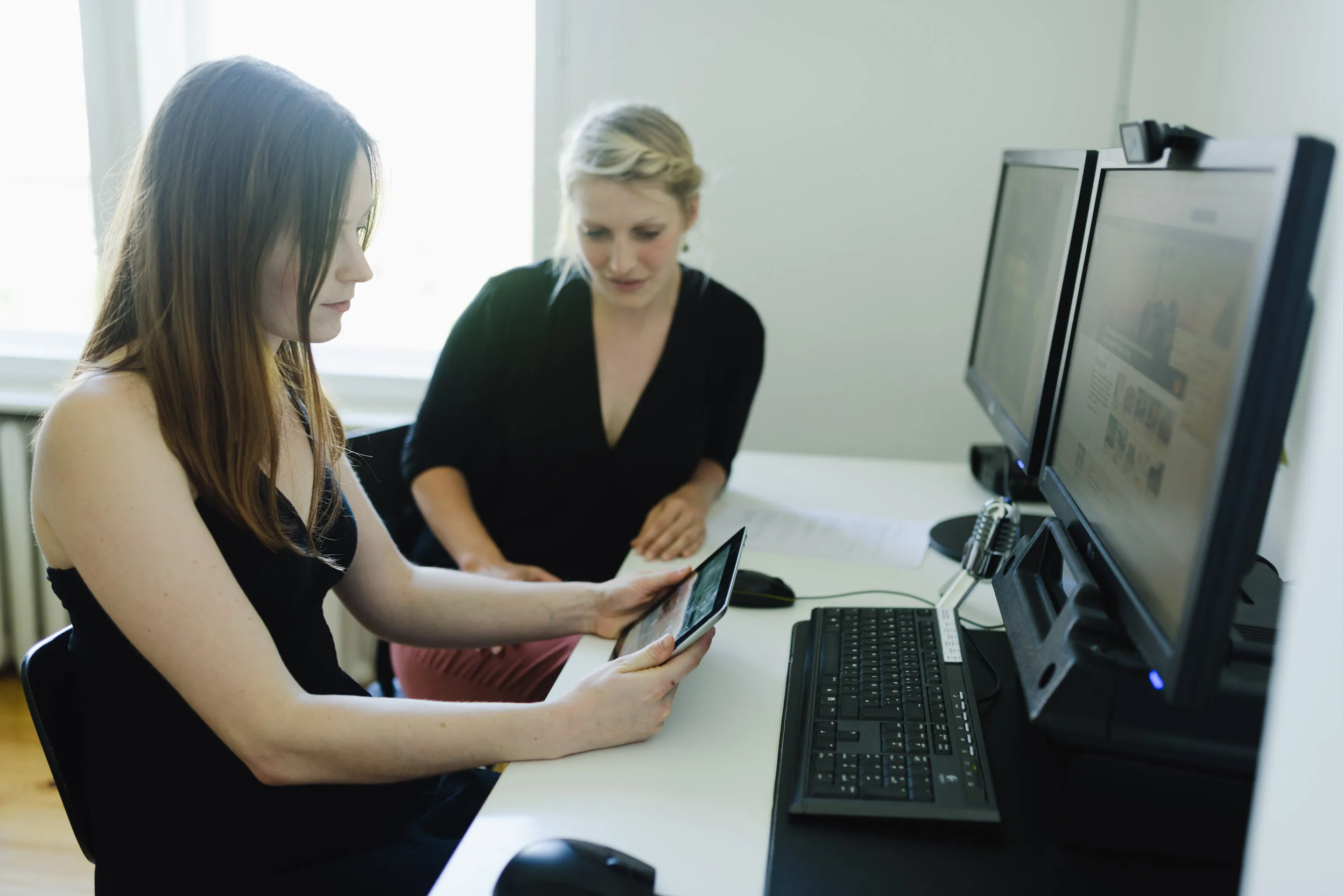
Marcus: Absolutely vital. The tests in our lab are the moment when all of us, our customers and our team, get a space in which we can focus together, protected, take on the users' perspective and work together in a targeted way. Without testing, no one may claim their company is user-oriented or that UX is taken seriously. Testing in the lab means: fast prototyping. Real users. Fail fast. Learn a lot. Together, with one another. Improve things immediately. Leave the inside view behind. Get a clear picture of what needs to be done. Testing designs, ideas, approaches, and observing what happens during use, are utterly fundamental parts of service design.
Without testing, no one can claim their company is user-oriented or that UX is taken seriously.
Can you tell an anecdote from a service design project with an aha moment for the client?
Marcus: In agile UX projects, we implement user centricity by involving users in every sprint. Often that's a UX test where in the morning test participants try out something prototypical, and in the afternoon we develop recommendations based on the observations. That's a day where we all work on the product together with clients and users. On such days, clients have several eye-opening moments at once and clear up myths and legends that have accompanied them for a long time: you have to test many participants, tests are expensive, tests are laborious, results are unpredictable. In the end, everyone realises that doesn't have to be true – quite the opposite.
We optimised checkout journeys for a major financial services provider and, in the process, also tested competitors' journeys. The biggest problems lay in the areas of expectation conformity, user guidance and comprehension. Wording in menu items and on call-to-action buttons was often misleading, and drop-offs were often caused by a lack of clarity. Most of the optimisations in the prototype therefore involved only rewording and wording changes, which we were able to implement quickly – by the second day of testing there were no more drop-offs and no more ambiguities. It suddenly becomes very clear in the UX lab that sometimes only 'small details' are decisive for success or failure. And then you don't even discuss it.
Marcus Völkel founded one of the first specialist usability agencies in Berlin in 1999. As an expert in UX testing and service design, he places particular value on agile methodology and pragmatic processes. Marcus has worked for many years with market-leading companies, creative agencies and thousands of real users. His approach is consistently user- and benefit-centred.
We managed to ask Marcus a few questions between two tests in our usability lab. In the interview, he explains what service design actually is, how we approach such projects, and why service design matters as much for online banking as for operating a crane.
- Marcus Völkel
Consultingsynaigy
Show phone numberShow email address