



#131 - 3 measures that quickly win you deals and trust in wholesale
In wholesale, being slow eats your margin. Adrian Seeger shows how to free yourself from the price trap: think of service as a product, deliver quotes within 48 hours, use AI as an amplifier, and factor in availability plus financing. That way you shift the conversation from purchase price to value, risk and speed - and win orders predictably.
 Joubin RahimiManaging Partner · synaigy
5 min. read
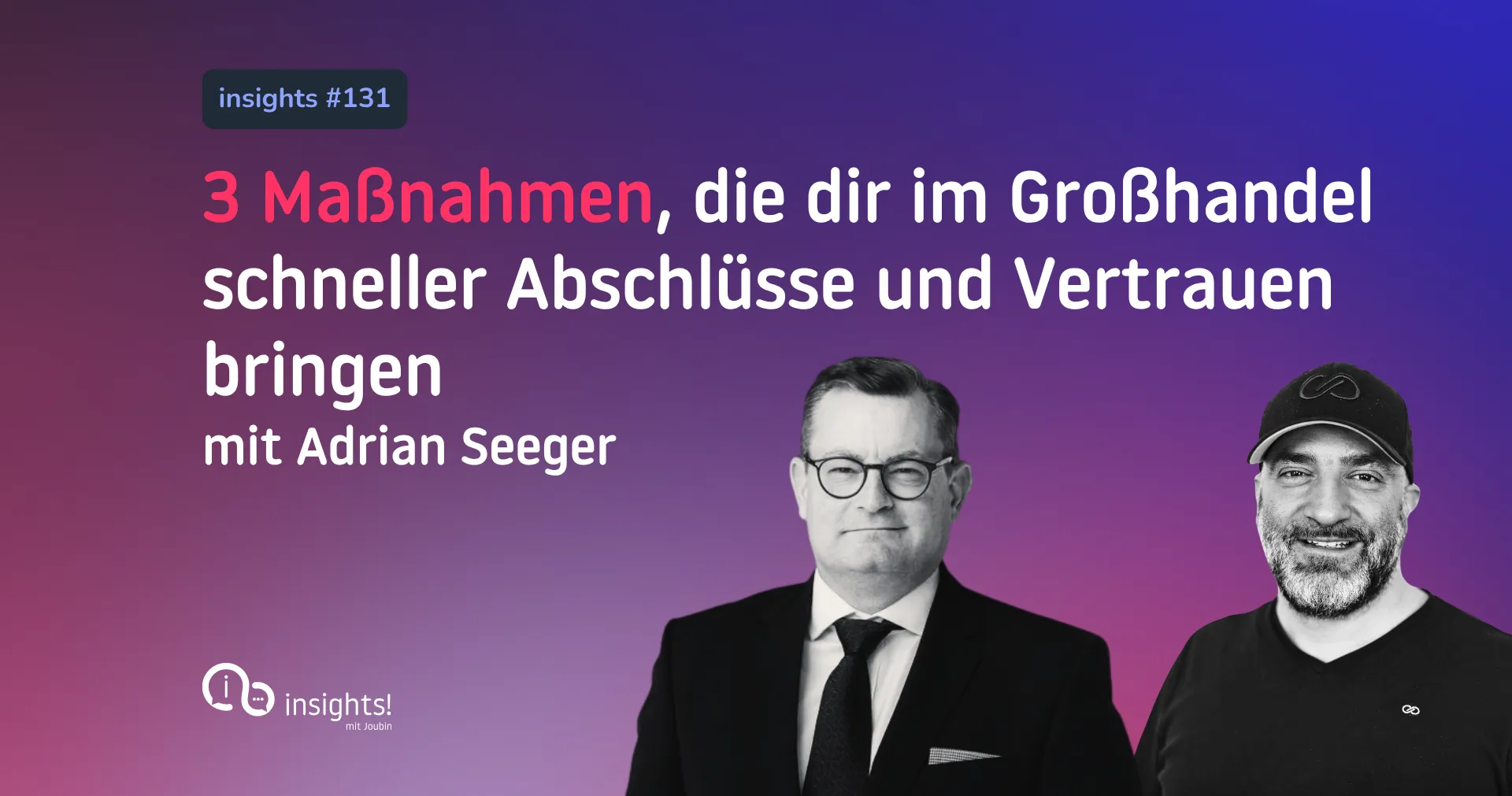
Wholesale has to emancipate itself and become part of the customer's value creation. Trust is built through speed - not only in delivery, but also in quotes and invoicing.
This episode shows why in wholesale it is no longer the shopping cart that decides, but service as a product, pace and smart AI support. You will learn how a 48-hour time-to-quote wins orders, how AI scales the quality of your quotes, and how availability, C-parts management and financing shift the conversation from price to solution. Your benefit: • Concrete steps to halve your time-to-quote and stabilize your processes. • Hands-on examples of how AI answers bills of quantities faster and makes consulting measurable. • A clear roadmap to secure margin through value, risk and speed.
The starting point: why wholesale is under pressure right now
Wholesale - like many other industries - finds itself in a demanding environment. The economy is faltering, interest rates are rising, margins are thin. In phases like these, the familiar question flares up: „Do we even need the intermediate stage?“ The German three-tier structure (manufacturer - wholesaler - processor/customer) is once again being put to the test. And yet: it is precisely this structure that offers opportunities. Financing effects, logistics advantages, proximity to the market. All of that is a lever - if you use it actively. At the same time, expectations are rising: customers are better informed, more demanding and more service-oriented.
Three pressure points you should not ignore
The current challenges can be named clearly - and tackled in a targeted way.
1. Cost pressure
Your margin is finite. Every wrong decision eats into your room to manoeuvre. That makes clean prioritisation of measures that show quick, scalable impact all the more important.
2. Service expectations
Information, speed, guidance: customers expect more than an article number. Service becomes a differentiator — measurable, marketable, monetisable.
3. Staff
Fewer applications, changing work attitudes, ageing workforces: you need new models, clear prospects and smart relief through technology. That's not a risk but a career booster for newcomers – even without company growth
Leadership instead of hesitation: courage is now a management task
Transformation does not begin in the tool, it begins with the decision. In a low-margin environment, every misstep feels expensive. Even so, doing nothing is the most expensive option. Your job: place clear bets, enable piloting and make successes transparent. At the same time, the view of „customer centricity“ is shifting. It is not enough for sales alone to know the customer. HR, finance, operations - everyone has to grasp what the customer is paying for and what they really need. That changes priorities, budgets and job profiles across the entire company.
Service as a USP: from supplier to enabler
Wholesale is ideally positioned to close real gaps - between digital and physical products, between manufacturer know-how and the daily reality of the trades. Smart additional services (from demand planning to on-site services) get you out of the price trap.
There is particular potential in the skilled trades: think of exoskeletons for large-format tiles, rental equipment „on demand“ or evening breakdown services in maintenance. Those are concrete, tangible forms of relief. You help get work done faster and more healthily - and become a partner instead of a supplier.
Speed beats everything: quotes within 48 hours
Today, time is a competitive advantage - in delivery and in information. The probability of winning an order rises massively if your quote is on the table within 48 hours. After 14 days it is practically zero. Speed creates trust, justifies prices and demonstrates the ability to deliver. That requires lean processes: central order processing, standardized quote building blocks, defined lead times and clear approvals. Make „time-to-quote“ a KPI that everyone knows and that you market offensively.
Digital levers: where AI immediately takes work off your hands
Apply technology where it has an immediate effect: • Answer bills of quantities (BoQ) at turbo speed: automatic mapping, variant creation, plausibility checks - all of it compliant, with bonus and manufacturer logic. • Prose instead of a line-item list: AI adds customer-appropriate value arguments to your quote („Variant B saves installation time“, „Variant C allows you to scale up later“). • Explainer assets on top: automatically generated short videos or one-pagers that get the differences across and make your consulting visible. • Private label integrated: algorithmically controlled alternatives - advise neutrally, increase margin, secure availability. These tools do not replace your experience. They scale it. And they make you resilient when the people who hold the knowledge retire.
From warehouse to network: anticipate demand, distribute stock intelligently
Instead of just picking faster, think one step earlier: forecast demand, organize stock across the network and display availability transparently. The clever part: you bring together insights from many customers - and build a lead that a single manufacturer can hardly replicate. That is how you become a partner „as an equal“. Anyone who anticipates needs gets involved in projects early, influences specifications and shifts the conversation from purchase price to TCO, risk and speed.
Processes as a sales booster: where you gain efficiency right away
Short-term relief without a cultural revolution? It is possible. Centralize incoming quotes and orders, harmonize master data, build templates for standard cases - and measure lead times live. Create transparency: which quotes are lost, where do things get stuck, how often does the customer follow up before ordering? In parallel you need C-parts management that is genuinely built into your costing - including process costs. Otherwise purchasing compares apples with oranges and blocks value the customer would pay for if they could see it.
Five concrete steps for the next 90 days
• Halve your time-to-quote: 48 h SLA, standard building blocks, central responsibility. • Automate BoQ responses: pilot with AI-supported variant creation and bonus logic. • Sharpen your service offering: 3 measurable additional services (e.g. Exoskeleton rental, after-hours breakdown service). • Customer rounds with management: visit one A, one B and one C customer per quarter - not just for dinner. • Onboard a financing partner: at least one offer for project or installment financing.
Would you like to listen to the full episode?
You can find the podcast of the interview here:
Please accept the corresponding cookies to view this embedded content.
Would you rather watch the episode? No problem!
You can find a recording of the interview here:
Please accept functional cookies to watch this video.
Would you rather read?
Joubin Rahimi
Wonderful to have you back for a new episode of insights! My name is Joubin, Joubin Rahimi, and with me today is Adrian Seeger. Hello Adrian.
Dr. Adrian Seeger
Hello Joubin, thanks for the invitation.
Joubin Rahimi
My pleasure. Thanks for coming. Would you like to say two or three sentences first for anyone who might not know you?
Dr. Adrian Seeger
Sure, my name is Adrian Seeger. I have been in wholesale for 20 years now, in various sectors - technical, electrical and building materials - and I have regularly supported companies through situations of change. In the beginning we did a lot with e-commerce. Then we talked about the whole topic of digitalization. Then we worked on customer centricity. Then came all the CRM and NPS tools. Today we of course also have a lot of transformation in the area of restructuring, which is perhaps due to the economic situation, but fundamentally I have been in this industry for a very long time.
Joubin Rahimi
And that connects us. I think the first customer who signed with synaigy was Wilhelm Koch. They no longer exist, in Osnabrück. That was the first project. But we still have many, many customers in that environment, and that is what today's episode is about. What defines the industry, or what mountain is the industry currently facing? Because things are not exactly going downhill right now. Well, downhill as in getting easier. That is somewhat ambiguous.
Dr. Adrian Seeger
Absolutely right. I think the industry itself is suffering from the same economic development as everyone else. That is quite clear. And whenever things get a bit tighter, someone in this chain inevitably asks the question: do we actually need these intermediary structures? That is completely normal. This discussion gets repeated like a broken record whenever something like this happens.
Joubin Rahimi
In other regions of the world it does not always exist in this form, does it?
Dr. Adrian Seeger
No, it is an almost typically German situation, where we talk about a three-tier structure: we have a manufacturer, a wholesaler, then a retailer, or in B2B, the end user. But this form has simply become established here in the market. And it does make sense. There are many advantages in it - a financing effect, a logistics effect and so on. But you have to say that today it is already a topic that puts a burden on things. Higher interest rates push up costs. Then we clearly have a whole range of new digital tools that challenge wholesalers to join in or to make a decision to do so. But of course they also create possibilities for manufacturers in the background to become similarly active and, in a sense, to build a bypass for large projects, for A customers and so on. That is certainly somewhat threatening. And then, put quite simply, we also have a situation where customers have simply become more demanding today. Quite naturally, because they are simply better informed. That has just changed. They are well informed both about the product and about the possibilities of service. As a wholesaler in today's world you simply have to think about how to do more there. And in my view service is certainly one of the truly essential points that will have to be decisive in the future, because it is a genuine differentiator. So wholesale actually has to emancipate itself and become part of the customer's value creation. And whether that happens with digital tools, with logistics topics or with product topics basically depends on the situation. And then the third and last point I see is the topic of people, which is also a scarce resource. It has never been an issue of the complexity it is today. On the one hand we have Gen Z, who certainly have a somewhat different work ethic than Generation X, which I still belong to. But we perhaps also have to say that there are simply far fewer applicants and far fewer young colleagues coming out of universities and schools, and they will all be fought over. And unfortunately it has historically always been the case that trade ends up at the back of the queue.
Joubin Rahimi
And it is somehow doubly bad, because with demographics, a great many people are now simply reaching retirement age. Exactly. And so you need even more young talent than in normal times. Absolutely.
Dr. Adrian Seeger
But I would like to say that if you take these challenges together, it does not mean that everything is dramatic. On the contrary, I think it is precisely now that the opportunity is there to change things and to be bold and go in a different direction for once. When it comes to recruiting, that is, hiring young people, there is the possibility of showing career prospects when older generations retire. That is really the opportunity in it, and that is great. And career prospects can be defined without the company growing. I think that is a really cool thing and it is something you can do these days. We can talk about working time models. That can be done in a situation like this too - models that are perhaps different from before, and that lend themselves to an environment like this. The same goes for digital tools. I believe wholesale sits exactly at the interface between the manufacturer and the customer and is therefore ideally suited to be a pioneer in using digital tools, to gain the first experience with them and to reap the benefits. And that is why I do not see it as a threat, quite the opposite - I see it as a great thing. And you yourselves offer good opportunities to try these things out and then also to turn them into a quick win that shows it is worth engaging with the topic.
Joubin Rahimi
What I see, and that is really the great thing about the industry and the situation: let me take the three challenges with me again. I have cost pressure, a great deal of it. I have cost pressure. At the same time I want to and have to increase service, and my workforce structure is changing. Personnel is not the largest cost factor, but in relation to services it is one of them. And now it fits perfectly that with AI, if I go into it and find the right things, I can then make service better. I can do more with fewer people, so I get less pressure on staffing, and at lower cost. And that is really what is exciting right now. If I approach it correctly, I can position myself as a wholesaler in a genuinely different way compared with others. Absolutely. This is now the time when I... I mentioned Wilhelm Koch. They did not make it. And in hindsight, and that really is 15 years, twelve years ago now, I can see fairly clearly why. There was simply no courage left, it was only being wound down. But those who really change something make the leap forward, and we will probably see that in five years when we are sitting here.
Dr. Adrian Seeger
What you are saying presupposes that the courage is there to make the decision for something like that. So it is a leadership question.
Joubin Rahimi
But it is difficult, given that we said margins are very small, one mistake in a decision. Absolutely.
Dr. Adrian Seeger
And then the margin is used up. That means you of course need a clean selection, but you also have to be clear about situations like the current economic moment. In Germany we are in the third year without significant growth, or rather no growth at all.
Joubin Rahimi
How many years do you expect it will continue?
Dr. Adrian Seeger
That is hard to say. If we assume that the investment booster comes next year, then that is a special economic cycle. It could lead to economic growth, because then basically all the dealers, especially those active close to construction, will be in demand, and some of it will stick. And 500 billion is quite a large sum. Add to that the other investment package, which is oriented more toward defense technology, and that will mean that mechanical engineering, and the suppliers behind it - again dealers - can take part, and then there will be economic growth. That may be a start that carries them. But fundamentally you must not forget that Germany, with 80% exports, is simply a business model that is strong above all in exports, and at the moment we are surrounded by trade restrictions. We see that certain markets have simply changed. Automotive in China has simply changed, and very, very quickly, and from within, without luxury brands, which used to be sold in large quantities, still being in demand. All of that has shifted. But there too I believe this situation offers an opportunity to position yourself now, as you just said, with new technologies and perhaps also with a somewhat different strategy, and then actually to change your USP.
Dr. Adrian Seeger
And if I say as a dealer today - back when I started working in wholesale, I worked in technical wholesale, and in the beginning we moved a lot of boxes. That was normal. Then we did the whole e-commerce topic and moved fancy boxes, but basically we just did it faster. Then we took it into the warehouse and everyone had a scanner and knew exactly what to do. So it was a fully digital process, until at some point the customer had scanned as well. Then that was done. Then we could send the invoice or debit it directly. Today we have to talk about actually anticipating the customer's demand, and anticipating it in such a way that we organize our stock so that it is as cost-optimal as possible for us, or organized within the network. Then the dealer is also a partner, because what does the customer want? Unfortunately the customer still has exactly the same view of it. They want a good price for a fast delivery time and yes, they are happy to take the service as well, but at the beginning it is always the same. It takes a great deal of persuasion. Because normally the customer assumes it is all included in the price. But at some point you have to teach them that it is a separate service. And there too you have to say that wholesale has moved into some great things, taken things on, taken over parts of the value chain. That started with providing master data. Those were the first things. Wholesale can of course do that perfectly. Then it went into logistics topics - on-desk deliveries were the sort of thing that came up around 15 years ago on a large scale. Later it went all the way into workshop delivery. Central warehouses at customers were abolished, because people said: okay, trade can do that for me, and if it is good at logistics, it can also distribute it across the plant. We began with things like that back then. Today that is completely standard. Then people talked about programs like C-parts management. Actually a great topic. Unfortunately many still have not fully implemented it, because we are still talking about apples being compared with oranges. The old game is that purchasing looks at the price. They have a price for a product. One supplier has C-parts management integrated. Then of course the margin, the costs are on top, and the other one does not. And then we are back to talking about how it cannot be mapped in SAP. You end up in discussions that are endless. But what is clear is that this is the only way for trade. It has to make sure it moves into value creation and does so intelligently, or takes over entire projects that are perhaps peripheral business for the customer, organizing production. It can usually do that, because its customers are exactly those people - and in that way it becomes something of an intermediary at the center of the web. And I believe if it does that, paired with intelligent, good digital tools that also offer a degree of added value... I think showing the customer a demand plan, showing what we expect them to bring, is very illuminating on both sides. And I believe that also creates the necessary standing of being taken seriously, so that... You have to be careful to get out of that purchasing corner. You have to become a partner on equal footing.
Joubin Rahimi
Alongside the core digital topics we always address, I also see the interface between digital and physical products in particular. So everything is becoming more smart home. And whether that is in the bathroom or in the kitchen. And you have different people doing these trades and none of them have a clue. And for a tradesperson it is of course much harder to say: I will work my way into that. I always have different manufacturers, and even if I just want LED lighting - that is not even smart home - LED lighting in the bathroom and I say: I do tiles. And that is where I see a real gap, for a wholesaler to move in, also toward: how can I make the work easier? Take the topic of tiles - large-format tiles are a great trend. Laying them is very strenuous. And tilers are also getting older and not exactly healthier in the process. Topic: exoskeletons. Who takes care of saying: okay, I will step in and say, if you work with us, we will lend you an exoskeleton so that you still lay the tile with two people, but with far less physical effort.
Joubin Rahimi
I think there are a lot of things you could do there.
Dr. Adrian Seeger
The umbrella topic of machine rental. We also started doing that some years ago.
Joubin Rahimi
But that was probably not a huge hit, was it?
Dr. Adrian Seeger
It was not a hit at all, to put it plainly. People expected far more from it than it turned out to be. In effect it was just another form of financing the machine. So the rental ended and then you could keep the machine. But the idea you are describing is a different one, namely knowing what the problem on site is in order to offer help that is not needed all the time, because they do not have to buy this aid if they only need it twice a month rather than every day.
Joubin Rahimi
And that is a modern thing, a real leap. That is maybe three, four, five years and then everyone has it. But as a wholesaler it will differentiate me at first and I can say: okay, I help you with your work, and that way you can do the bathrooms faster. You usually have fixed prices, so you can do more bathrooms, or you get home earlier and do not have to work on Saturdays.
Dr. Adrian Seeger
Exactly, that is it. Especially in the trades, I think those are things that absolutely have to come, because the problem there is that we are dealing with a group that keeps getting smaller, and you simply have to remain their partner. And you can only do that by helping them. Not so much via the topic of value creation, but rather by helping them do their work so that it gets done. Otherwise others will do it and you end up at the back of the queue. If you look at it in B2B, so in the simplest case in maintenance, in the most difficult case in the product, that is, in production, then it is somewhat easier to understand, because there companies also maintain departments and warehouses that, to be honest, are really no longer necessary in that form today, because the virtuality of the warehouse can now be created digitally. That means you can display availability, and the question is how quickly it is there. That is a question of the agreements about where it is stored. And even bringing it onto the site, or, if we are honest, saying: from 5 p.m. To 11 p.m. We will bring the tradesperson along, because you only have one and at some point their day ends. Then you get into the area where you say: right, now we are actually taking over functions, a breakdown service function. That is certainly something you can think ahead about, where there is also a possibility in industrial manufacturing, that is, if you really...
Joubin Rahimi
Sorry, that really is an opportunity. Absolutely. We have a Weiland heating system, we also live in Remscheid. Of course we have a Weiland heating system. Naturally. Or something from Weiland, and something was broken. And it was needed. So I called the tradesperson and said: no idea, let us swap something out. So something was swapped out, but it still did not work. And then I called Weiland and they said: yes, no, we do not do it directly. Go to the tradesperson. It was always this back and forth. And because we live in Remscheid and knew one or two people, we ended up in a B2B division and they helped us. But I found that interesting too. For me that is also completely the gap for wholesale. Absolutely. To say: yes, I offer that and then support it on a completely different level.
Dr. Adrian Seeger
In B2B that kind of support already exists. What you are describing is more pronounced there, that in the corporate customer segment you already take on services and do things as a matter of course, and the customer also already has the trust to rely on it, because that is the precondition for being able to do it. But in this trades segment it is not yet as pronounced, because it requires professionalism on both sides. And you must not forget that here we are talking about a one-to-many function, while the other is already a one-to-one relationship. The one-to-many relationship is harder to organize, but it is still the opportunity. Absolutely, quite clearly. And even so I have to say that, as badly as things are going right now - because I think much of it is externally driven, where nobody is really to blame, since many other industries are not doing particularly well at the moment - there is nevertheless an opportunity right now, simply because there is time to think about new ideas and then to tackle them. You need the courage to do it.
Joubin Rahimi
Now we are actually coming back to... Really, that was all overture. Absolutely. But what are the things where you say, as a wholesaler you can achieve savings and improve service at the same time? I have some ideas too, but you are the hero of this journey.
Dr. Adrian Seeger
Let us... I always look at the wholesaler as being there for the customer. That means we start with the customer. And if we put the customer at the center of all our measures, then it is all good.
Joubin Rahimi
I am really pleased - that is why I smiled into the camera - because then it is not a finance perspective, but one that is more sustainable.
Dr. Adrian Seeger
The advantage is, if you... I do not want to talk about that flat term „customer centricity“, because it is a bit worn out. I think customer centricity has to be thought about differently. It has to start with you understanding at the front end what the customer really needs, and the whole company has to understand it. And there are departments that are very far from the customer, an HR department for instance, because it never comes into contact with the customer, but it too has to understand what the customer's needs are, because they have to hire the right people. So basically you have to change a mindset. You can start doing that by talking about good projects, creating lighthouse examples, and also taking people along to the customer and giving them the chance to understand it. That works. Savings was your question. Savings have to be looked at on two levels. On the one hand in the short term within your own company, in order to cope with a certain situation, because right now it is loss-making. The possibilities are there, put very simply. There are always process optimizations, by starting to rethink processes and ideally then also digitalizing them, or consolidating processes, centralizing them, and if necessary carrying them out somewhere else where it is cheaper.
Dr. Adrian Seeger
The whole order processing topic today is normally dictated by the system, does not have to be done in many places, and can be done in one place. That is a huge saving, but it is also a huge lever, because it creates transparency that in turn gives the company an answer to: what is the customer actually doing? Because this customer information is not there. The second topic on the subject of the customer: today you have to think about innovative formats for understanding customers better. There is a very simple question that I keep discussing with colleagues. If you ask how many managing directors, CEOs, CSOs and so on have actually been to see a customer in recent years, unfortunately the answer is often silence. And that is where you can really see the problem. We are too preoccupied with ourselves. Everything that has to be done there is right, but at the end of the day there is only one source of money in a company, namely the customer's. So I also have to engage concretely with them and understand their wishes. And that is why it is not only the job of sales, as the one at the top of this pyramid, to build that bridge. I think it is absolutely essential that management goes to the customer too, and not just to the A customer for dinner, but perhaps also to a contract negotiation or to a claims discussion, and does the same with a medium-sized and a small customer. And once you have done that, you know how things really stand. And then you also understand to some extent what you have to do. And then all processes have to be aligned with that. And then we are at the topic of efficiency. Then you will also be able to answer the question immediately: where can you save costs? Of course we can go and say we will now do the accounting process differently, because we have to, because it is prescribed by law. Because that is a topic. Above a certain company size I have certain documentation obligations. That means I am dependent on it. But once I have understood what the customer wants and then look into my company and establish what I actually have there, I may find that these are things the customer does not want at all. And then I am at the topic of costs or, let us put it differently, then I am at the topic of opportunities, because then I may be able to convert what currently costs me effort into revenue.
Joubin Rahimi
We are also called in again and again to run surveys and optimize processes, because - and I would like to underline this - many managing directors really do not have the customer's perspective. And absolutely, that is not rocket science at all and it applies to us just as much and to every company. When a customer wants a quote, they do not want to wait long, because the person behind it gets three, four, five quotes and actually wants a swift decision. Or the possibility of a swift decision. It may be that internally they need longer, but really they want it fast. And a lot of companies are consistently slow there, and quite bluntly: if a company is slow at producing a quote, do I as a customer then get the feeling they will be fast at implementation? No. If it is already slow at that stage, the whole thing looks different.
Dr. Adrian Seeger
On this topic I would perhaps simply cite figures, statistics. The probability of winning an order if you submit your quote within a certain time, 48 hours, and make it available in readable form, is 40% higher than if it takes eight days. If you come with the quote after 14 days, the probability of getting the order is gone entirely. So that means if you have submitted your quote after 48 hours, you can even put higher prices in it, because the deciding factor is not only the price but also the fact that this one can produce it quickly, so they can probably deliver quickly too.
Joubin Rahimi
And also, they have done it a few times already. They do not have to reinvent everything. It should of course still be personal.
Dr. Adrian Seeger
And that is another topic where I believe we can already achieve a lot with the means available today, if speed is understood as a competitive advantage. And for me it is quite clear that it has become an absolute competitive factor these days, not only in delivery but also in providing information such as quotes, or in properly timely invoicing. It is also a question of how we agree on invoicing. And then it has to work as well. And the best deals I was allowed to organize were when we had got so far with a customer that at some point they said: I will give you the option of debiting the amount. So we essentially implemented a self-billing procedure, and that was great, because with that the level of trust is so high. Of course we have to document it. That is not the question. It also has to stand up to all kinds of audits, of course.
Joubin Rahimi
But it saves time on both sides.
Dr. Adrian Seeger
The invoice verification in that company - that was when I was in technical trade - which of course then has to check a great many small line items, is eliminated. That can be done digitally today, no question. But this entire booking process is also eliminated, because it simply happens.
Joubin Rahimi
Trust through speed.
Dr. Adrian Seeger
So, and I believe that speed is a competitive factor that these days... And again, only the wholesaler can do that, because they are in the driver's seat.
Joubin Rahimi
And that is one of those topics, bills of quantities. There too we found it works brilliantly, that they say: okay, we can answer faster, it shows our competence, it creates trust, and we can answer more of them, which is also remarkable. And that, in combination with the statistic you mentioned, means I simply build a structural competitive advantage.
Dr. Adrian Seeger
The topic of bills of quantities is one of those topics that are standard today. They get sent around to all sorts of people, and then everyone starts with their own program and answers it. And today there are possibilities - you yourselves are not exactly idle on that topic.
Joubin Rahimi
Funnily enough, at the moment there are still a lot of experienced people behind it who have to steer it somehow.
Dr. Adrian Seeger
And they can only do it because they have experience. And at some point we reach the point where they retire, and then we have a problem. And Gen Z simply does not do that. Exactly, they may not even want to. Even so, I think it is actually a nice example: a complex request needs a complex quote. And if we can support that digitally too, so that it can be made available very quickly, then I have a structural competitive advantage.
Joubin Rahimi
We came across it because customers say: yes, we already have a service like that, but it is not that good. We have to do a lot of rework. And when we then want to say, for example, that we want to bring in our own products, or increase the margin, or be as cheap as possible, or we need it via the manufacturer because we then get a credit note at the end of the year - and there are many other considerations for slicing it - then they bail out, because nobody feeds the prices in there, or the purchasing data or other things.
Dr. Adrian Seeger
And actually, as you rightly say, you have to build these basic principles of wholesale into a calculation like that. The topic that I have, for example, agreed a volume with a manufacturer in order to receive a bonus. So very simple logic, a classic standard, but I have to have it in that logic. In case I want to offer private labels as a manufacturer, even if only as an alternative, I have to offer them here as well, in order to show the customer what options there are.
Joubin Rahimi
That is highly complex.
Dr. Adrian Seeger
It is super complex.
Joubin Rahimi
Where do you have them, where not? You essentially have two quotes for it, or one complexly prepared single quote.
Dr. Adrian Seeger
Right. And I think that in this case in particular, that is, on private labels, you could talk for a very long time. There are many reasons that speak for them today, because they simply increase margin and are very sensible especially in the consumables area, which may not be visible - in tools for example, because the quality is absolutely comparable. But of course there is still the other case, where you can be very strongly brand-oriented. That has to do with bonuses. It is always a question of where you cover it. I believe there always has to be an as-well-as strategy. There must never be an either-or strategy; you really have to be able to do both. And then on the quotation side you of course have to be in a position to show the customer: you can have the brand, but in this or that case we would perhaps also recommend an option. And I think that is also a service only wholesale can offer. Of course you also have to comment on that service accordingly. You have to tell them that we basically have the know-how to be able to do something like that at all. That means I have to know the product, I have to know the alternative product, and all that know-how ends up in nothing more than a quote. And I think you have to be very clear that these days something like that has to be supported, because unfortunately today it is not the case that you get paid for quotes. Nobody has managed to implement that so far. But if you know what is behind it, it would actually be entirely logical.
Joubin Rahimi
You can extend the quote nicely, especially if you have two variants, even when the tradespeople reading the quote are specialists. And in the sanitary wholesale... Or no, electrical is even more complex. You bring in a new brand with a few new functions. A salesperson does not write all of that down. And if you then use AI to say: okay, I have the quote at this price, but you could also get this and you would have these and those advantages for your customer - because the tradesperson is often in competition too - then you have something at the same price that is better, or for a bit more money, much better, whatever. Absolutely. And that prose is completely missing. Tradespeople are not copywriters.
Dr. Adrian Seeger
And what is important is that you use other media for this, that you also train them to that extent. That sounds very grand now, but it is enough for the benefit of this product to be made comprehensible to them in a simple way, so that they can also convey it to the customer, because they are the ones on the front line, and that is possible today.
Joubin Rahimi
Or you also include a link. Or something I think could soon be coming, just as an idea: automatically generating a video for it. Quite bluntly, I already have all the assets. They are there. I use them to generate a video which, I think, if you do it now would still be a bit clunky, but in six months or a year you have a short explainer video showing what the difference is and what else you can pass on to your customer.
Dr. Adrian Seeger
Today there are explanations for every product, but you do not want to watch three videos - what you need is basically the synthesis of them, saying: okay, there is A, B and C, and this one has this advantage, the other has that advantage and the third has this advantage, and depending on where your benefit lies, we recommend thinking in this direction. And if you can produce that in the simplest way, individually for each customer, and pass it on with the quote, with the bill of quantities, then I think you are beyond.
Joubin Rahimi
And then perhaps one step further and say: I also have a second version, you send that to your customer or your prospect. I have prepared the quote for you. These are the differences. They can watch it, listen to it or read it.
Dr. Adrian Seeger
I think that finally brings the circle back to the customer. The customer asks about something today, possibly because they believe they know it. They may not know the complexity either. In the electrical field that is the case. But now offering them the possibility of saying: in addition to what you asked about, there is also A, B and C, and we will show you what is possible and we will bring you a comparison right away. And if you get that in a very simple form, so that it is consumable, as you just described - not through a table, but perhaps through a visual experience - well, that is decisive for the purchase. Incredibly decisive for the purchase.
Joubin Rahimi
And the service gets better too. Especially, let us say, take electricians, KNX or not KNX? Exactly. Because I had that question myself, I wanted smart home and then there is also KNX, what does it cost? There was simply a sum on it. Are there alternatives? Difficult. There are alternatives, I found out later, when a good friend of mine drilled into it, an electrical engineer. Of course he drills into it. I then decided on Meta. Would I do it again? I do not know. I think what my friend did there, I would have been tempted by that too. But who can really advise you there, and that is why I do not swap out a trade at the general contractor. No. When you also have a schedule like that, when you notice on the fly.
Dr. Adrian Seeger
As a customer, I think it gets difficult when you fundamentally have to make decisions and do not actually know the options, or do not know the option space. Or when you have to make fundamental decisions but know that the technology is developing further and you do not know whether one decision will at some point come to an end and you will then have to decide again. Those are the odd topics, and this is where you can provide support, because you cannot reasonably expect anyone to advise on that properly. But if you have data sovereignty in the background and you also have the product strategy behind it, then you can very well say something on a topic like that. And the wholesaler's advantage remains neutrality. They are in a position to sell several products, so they can also advise on them, so they can also evaluate them. And I think that is a really important topic. We have often talked about the customer knowing what they want and so on, but the example you just mentioned shows exactly that while that may be true in certain areas, in other areas advisory competence is precisely what is needed. And I believe that where the two come together, genuine added value is created.
Dr. Adrian Seeger
And then you can also make a great offer and are actually involved in the decision-making process.
Joubin Rahimi
And I think that is a great closing word, because the challenges are there and the possibilities are there too. Absolutely. This really is a tipping point for moving forward. What do you think - in five years, will the wholesale market, the number of wholesalers, shrink, or will new players arrive who suddenly play the game completely differently?
Dr. Adrian Seeger
Yes, I do believe the market will change. That has to do with the fact that it is a very fragmented market with a great many small and medium-sized players who, for various reasons, may no longer be around. There is this succession issue that we have left unsolved here in Germany. That affects this industry too. But there is also the fact that economies of scale really only start to make sense above a certain size, and that is not being reached there. And then you simply have to say that you also face investment pressure, especially when it comes to technological things, and you have to be able to afford them. So there are certain sizes that may not manage that alone, but that does not mean they will not manage it. It can mean they say: okay, then I will find a cooperation. And there is a lot of that. There are alliances. There are many options you can pursue there. And I believe the whole topic also has to be thought further along the chain, for example by taking away the customer's pain. Today we have a situation where many customers are quite simply short on liquidity. Okay, so do I have to work with a wholesaler who also offers me financing solutions? And there are certain wholesale sectors where that was not at all customary. But by now there are also very innovative buying groups that bring a bank with them. And they bring a bank with them because they have realized that I have to give the customer - the wholesaler in that case - the possibility of offering their own customer financing options in turn. And if you are clear that the entire car market came about because leasing was offered, and that only through that did this growth in the market come about, then for me that is the next logical consequence. And if you look at retail, especially the big Saturn and MediaMarkt stores, well, a large share of the products there is financed today over several installments. That has become completely normal. Those are these micro-loans. And seen that way, I believe it will find its way into B2B business at some point too. And whoever offers something like that today and is innovative and has said: yes, I will join in - they are in. And project financing is certainly feasible these days. We did it ourselves on larger projects together with customers, and I believe that is once again the topic of the customer, my favorite topic, which then really creates loyalty, because I bring more with me, not just a product or a service, but I also make sure they can pay for it. And with that I am completely out of the competition and then I am the enabler. Exactly. And in that respect... A good closing word.
Joubin Rahimi
Thank you, Adrian. Be enablers. Exactly. Thank you for your time.
Dr. Adrian Seeger
Thank you for having me.
Joubin Rahimi
My pleasure. Thanks for the insights. And if you have questions, feel free to post below or write to us. We are very happy to answer them. Absolutely. Make use of Adrian's expertise in this area, and be bold - I am looking forward to the next episode with you.
Dr. Adrian Seeger
Thank you very much.
Do you have questions or feedback?
Then get in touch with us directly.
- Joubin Rahimi
Managing Partnersynaigy
Show phone numberShow mobile numberShow email address
Subscribe to the blog now and never miss any news
✔️free of charge ✔️news every week ✔️expert knowledge
Please accept the corresponding cookies to view this embedded content.