

Why leading companies choose the CMS FirstSpirit
8 min read

Numerous large companies such as Airbus, Bosch, Liebherr or Wacker, but also major cultural institutions such as the Berlinale, rely on FirstSpirit for content management. Precisely because the system integrates so seamlessly into existing IT structures and offers such diverse development options, the number of FirstSpirit customers continues to grow steadily.
Content management for digital transformation
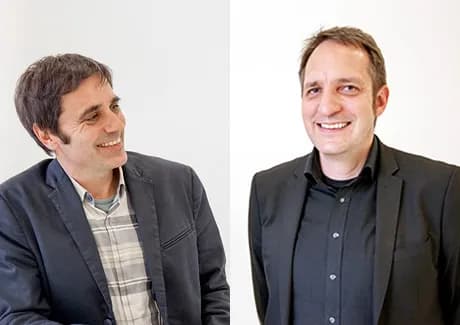
Dr Raphael Richter, senior project manager at e-Spirit AG, and Robert Birker, managing director of the Berlin-based full-service agency interactive tools, are connected by years of client consulting and work with the FirstSpirit CMS. A conversation about challenges, solutions and the future of content management systems.
Mr Richter, how would you describe e-Spirit AG in two sentences?
RR: e-Spirit helps companies realise global digital marketing and transformation strategies. To do this, we develop a content management solution, namely FirstSpirit, with passion and enthusiasm, enabling them to reach their customers efficiently and effectively across the countless channels available today.
Looking at customers and their needs, the term digital transformation comes up often. What does it mean for you and e-Spirit?
RR: we put on our customers' glasses: what are their pain points, what does our product need to deliver so we can support them optimally through digital transformation? Digitalisation is changing how companies reach their customers. They need to engage them differently than a few years ago, and to do so they must not only digitise but also transform – that is, adapt their business models to new possibilities. That's very much about customer focus. And content matters at every point of customer interaction, which is why content management as a strategic component is increasingly moving to the fore in organisations. The days when the CMS was just a tool for managing static HTML websites are long gone. Content now needs to be prepared completely differently and delivered highly dynamically and consistently across a growing number of channels.
In this context, what makes FirstSpirit special as a content management system?
RR: one unique selling point is our best-of-breed approach: all the heterogeneous systems from the marketing technology space, from analytics through e-commerce and real-time targeting to video management, that are used within organisations can integrate with FirstSpirit. This lets companies break down their silos, so they keep using the solutions best suited to them, but everything on one central, user-friendly platform, namely FirstSpirit. The system is platform-independent, meaning it works largely regardless of the operating system a company prefers. The customer's familiar frontend, e.g. a shop or a personalised website, can be retained. Thanks to this integration approach, users have the flexibility to easily adapt their best-of-breed infrastructure to changing requirements. The set-up is therefore ideal for transformation processes.
We regularly spark amazement when we show how easily FirstSpirit fits into an existing IT infrastructure and how simple it is to resolve issues with our CMS.
How do companies experience this CMS solution? Do you remember a special moment or an "aha moment" when you think of FirstSpirit and your customers?
RR: we experience moments like this again and again, especially in technical meetings. Many of our customers previously used other systems, ran into numerous problems and then presented us with a long list of questions. We regularly cause surprise when we show how easily FirstSpirit fits into an existing IT infrastructure and how simply our CMS resolves these issues. Architects and IT managers usually grasp straight away how to integrate their systems, while marketing and business units are delighted by the ease of use and look forward to running, for example, integrated, consistent campaigns that measurably boost customer loyalty or lead generation.
From e-Spirit AG's perspective, why does it make sense to enter into a partnership with service providers like interactive tools and develop product extensions/modules further using external expertise?
RR: e-Spirit is a product house. We decided early on to focus on software development and rely on committed, skilled implementation partners for project delivery. Partners also build their own project solutions and modules, which we add to our marketplace. They're also a valuable channel through which we keep getting customer feedback, and together we improve solutions for our customers in close exchange. Everyone involved benefits from this close, trusted collaboration — customer, partner and us as vendor.
As a "Trusted Partner" of e-Spirit AG, interactive tools uses FirstSpirit very frequently. Mr Birker, why have you relied on this CMS for years?
RB: we've been partners since 2005 and quickly noticed that FirstSpirit is a very interesting product, especially in terms of usability for editors. interactive tools focuses on usability and joy of use when developing websites, and that fits well with a content management system that convinces us not just technologically but also through its user-friendliness. Another advantage is that FirstSpirit handles even highly complex projects very well. Looking at interactive tools' development over the last ten years, it's clear that the big growth steps are largely down to FirstSpirit – especially in corporate communication and with B2B customers.
Which synergies, potentials and products emerged from the collaboration between interactive tools and e-Spirit, and what came out of it?
RB: over the years, in dialogue with e-Spirit's professional services, we developed various solution approaches. These include conceptual approaches that let us address recurring customer needs. How do I build an internationally oriented website so editors can handle it well? And how do we ensure the website simultaneously meets the often complex requirements of internationalising online communication? From questions like these raised by our customers, we develop technical solutions that we apply to individual company needs and deploy quickly. One example is our Dynamic Content Controller.
The advantages of FirstSpirit have now become clear. Are there also challenges in working with FirstSpirit?
RB: Challenge lies more in continuously evolving system and adapting it to customer needs. Right now much focus sits on static content generation. Greater complexity of website structure, more external applications connected via interfaces, harder both technical and editorial content management becomes. Our Dynamic Content Controller solves this problem. Yet as applications and systems keep evolving and changing, we will also keep developing and optimising this solution.
RR: With growing number of delivery systems in company, finding right path with customers to publish their content stays constant challenge. Challenge we always welcome, since our best-of-breed approach follows forward-looking path. FirstSpirit's hybrid architecture makes it fully flexible – system can pre-generate content in time- and resource-efficient way while frontend stays highly dynamic. For companies wanting to offer personalised digital online experiences, combining dynamism, resilience and high performance is efficient approach.
It's now about optimising the content and evaluating the respective goals set for the content, such as conversion, customer loyalty, new customer acquisition, revenue growth.
Mr Richter, how do you see the future of content management systems? What requirements will such a system face in future?
RR: future of content management systems lies in orchestration: it's about interplay of content from many different content sources, connecting with complementary best-of-breed technologies, and collaboration among editors in the broadest sense, working across locations to get brand messages and company content optimally to customer. "Customer experience" is the buzzword here. Now it's about optimising content and measuring against goals set for that content — conversion, customer loyalty, new customer acquisition, revenue growth.
How can companies meet these challenges?
RR: Companies need to rethink content completely. Content can no longer simply be managed. It's about creating it for specific target groups, delivering it consistently in a personalised way across a growing number of relevant channels, analysing it and optimising it to achieve measurable business goals. And always with an eye on the value for the customer in a world undergoing digital transformation.
RB: The internet is no longer just one of many communication channels; it's on its way to becoming the leading channel. We're seeing with our clients that high-quality, precisely targeted content is becoming ever more important. As content becomes more important, the demands on the systems used to manage it rise too. On one hand, it's about rethinking content; on the other, about creating the technical infrastructure. Content can't be generated by machines – it still comes from people's minds. And for these people, we need the best possible digital tools.
Your contact person
- Marian Gertheim
Consultingsynaigy
Show phone numberShow email address