
Headless CMS
Hitting limits with your current web CMS? A headless CMS opens up new possibilities, especially for omnichannel marketing.
15 min read
Definition: What is a headless CMS?
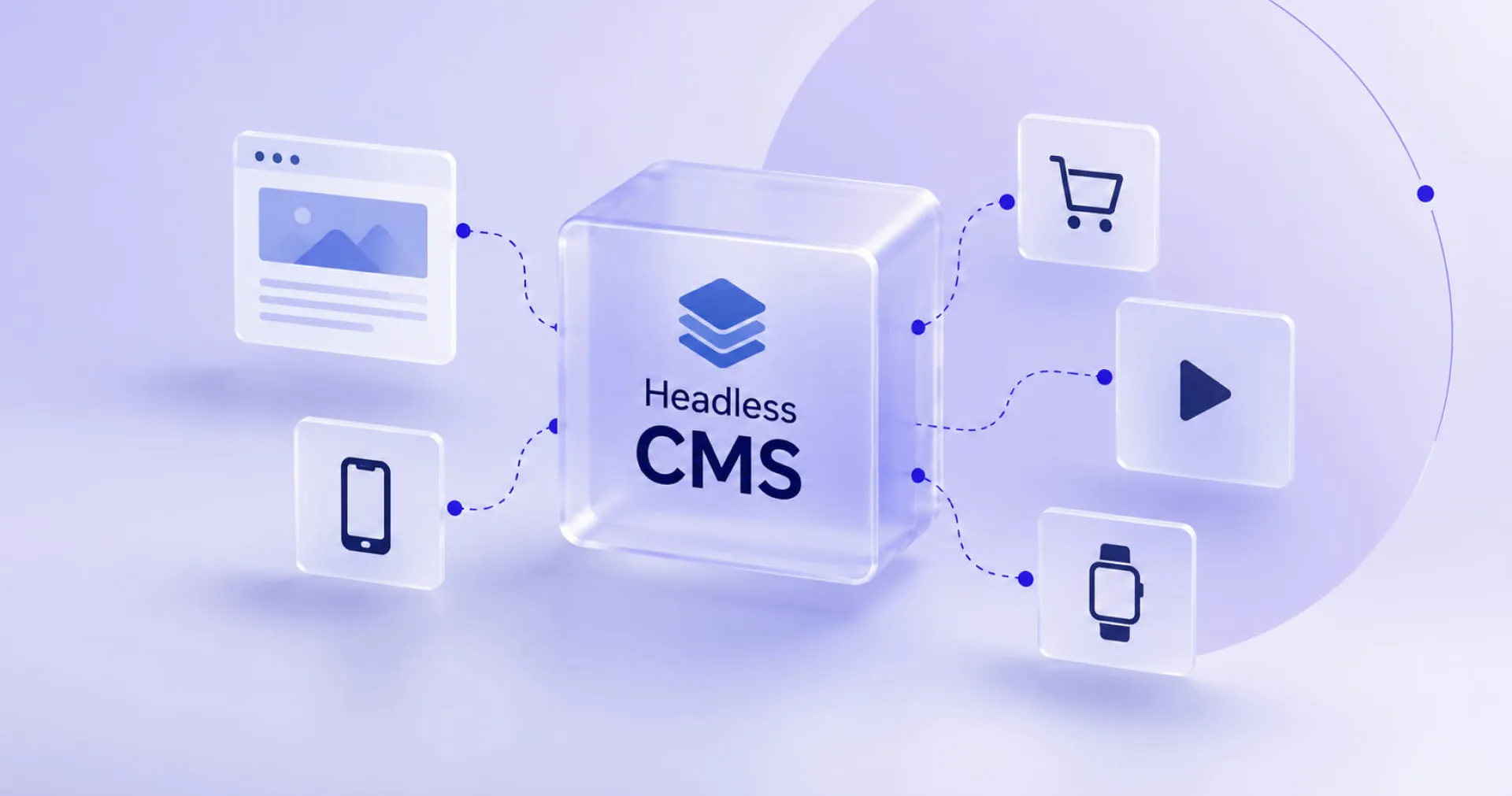
A headless CMS is a content management system that has only a backend and is primarily specialised in managing content. The frontend (presentation layer) is decoupled. Instead of rendering content itself, the headless CMS delivers it to other digital channels via an API (interface). This means a headless CMS can manage content not just for a single website, but for an entire digital platform with further frontends — such as customer portals, online shops, POS displays or IoT devices.
Headless CMS systems have grown steadily in importance in recent years and are now considered innovative solutions for managing digital content in complex ecosystems. Yet as the term “headless” becomes ever more popular, it's important to check carefully whether and when this approach is actually the optimal solution. Our many years of experience with CMS systems show that the decision for or against a headless system should be made carefully. It's essential to consider the specific requirements of your digital landscape and check whether the headless system's architecture meets them.
Who is a headless CMS suited to?
A headless CMS is the right solution for your content management if you
Actively pursue digital strategy for your marketing and sales.
Several digital channels, all of which play an important role, such as marketing website, online shop, customer portal and apps.
Further systems you'd like to integrate into your digital platform, e.g. for CRM or applicant management.
Want to personalise content for user groups, e.g. for private and business customers or multiple regions.
Benefits of headless CMS
Although headless CMS „lack“ one thing – the frontend – they offer a whole range of benefits.
Enables omnichannel strategies
As mentioned, a headless CMS lets you serve a practically unlimited number of channels. This technology gives you a genuine, digital omnichannel strategy for the first time. You can run channels not just side by side, but truly link them together – both internally and from the customer's point of view.
Your marketers and editors work in a central system and manage all content and campaigns from there. There are no technical restrictions from different systems any more. You align your campaigns purely with customer needs.
You also give your customers a seamless customer experience. They find the same high-quality, personalised content and offers everywhere. Your customers can conveniently switch between channels without any perceived disruption or extra hassle.
Efficient and scalable
Thanks to the special architecture, work in marketing and IT becomes much more efficient and faster. Content only needs to be created once, after which it's reused across all channels without extra effort. This significantly shortens time-to-market for new campaigns.
Your developers can make changes in the backend without affecting the frontends, and vice versa. You can integrate new backend systems and frontends at any time without changing the overall system. This lets you respond quickly to market changes and adapt your platform to your needs.
Powerful and secure
Separating backend and frontend also has positive effects on performance and IT security. For frontends you can each select most powerful technologies available. Content is loaded into frontends via content delivery networks (CDN); backend barely burdened. Digital platform thus responds quickly even under high visitor numbers, delivering great user experience.
Backend systems and data cannot be reached directly via the frontends. This gives them less attack surface for cyberattacks. Backend and frontend can be secured independently, each with its own specific measures.
How does headless CMS work?
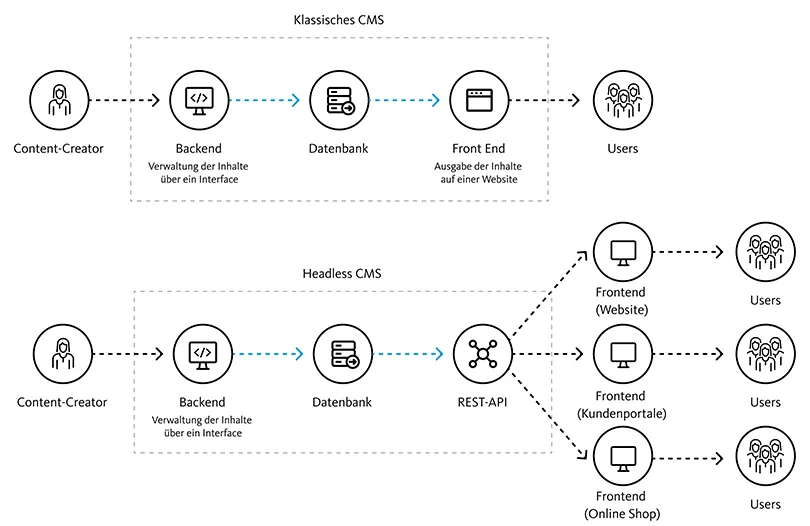
A digital platform based on a headless CMS consists of three layers – the headless CMS is responsible for the first two of these: backend, APIs and frontend.
Backend
Content hub: in narrowest sense, headless CMS backend consists of a database (repository) managing all content — text and media. Input and editing happen via masks or forms. The data has no formatting. It's stored as individual, structured elements that relate to one another. A blog article, for instance, would consist of elements like title, text, image and various metadata. This content can be shown in frontend as a connected blog article, but also used individually in entirely different contexts.
Editorial functions: Beyond pure content masks, most headless CMS platforms bring many further content management functions with them; for instance workflows and a role and permissions system for editorial collaboration within the team, a search function and management of content versions and variants, for example for multiple languages or personalised content.
APIs
APIs (application programming interfaces) are the link between the backend and the various frontends. Through them, the content from the content hub is retrieved and displayed in the frontends. RESTful and GraphQL are common types of such interfaces.
The APIs use standard protocols for data exchange. This simplifies connecting other systems. Solutions using the same protocols essentially just need to be docked on and can communicate with each other immediately. Via the API you can also connect further backend systems to the headless CMS, such as e-commerce, CRM or analytics solutions. Their data can then also be managed in the central content hub.
Frontend
In the frontends, content from the headless CMS is displayed to users; it can be combined with content and services from external sources. Layout and format are controlled via templates, which are, however, completely independent of the headless CMS. Developers build the frontends using various technologies. JavaScript-based frameworks such as React, Vue and Angular are often used.
Traditional web CMS compared with headless CMS
How exactly do traditional web CMS (monolithic or coupled CMS) differ from headless CMS? The table below compares the individual features. What becomes clear: for small projects where only one website needs to be created, traditional web CMS remain the better solution. As soon as several digital channels are needed, headless CMS becomes more interesting.
Web CMS
Integrated frontend and backend systems: The CMS includes both the database for content management (content repository, backend) and the editorial area, as well as the functions used to control how content is displayed (presentation layer, frontend).
Server-side rendering: The web pages are generated on the server and sent to the client (web browser, smartphone app, etc.) as finished HTML pages.
Template-based: The design of the web page is created using predefined templates in the CMS, which determine the look and layout.
WYSIWYG editors: These editors make it possible to create and format content in a layout without having to work directly with code.
Lower technical requirements: No deeper programming knowledge is required to design content in the frontend. Many CMS come with ready-made templates.
Headless CMS
Separation of frontend and backend: The CMS contains only the content repository. The presentation layer, responsible for displaying the content, is outsourced and managed separately.
No server-side rendering: Rendering of the content is not controlled on the server, but separately in the frontend. Client-side rendering can be used, which can improve performance and reduce loading times.
API-based: The headless CMS provides content via interfaces. This approach is called API-first.
Format-neutral content: Content is maintained and delivered as pure data without format. This enables flexible use of content across different output channels and devices.
Higher technical requirements: More technical know-how and effort is required, as frontend development and backend integration must be handled via APIs.
Hybrid headless CMS as a link
So-called hybrid headless CMSs combine the characteristics of both types and allow parallel use of the headless API as well as running websites via a built-in frontend. This can make the switch to the new technology easier.
Companies can, for example, first implement the corporate website in the classic way. This is somewhat quicker, and marketers and editors can initially retain their usual way of working. Nevertheless, the company keeps all options open and can gradually add further channels headlessly.
Challenges when implementing a headless CMS
Migrating to a headless CMS can bring some challenges:
Data migration
In traditional digital platforms, data sits separately in individual systems, often each in own format. Data exchanged via individual interfaces, manually or not at all. For headless-based platform, all data must be broken down into format-neutral, structured elements and transferred into central content hub. This part is among most demanding in a project.
That's why you should thoroughly analyse your data structures and plan the migration. It's also advisable to proceed step by step rather than migrating all systems or channels at once. This helps you keep complexity under control.
Designing the new user experiences
Traditional CMS or shop solutions have their own frontends and templating engines. They design user experiences individually per system, guided by that system's requirements or capabilities.
With headless CMS, process different: great freedom in user experiences. Consistent, on-brand user experiences across channels get built – while adapted to channels and personalised for target audiences. Great possibilities. But means different concepts and design processes needed than before. Frontend dev effort therefore bit higher at start.
The Magnolia CMS offers an interesting solution for this challenge: the Headless Accelerator. It consists of a library of frontend components. With it, you assemble your first frontends following best practices without having to start completely from scratch.
Changed editorial processes
WYSIWYG editor is popular tool for good reason: marketers can work creatively with it and flexibly adapt websites to campaigns. Running digital channels in headless mode, that's no longer possible. Frontend templates define how content is displayed, adapted to respective channel, device and user group. For marketers this can be unfamiliar at first.
Content management in an omnichannel environment demands different processes. Modern headless CMS platforms make this easier, though, with smart features. A live preview lets marketers see instantly how content will appear on the frontend – even in personalised variants. Marketers can also be given certain freedoms within templates. Analytics features help them optimise content to best fit user needs.
Headless CMS unlock unlimited potential for the future
Sounds like a mere marketing promise, yet it's true: headless CMS is the best investment in your digital platform's future-readiness. Reason: the open, API-first approach. Want to integrate more systems, technologies or services down the line? Build innovations? Run more channels? Whatever it is: your headless CMS always stays the heart of the platform. No major relaunch needed anytime soon just because current system hits its limits. Via APIs, you keep extending your platform around the CMS without the overall system growing more complex or sluggish.
And most importantly: you can always offer your customers the best customer experiences and gain a digital edge over the competition.
Find out in another article how to build a Digital Experience Platform (DXP) for this purpose.
The right headless CMS for your digital platform
Looking for the right headless solution for your platform relaunch? We at interactive tools have already delivered numerous projects with Magnolia, Crownpeak (formerly FirstSpirit), TYPO3 and other systems. We're happy to help you analyse your requirements and, of course, with planning, development and operation of your future digital platform. Get in touch, no obligation.
In summary: the benefits of headless CMS
Unlimited different channels and systems connect
Enables high-quality, seamless omnichannel customer experiences
Efficient, centralised content management
Modular, scalable system
Short time-to-market for campaigns, features and innovations
High performance and security
Open to all future digital technologies
Your contact person
- Daniel Richter
Web Developmentsynaigy
Show phone numberShow email address