

Update: content management systems for businesses compared
8 min read
Every company has different requirements for its own website. Some need an international corporate website, others work with several campaign-driven microsites, and some companies operate complex portals that serve as international sales, contact or brand platforms.
One thing they all have in common: they use content management systems (CMS). These systems enable the creation, management and delivery of content – the foundation of digital communication. But which is the best system for your organisation? We've done the CMS comparison.
Straight to CMS description:
FirstSpirit TYPO3 Drupal Wordpress
How to find the right CMS for your organisation
Choosing the right technology can be enormously helpful. The CMS determines how responsible staff from different departments/branches manage and control content. The CMS provides the foundation for online communication with customers, the public and other target groups.
The following criteria influence the choice of CMS:
Structure and processes of the company
Current system landscape in the company
Aim of the website
Needs of target group(s)
Managing multiple websites
Multilingualism
Nature of content
Drupal
FirstSpirit: high-end technology for high demands
FirstSpirit is the flagship among enterprise CMS platforms. It's particularly suited to companies with complex IT infrastructure, multiple business units or an international structure. It can also deliver and manage less complex websites, intranets, magazines or campaigns to a very high standard. Alongside its comprehensive flexibility, FirstSpirit's usability for editors deserves particular mention.
Seamless integration via APIs
The stable CMS system architecture from manufacturer e-Spirit can easily be integrated into existing IT infrastructures via interfaces (APIs). A standardised access interface enables the connection of existing applications and data sources. This makes it easy to integrate product information systems (PIS), online shops, portals, CRM systems or other applications. By separating the editorial system from the website, the system also meets the highest security standards.

Internationalisation of websites with the FirstSpirit CMS
FirstSpirit is particularly well suited to central editorial teams that want to control content at a global level and across multiple business units. The internationalisation of websites is an important criterion for enterprise CMS — and this is exactly where FirstSpirit convinces. The CMS enables professional multi-site management. This means websites in different languages can be created and controlled from one central editorial team — and the CMS provides simple, intuitive editorial processes and workflows for this.
FirstSpirit is also designed as a content hub. Through complementary products and models such as FirstSpirit CaaS (content-as-a-service), the CMS connects to any number of digital touchpoints (e.g. Mobile apps, smart/connected devices in the Internet of Things, right through to shops, portals or third-party websites). This makes content available on demand with no further implementation effort needed. Have specific ideas or creative concepts for your corporate website? No problem!
Individually extensible CMS
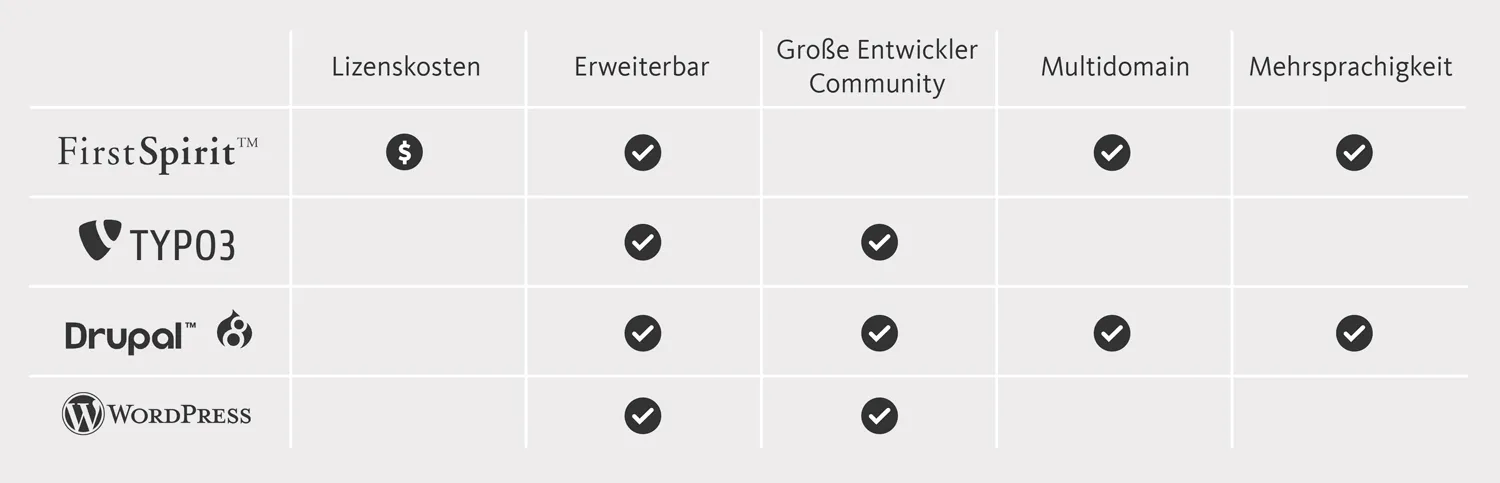
Thanks to modular approach, CMS can be extended as needed and enables tailored, customer-specific requirements. We have 13 years' expertise developing and implementing FirstSpirit and are "Advanced Partner" of manufacturer e-Spirit. Through licence costs, manufacturer e-Spirit enables centralised, controlled further development of system.
The advantages of FirstSpirit at a glance:
Enterprise content management, cross-media management, print management and media asset management from a single source
Built on Java and XML, flexibly configurable and adaptable to the needs of the business
Ready-to-use editorial environment, which can be extended with custom applications as needed
Central information platform in the company: ability for seamless integration into existing IT infrastructures
Through multi-domain or multi-site content management, different country sites can be managed from a central editorial team and controlled via specific approval workflows
Dynamic, personalised content through the Dynamic Content Controller developed by interactive tools, which can be supplemented with customer-related user data
With Solr and Elasticsearch, two powerful search technologies are available
TYPO3: the open-source CMS for businesses
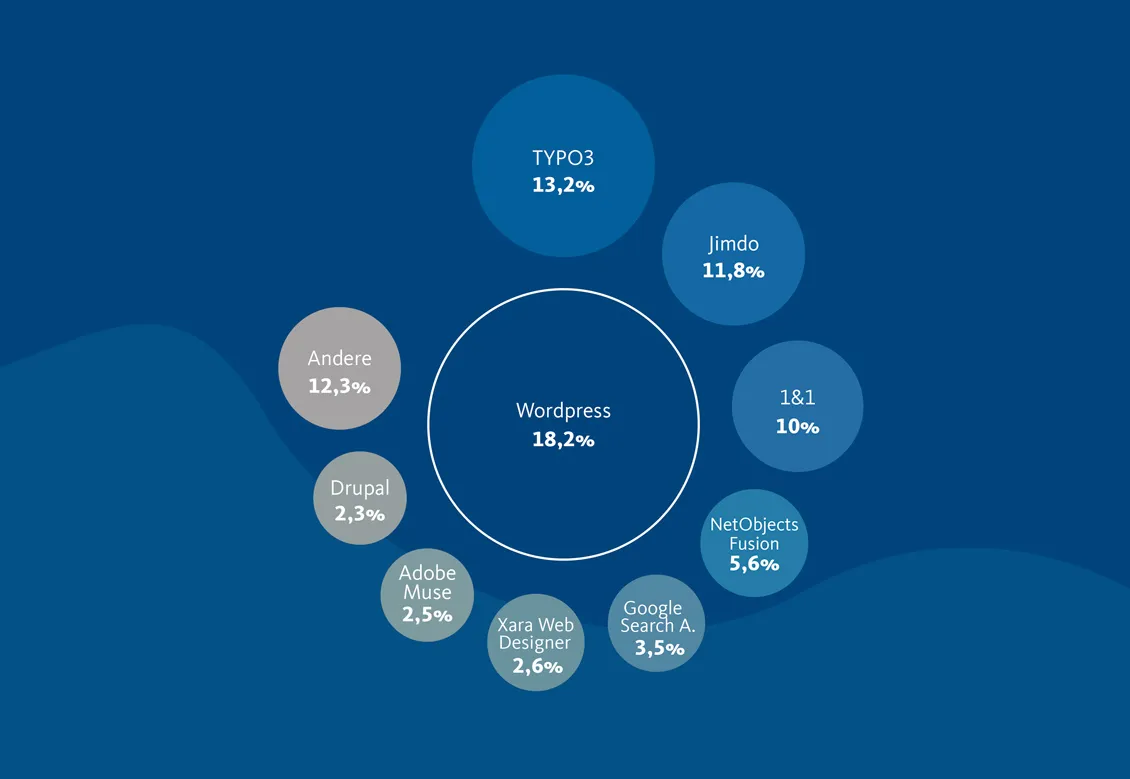
TYPO3 is the second most widely used CMS in Germany. It has a very large community of developers and users and is under continuous development. Being open-source, it comes with no licence costs. On top of that, Long Term Support (LTS) keeps your corporate website regularly supplied with all major security updates. The CMS can be adapted to customer needs via more than 1,500 extensions — TYPO3 extensions. So if you have specific ideas and requirements for your website's functionality, extensions help bring them to life.
Certified TYPO3 integrators at interactive tools
Do you need a function that isn't offered by conventional extensions? No problem. Interactive tools employs certified TYPO3 integrators who can programme new bespoke extensions. So even with TYPO3, you get a website that is fully tailored to your requirements.
Central management of multilingual websites
The Bootstrap Framework serves as the foundation for TYPO3 projects, enabling fast and responsive implementation. With the framework, workflows can be better planned and shortened in advance. The result is a user-friendly – meaning fast – implementation of the website on all mobile devices. An important aspect, since more and more access happens on mobile. The CMS is also well suited in the context of internationalisation. For globally active companies, translations are possible directly within the CMS. Content for multilingual websites can, just as with FirstSpirit, be managed centrally.
The benefits of TYPO3 at a glance:
No licence costs
At least three years long-term support (LTS) for TYPO3 core
Continuous development driven by large developer community
Individual customisation via over 1500 extensions
Additional extensions can easily be programmed in
Direct newsletter dispatch from the CMS
Manage multilingual websites and translations directly in CMS
Continuous relaunch with TYPO3: ongoing optimisation of website

Drupal: the all-rounder among CMS
Compared to other CMS platforms, Drupal is particularly suited to building extensive news, social publishing and community portals. So websites where users generate content themselves, post comments or interact with other users. Companies can make optimal use of Drupal's advantages and structures if they focus on the rapid delivery of generic content such as news and want to communicate this in an automated way.
Like TYPO3, Drupal is open source software, so using it incurs no licence costs. Drupal also has a large community of users and developers who ensure consistent further development and innovative solutions. The CMS is virtually infinitely extensible. Following a modular building-block principle, thousands of modules and extensions can be combined with one another. The result is a website designed and optimised to your company's requirements.

Multi-site management and multilingual support
And for those working with it: clear, user-friendly menu navigation makes content management in Drupal much easier. Multi-site management — running several websites — and multilingualism also possible in Drupal.
Over 91 languages are now available for Drupal websites, including right-to-left languages such as Arabic, Persian or Hebrew. Thanks to its scalability through a framework, fast loading times and responsive implementation on all devices are possible here too. The CMS also remains reliable under high traffic and continues working without disruption.
The benefits of Drupal at a glance:
No licence costs
Continuous development driven by large developer community
Easily scalable user management for e.g. portals and company websites
Representation of comprehensive or content-rich websites
Multidomain or multi-site management and multilingualism
WordPress: popular, open-source, simple
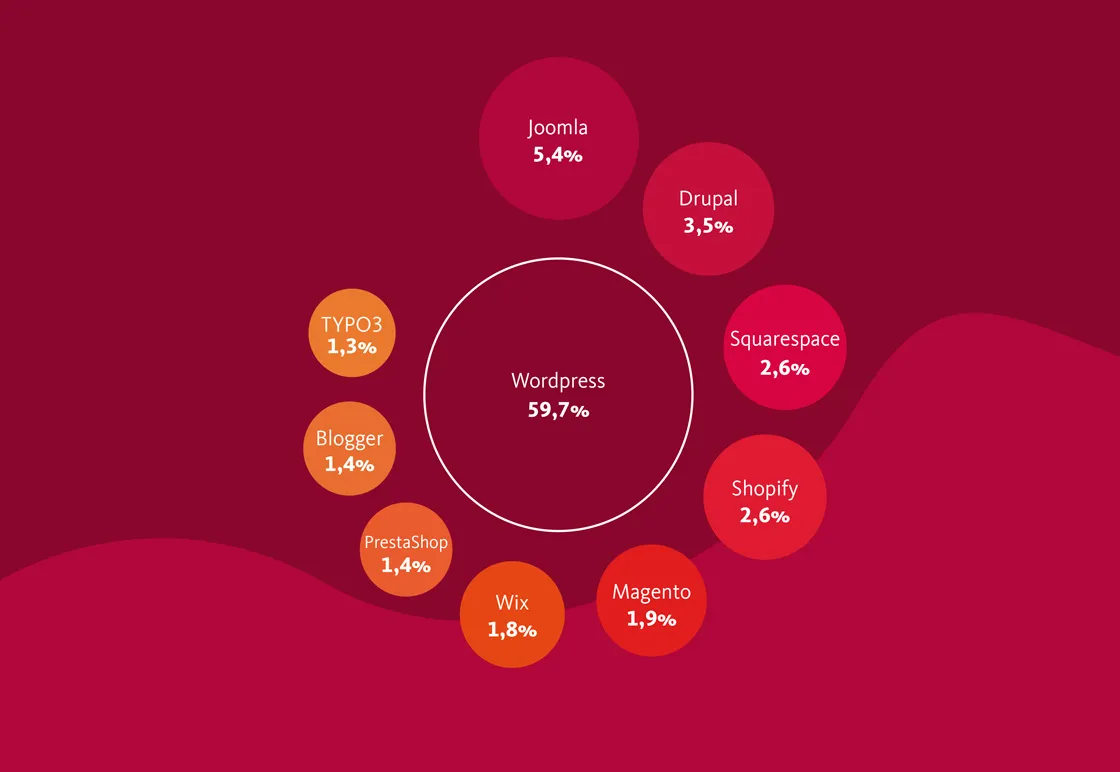
WordPress is the most widely used content management system on earth. Around 18 million websites worldwide run on WordPress. Originally, WordPress was designed as a blogging system. In the meantime, various extensions enable the integration of many new functions and turn WordPress into a fully functional CMS. Like TYPO3, WordPress is open-source software, the use of which incurs no licence costs.
Fast installation and dynamic content
WordPress is known for straightforward installation and setup. There's a huge range of free or inexpensive templates and designs that make it possible to build and publish a website in record time. The initially limited functionality can be extended with many plugins. In addition, the backend lets you place pages and articles in the menu automatically or manually — handy when content needs to be dynamically controlled or personalised, for example.
Many individual parts cause security risks and sluggishness
Due to its widespread use, WordPress by far has the largest developer community of any CMS. This community often provides its plugins and themes free of charge. The huge variety of extensions offers near-limitless possibilities for shaping websites. However, not all plugins are optimally coded, which can lead to incompatibility and security issues.
The many extensions make the originally small, compact software comparatively complex and cumbersome. On top of that, the backend can only be edited to a limited extent.
The benefits of WordPress at a glance
No licence fees
Continuous development driven by very large developer community
Easy extension of functionality via plugins
Representation of comprehensive or content-rich websites
Fast installation
Conclusion
To make a strategic decision for the right CMS, you first need to assess your resources, the requirements of your communication and your existing IT infrastructure. For complex and international structures or the integration of a product information or CRM system, both TYPO3 and FirstSpirit are suitable. With Drupal, on the other hand, you can optimally implement smaller projects or the development of extensive social publishing and community portals.
The decision for the right content management system depends on many factors. With over 20 years of experience in developing, implementing and using content management systems, our experts are happy to advise you: from requirements analysis through strategy and CMS selection to implementation and further development. Call us or arrange an appointment.
Your contact person
- Frank Weisser
Consultingsynaigy
Show phone numberShow email address