



Schmersal x synaigy: B2B shop replatforming to Shopware in eight months
Switched to Shopware in eight months, including integration of SAP, PIM and payment provider, with go-live for all countries on a single day. This is how Schmersal mastered its replatforming with synaigy.
Project profile
- IndustryManufacturing, safety technology for machines and systems
- Project objectiveReplatforming of the international B2B online shop to Shopware, including integration of existing systems
- Technologies usedShopware; integration of SAP (ERP), PIM system and payment provider; infrastructure and hosting by synaigy
- Project durationPre-project and hackathon in 05.2025, project start 08.2025, go-live in 05.2026
B2B shop replatforming to Shopware for K.A. Schmersal GmbH & Co. KG
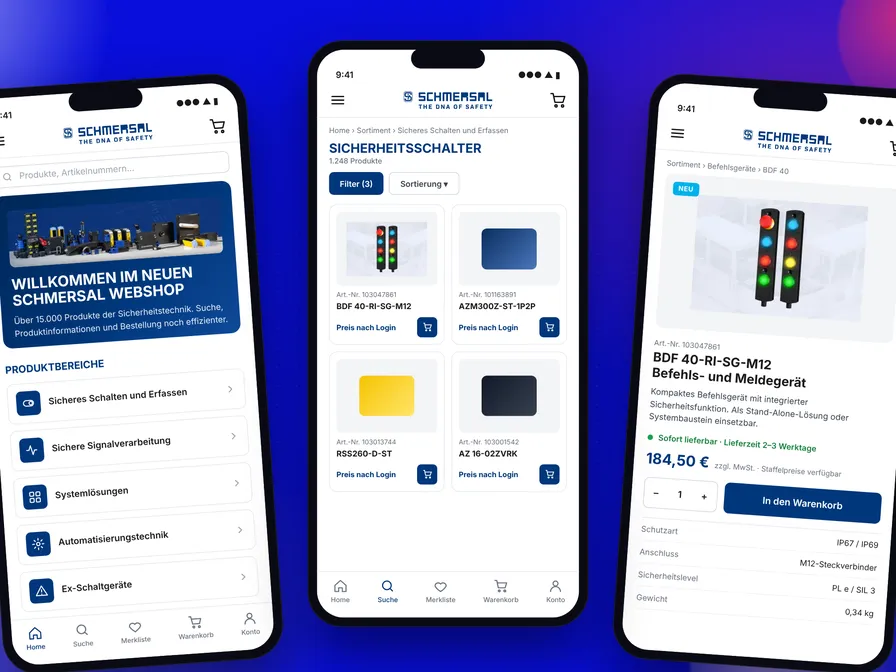
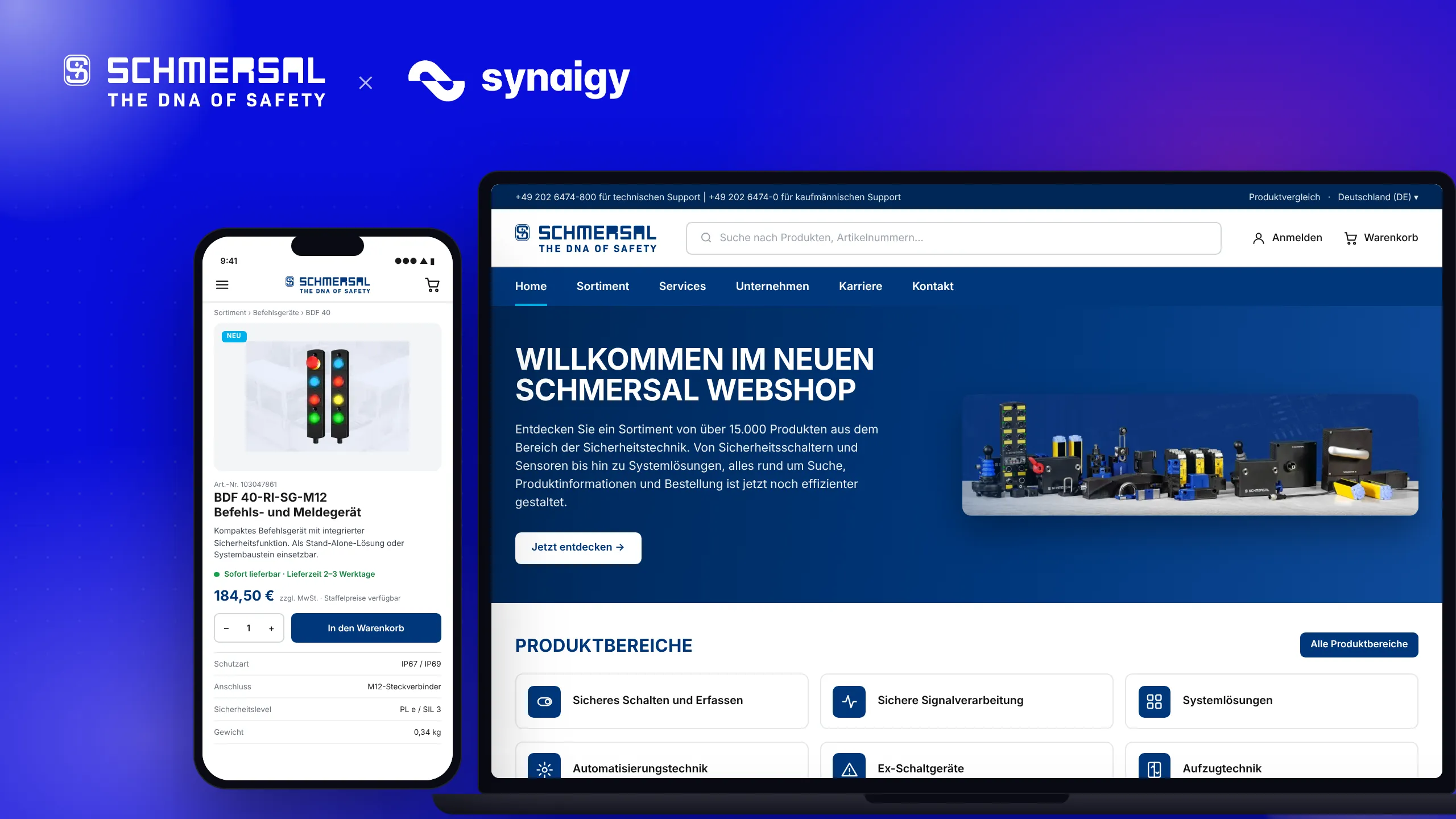
Schmersal operates an international B2B online shop and has replaced the previous platform with Shopware. synaigy rebuilt the shop from scratch, integrated SAP, PIM and the payment provider, and provided infrastructure and hosting from a single source. The special feature: with AI-supported development, the project could be brought within the budget framework and implemented in around eight months.

I have never worked with a service provider like you before. So professional and at the same time so easy to handle. You really have to give both thumbs up. We were all really, very, very satisfied.
Initial situation
The initial situation at Schmersal
Schmersal operates an international B2B online shop and was faced with a clear task: the existing platform was to be replaced by future-proof technology that runs stably and where all points of contact come from a single source. The impetus for the project therefore came from the technology side. The goal: a reliable foundation for the shop.
The team deliberately took time for the platform decision and compared Shopware, Intershop and Shopify, because a replatforming is an investment that needs solid justification. Schmersal brought with it a basis that synaigy has rarely seen: a detailed requirements specification of around 230 pages with image descriptions and links, in which the complete functional scope of the shop was documented.
The task was therefore clearly defined: the existing functional scope was to be rebuilt on Shopware, including integration with SAP and the PIM system. The catch: the first estimate exceeded Schmersal’s clearly defined budget framework. This is where the real work began: how can a complete replatforming be made possible within this framework?
Solution
The solution: Shopware and AI support throughout the entire project
Instead of simply calculating the requirements specification, synaigy first started a pre-project with Schmersal. There, the requirements were refined together and compared with usage figures. For individual features it quickly became apparent that they were hardly used and could be removed. This created a scope that was oriented towards what users really need.
To bring the project within Schmersal’s budget, synaigy took a new approach. In a one-week hackathon in May 2025, the team examined whether and how much effort could be saved in development through the use of artificial intelligence. The result: with AI support, the calculated effort fell by 26%. On this basis, Schmersal gave the go-ahead for the project.
Solution
The use of artificial intelligence and the technical foundation
synaigy communicated transparently from the outset that AI would be used in the project. Over the course of the project, it became clear where AI delivered the greatest added value: in development, in bug fixing and problem analysis, and in building basic functions. AI also helped in project management, for example in preparing status reports for Schmersal and in matching requests with the requirements specification to clearly separate change requests from the agreed scope.
For Schmersal, AI became tangible wherever speed was concerned. Design components in Figma were set up with AI support and could be implemented in the shop more quickly. When Schmersal submitted a request, synaigy was able to show a result on the site within a very short time, often according to the principle: requested today, in the shop tomorrow.
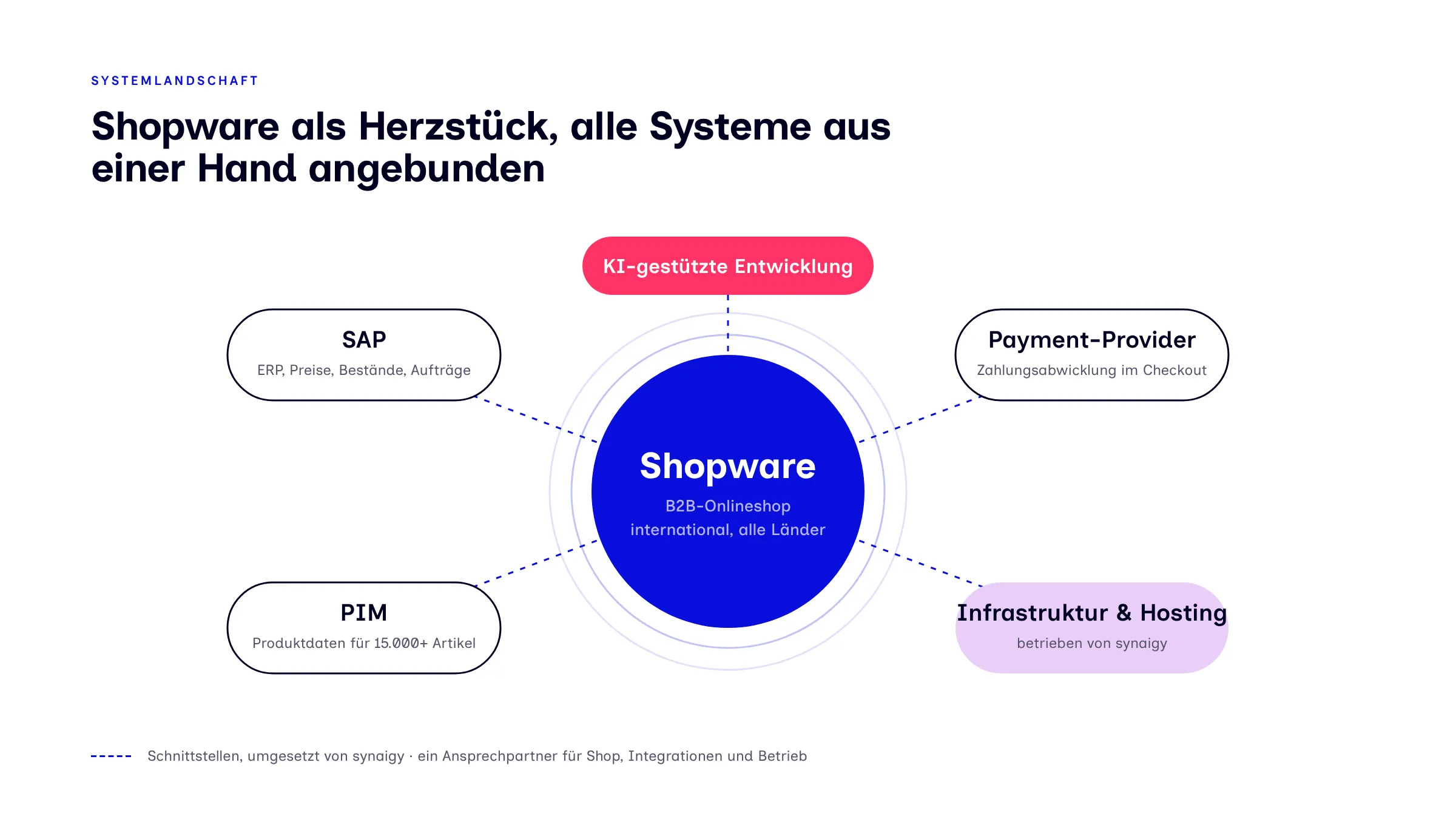
From a technical perspective, synaigy built the shop on Shopware and integrated the existing systems. This included integration of ERP (SAP) and PIM as well as connection of the payment provider. Infrastructure and hosting also came from a single source. This was particularly important to Schmersal, because it means there is one single point of contact for all questions instead of many. Previously, the team had to call around various service providers when problems arose.
Project success factors
A key success factor was collaboration on an equal footing. Schmersal entered the project with a small team of four people and a high level of decision-making authority. The team worked directly and closely with the developers at synaigy, without detours through additional coordination loops. This made the project pace possible.
And when something did not go according to plan, it was addressed openly. When it became apparent that the original AI-optimized schedule was too ambitious, synaigy communicated this transparently and readjusted it together with Schmersal. For Schmersal, this was exactly what built trust: not a classic client-contractor relationship, but one team. Over the entire project duration, there was not a single escalation.
Services at a glance
Pre-project and scoping
Requirements from the 230-page requirements specification refined together and compared with usage figures
AI-supported development
Hackathon with 26% lower calculated effort, AI in development, bug fixing, design and project management
Shopware and integrations
Rebuild on Shopware with integration of SAP, PIM and payment provider as well as infrastructure and hosting from a single source
Result
The result: go-live for all countries on a single day
The official start was in August 2025, in March the shop entered the international test phase, and in May 2026 it went live: a replatforming including SAP and PIM integration in around eight months. Schmersal made a bold decision that synaigy had never seen with any other customer: instead of a phased rollout in country cohorts over several months, all countries went live on a single day.
The difference is particularly noticeable in stability and performance. From Schmersal’s point of view, the checkout process has also become significantly better than in the old shop.
The takeaway: replatforming no longer has to take one or two years today. With clear requirements, a customer-side team empowered to make decisions, and AI-supported development, a complete platform switch including integration of existing systems is possible within a few months.
And the story continues. Schmersal continues to rely on synaigy after go-live and actively seeks AI expertise. Together, the focus is now on unlocking the potential of the new platform. The technology switch has been completed. Now the work on user experience and growth begins.
Let’s talk about your project.
Every project you see here started with a simple conversation. Briefly write to us what it is about. We will clarify the rest together.
Please accept the corresponding cookies to view this embedded content.