

Accessibility
Digital accessibility opens virtual doors and enables unrestricted access to digital offerings. From 2025, implementing accessibility will become a legal obligation for many companies.
9 min read
Accessible websites – how everyone benefits from them
Accessibility enables everyone to use web offerings without restrictions. In doing so, it not only creates better solutions for all and improves usability, but also has a positive impact on user-centred design, sustainability and SEO (search engine optimisation) for a website. While public institutions have been engaging with this topic for some time and taking measures towards digital accessibility, the commitment to an accessible website also pays off for finance and e-commerce companies. Despite the many benefits, the sheer number of accessibility requirements often leads some companies to forgo it entirely. For many, however, implementing web accessibility will become a legal requirement from 2025.
Find out here how to make your web offering accessible and promote digital participation for everyone.
Accessible internet – what's behind it?
An accessible internet makes digital offerings available to everyone. Regardless of visual, hearing, mobility or information-processing impairments, the person's age, or their technical capabilities. Accessibly designed websites are therefore important for every user.
The standards for accessible digital content are set out in the Web Content Accessibility Guidelines (WCAG 2.1). These extensive requirements are continuously expanded and sit at the heart of numerous guidelines and specifications developed to promote an accessible internet. On this basis, the Barrierefreie-Informationstechnik-Verordnung (BITV 2.0) was created, which enshrines the practical implementation of these guidelines in German law. Implementing digital accessibility is currently a legal requirement for public sector websites. However, with the Barrierefreiheitsstärkungsgesetz (BFSG), accessible design of digital services will become mandatory for many more companies from June 2025: anyone offering electronic services via a website, e.g. in eCommerce or financial services, will be legally required to make their website accessible.
Even though compliance with and implementation of accessibility standards is not yet a legal requirement for everyone, the applicable standards should be considered in every digital offering. Because with a focus on usability and accessible design, it becomes possible for everyone to use web offerings without restrictions.
Accessibility is the key to inclusion and opens doors for everyone to participate equally in digital life.
How you can test accessibility
An early evaluation of your website helps identify digital barriers while they are still easy to remove – ideally already during development. As an experienced partner, we're happy to support you at every stage – from initial planning through to the targeted implementation of accessibility.
Our free accessibility check shows you within seconds how accessible your website is – and where action is needed. Simply enter the URL of the website you want to check into the input field. The tool automatically analyses the website and checks it for accessibility issues (e.g. Missing labels or insufficient contrast).
Because everyone benefits: reasons for accessible websites
Accessibility is not a luxury. Only an accessible web offers equal access and equal opportunities for everyone. Accessibility makes digital participation possible – regardless of hardware and software, language, culture, location, or physical or cognitive abilities. An accessible website is therefore helpful for all visitors, as it is always user-friendly, intuitive to use, readable and understandable.
There are also strong business arguments for accessible design:
Increase Sales: In a society that is becoming increasingly older and more diverse, you’ll reach more potential customers over the long term.
Boost SEO: You’ll support your website’s search engine optimization and increase your reach.
Improve UX: By making your website accessible, you’ll enhance its user-friendliness—even on mobile devices.
Increase Satisfaction: With an intuitive layout and easy-to-understand content, you can boost customer satisfaction.
Set an Example: By creating an accessible website, you can demonstrate social responsibility and help promote greater digital inclusion.
For many website operators, accessibility poses a major challenge, especially in light of the legal requirements that will take effect in 2025. To remain competitive in a diverse and digital world, it is crucial to place greater emphasis on accessibility. This is the only way to ensure that digital offerings are accessible to everyone and remain viable in the long term.
Please accept functional cookies to watch this video.
To remain visible online and be perceived positively, you should focus on accessibility early on.
Checklist: how to make your website accessible
How accessible is your web presence? How accessible is your content? What measures are there to further improve accessibility?
The following points help with an initial assessment of your website's current status and are based on the four principles of the Web Content Accessibility Guidelines: Perceivability, operability, understandability and robustness (compatibility).
Is the website responsive and the content scalable?
An accessible website is easy to read on all devices. The content remains clearly legible even at high magnification.Is the page structure clear and easy to understand?
A clear and well-structured website makes it easy to find your way around. This includes marking up structural elements such as navigation, page content, headings, lists and quotes.Is the language easy to understand?
Short, understandable sentences and largely avoiding jargon ensure the content reaches all users.Is the text easy to read?
High contrast and consideration of colour vision deficiencies ensure good legibility for everyone – even when using a mobile device in direct sunlight.Are image descriptions and subtitles provided?
When images have alt text, screen readers can read them aloud. Subtitles make videos accessible to people with hearing impairments. This allows both people and machines to grasp the content.Are interactive elements easy to select?
Links and buttons should not be too small, so they can easily be selected with a finger on a tablet or smartphone, for example. With the update to the WCAG guidelines, defined minimum sizes for operable elements will soon apply.Are the forms designed to be accessible?
Accessible forms are essential so that all customers can get in touch or place online orders without difficulty. This includes clear and understandable labels for form fields and other input fields.
Do you need support planning or implementing your accessible website?
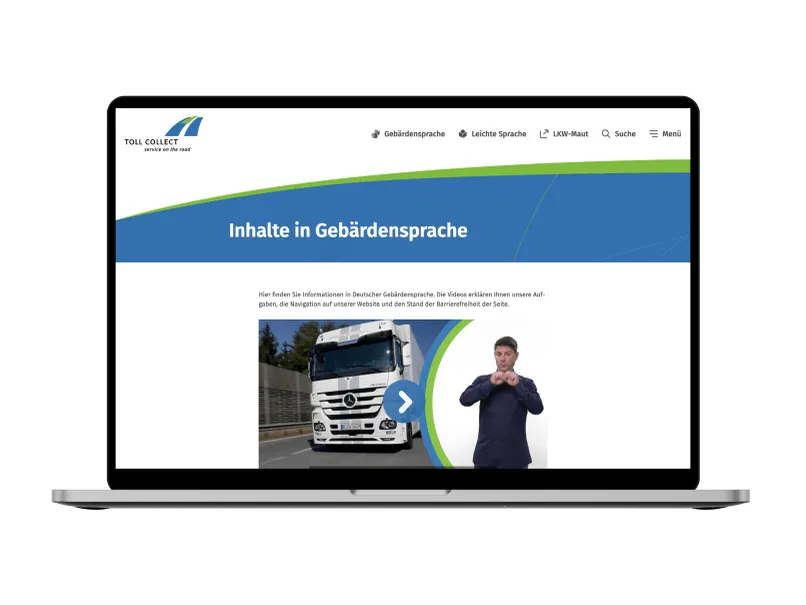
We're happy to support you at every stage – from analysing your existing website to gradually improving accessibility, right through to developing new accessible platforms. As an experienced partner, we've worked for several years with clients such as Investitionsbank Berlin (IBB), the GKV Spitzenverband and Toll Collect on developing and implementing accessible solutions.
In a nutshell: ROI for accessible websites
Increased reach through accessibility for everyone
Improved user experience and higher customer satisfaction
Improved search engine ranking through accessible design and optimised content
Positive brand perception as a socially responsible company
Higher conversion rates through accessible ordering and checkout processes
Long-term competitive advantages through meeting statutory requirements
Your contact
- Timo Wirth
Creationsynaigy
Show phone numberShow email address