

Cloud
Future-proof your business: the ultimate guide to cloud transformation.
13 min. read
Digital transformation is a decisive factor for almost every business to remain competitive in the long term. Cloud transformation plays a central role in this. It offers the opportunity to modernise and consolidate IT infrastructures that have grown over years and are often heterogeneous. We show you the potential cloud technologies hold and how to integrate them into your IT strategy to successfully drive your organisation’s digitalisation forward in the long term.
Without the cloud, there’s no digital transformation.
TABLE OF CONTENTS
What is a cloud transformation?
Why move to the cloud?
What cloud models are there?
What are the benefits of cloud computing?
Security challenge: how to use the cloud safely
Unlocking the full potential – what do serverless, cloud native and AI enable?
Getting started: recommendations for cloud migration
Migrating your IT infrastructure: in 9 clear steps
Examples: what does a successful cloud transformation look like?
Why you should tackle cloud transformation
1 | What is a cloud transformation?
Cloud transformation describes the shift from traditional, mostly local IT infrastructures (on premises) to cloud-based solutions. Cloud solutions are more than just technical infrastructure; they foster agility and help organisations respond quickly, use feedback efficiently and shorten release cycles. As a result, cloud transformation leads not only to more motivated teams and smoother workflows, but also to significant cost savings and faster delivery of working software.
Deciding to implement cloud services therefore opens up access not only to state-of-the-art technology, but also lays the foundation for a modern corporate culture that fosters innovation and flexibility.
2 | Why move to the cloud?
Yes, why exactly? Why set a change process in motion that can affect all business processes, why take on the risks of a data migration, why hand over control of your systems?
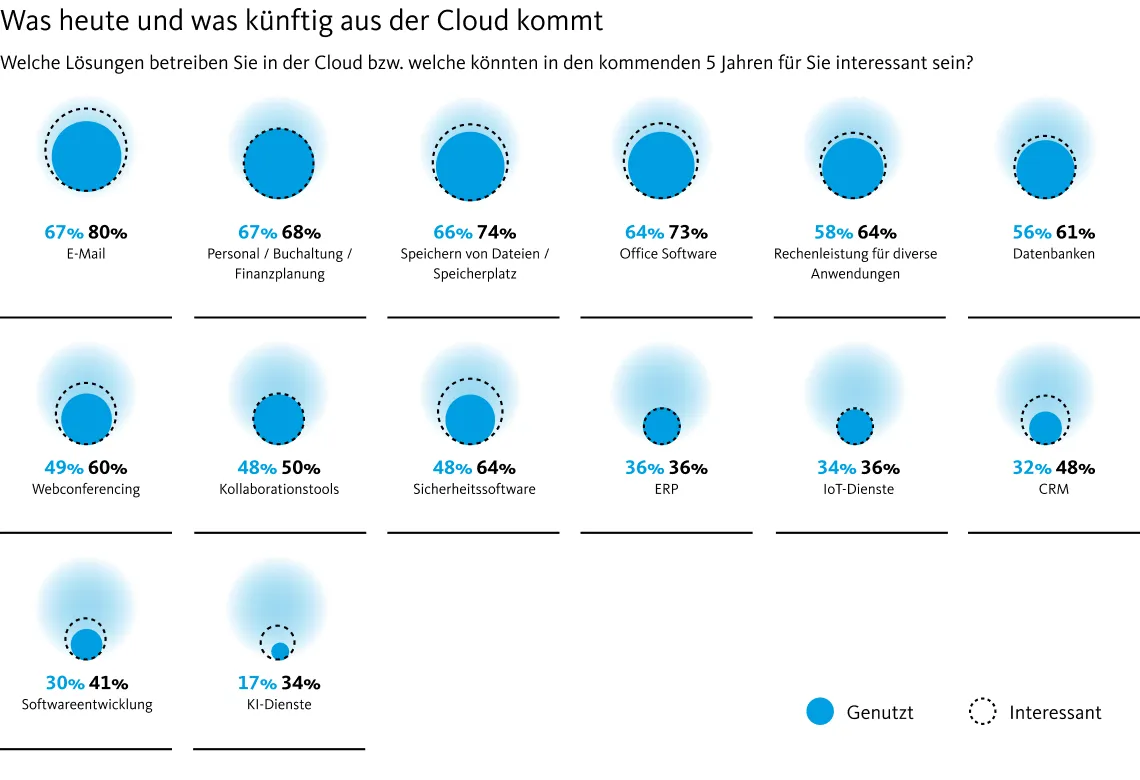
Quite simply: because the strategic use of cloud technologies is necessary to succeed in future. Because artificial intelligence unfolds its potential in the cloud. Because teams can collaborate more agilely. Because application performance scales with your organisation’s growth, not the other way round. The question shouldn’t be “cloud, yes or no?”, but rather “which IT architecture structures should run in the cloud, and which should stay on prem, so my business remains efficient and competitive?” The answer to that can look very different depending on the business model.
3 | What cloud models are there?
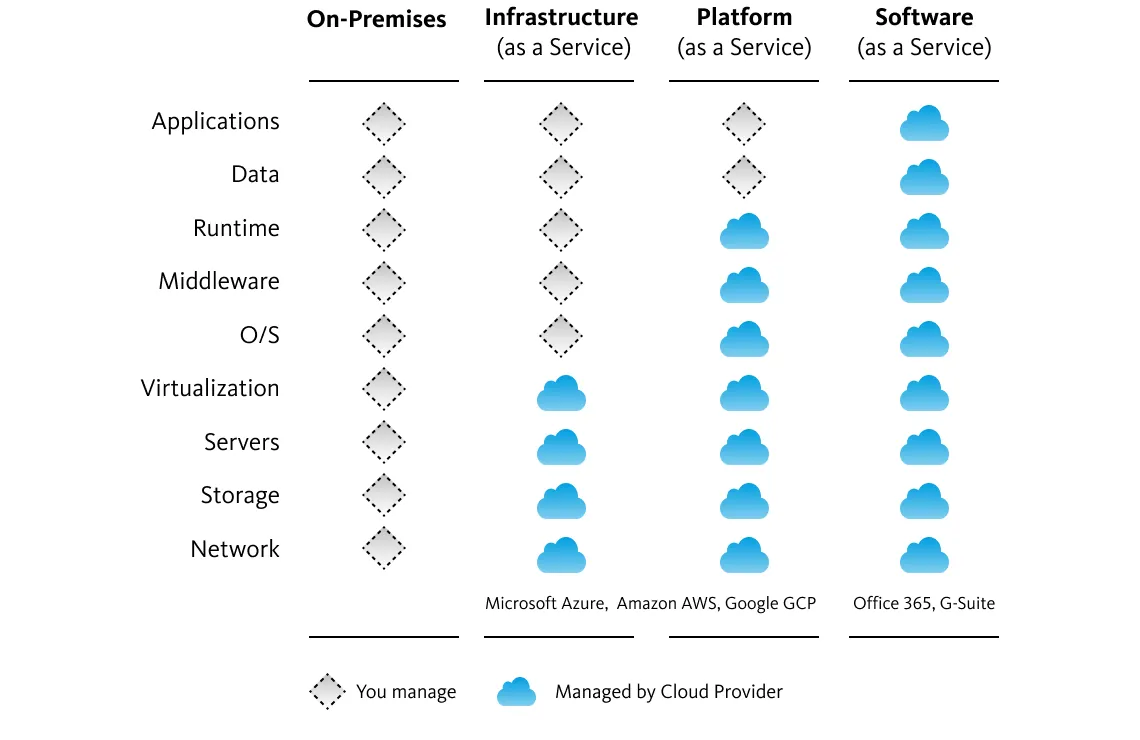
The cloud offers various architectures that can be chosen depending on organisational needs. Besides the option of hosting all services on prem or on your own hardware, there are four primary service models in cloud computing.
CLOUD SERVICE MODELS
Infrastructure as a Service (IaaS): IaaS provides basic infrastructure resources such as virtual machines, storage or networks. Companies can use these resources to manage their IT environments without owning physical hardware. Amazon Web Services (AWS) and Microsoft Azure are prominent IaaS providers.
Platform as a service (PaaS): platform as a service is a cloud computing solution in which an application platform is provided by a third-party provider. Development and programming teams benefit from this model, as it allows them to develop, run and manage applications without having to build and maintain the underlying infrastructure themselves. PaaS solutions can run either in the cloud or on local infrastructure. With fully managed services, the PaaS provider handles the hosting of hardware and software and provides the platform to users as an integrated solution, solution stack or service over an internet connection. Well-known examples include AWS Elastic Beanstalk, Heroku and Red Hat OpenShift.
Software as a Service (SaaS): this is fully provided software accessible via the internet. Users don't need their own IT infrastructure to use the services. Examples include CRM systems (e.g. Salesforce) or office software (e.g. Microsoft 365).
Function as a Service (FaaS): FaaS is a cloud computing service that lets customers run code in response to events without having to manage the complex infrastructure usually involved in developing and deploying microservice applications. FaaS and serverless computing are often used interchangeably. Well-known providers include AWS Lambda, Google Cloud Functions, Microsoft Azure Functions (open source) and OpenFaaS (open source).
CLOUD ENVIRONMENTS
Additionally, as part of a cloud transformation process, companies can choose between different cloud environments.
Private cloud: Private clouds are cloud environments that are exclusively allocated to a single user or user group and are often operated behind their firewall. Private clouds no longer need to be based on local IT systems. Increasingly, organisations use off-premise data centres from third-party providers, meaning arguments such as location and ownership lose their significance. Private clouds are particularly suitable for organisations that require a high level of control over their data.
Public Cloud: IT resources that are provided by an external provider and used by multiple organisations.
Hybrid cloud: a combination of private and public cloud that allows particularly sensitive data to be kept in-house while less critical processes run in the public cloud. Red Hat's 2024 Global Tech Trends Report found: "Hybrid cloud environments are the norm, and organisations generally favour neither a private cloud (21%) nor standardising on a single public cloud (9%). Instead, they report the importance of a well-thought-out hybrid approach."
Multi-cloud environment: more and more IT decision-makers rely on a multi-cloud strategy that lets them use services from several cloud providers at once. This allows them to combine the best features of different providers while minimising the risk of dependency (vendor lock-in). For example, companies might use AWS for their IaaS needs and Google Cloud for their AI applications. According to the IBM® Institute for Business Value, a comprehensive hybrid multicloud platform technology can generate more than twice the value of using a single platform and cloud provider.
Although SaaS accounts for a large proportion of software usage in modern enterprises, internal application development also remains very important. This is reflected in the fact that half of self-managed applications run in a hybrid cloud.
4 | What are the benefits of cloud computing?
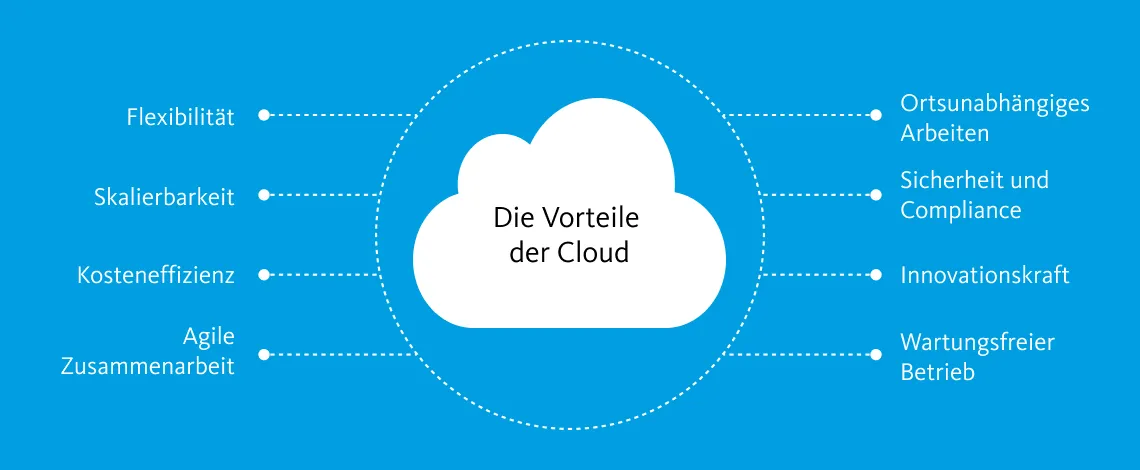
Flexibility & scalability: One of the biggest benefits of cloud computing is the ability to respond quickly to changes in the market or the organisation. B2B companies can scale their IT resources up or down in near real time. This offers an enormous competitive advantage, particularly in industries with heavily fluctuating demand.
Cost efficiency: since cloud services are billed on a consumption basis (PAYG = pay-as-you-go), companies only pay for the resources they use. High investment costs for their own servers, maintenance and IT infrastructure are also eliminated. As a result, targeted use of the cloud can lead to significant cost savings.
Agile collaboration & location-independent working: with cloud computing, employees have access to important data and tools anytime, anywhere. This not only eases collaboration in global teams but also encourages the adoption of flexible working models such as home office or hybrid work.
Security and compliance: cloud providers invest heavily in security measures that often go beyond what individual companies can achieve on their own. The large cloud providers also offer extensive tools and certifications to help companies meet data protection guidelines and standards.
Innovation through automation and AI: many modern cloud platforms already integrate artificial intelligence (AI) and automated marketing technology (MarTech). For example, Magnolia's cloud CMS uses ChatGPT, DALL-E and DeepL to create audience-appropriate content directly in the CMS in line with corporate language, generate matching visuals, produce translations for different markets, and tailor content for delivery across different channels.
Maintenance-free operation: compared with conventional on-premises structures, customers don't need to carry out any maintenance themselves with a cloud application. Extensions, patches and other updates are rolled out automatically by the provider, eliminating costly, time-consuming updates.
There are requirements that may call for cloud solutions, particularly when it comes to data integration and real-time services.
5 | The security challenge: How to use the cloud securely
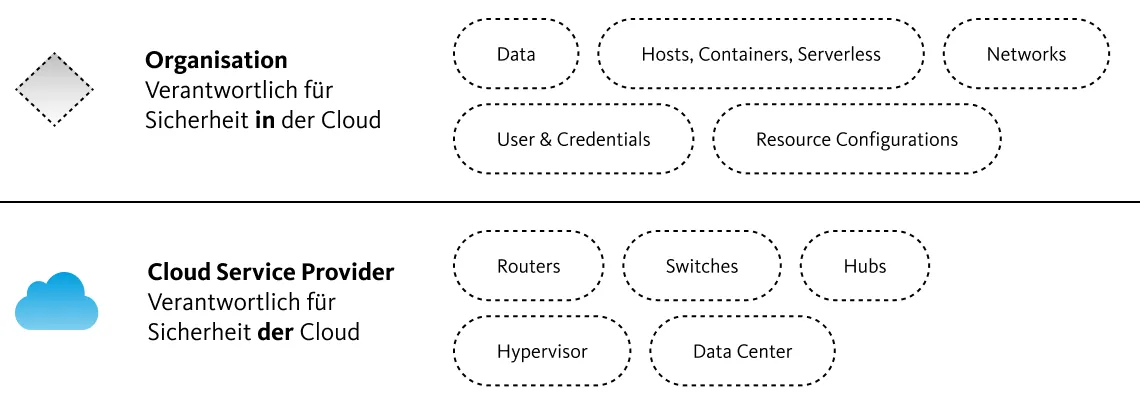
To implement a cloud transformation securely, companies should develop a multi-layered security strategy that covers both technical and organisational measures. Some security requirements within a cloud transformation are the responsibility of the cloud provider, but many also fall to the customer. This shared responsibility is known as the shared responsibility model.
Cloud providers are primarily responsible for the security of the cloud infrastructure. This covers the physical security of data centres, hardware management, the virtualisation layer, network security and basic encryption mechanisms.
Customers, on the other hand, are responsible for security in the cloud, including configuring cloud services, access and identity management, and role-based access control (RBAC). Other key measures include data encryption in transit and at rest, and multi-factor authentication (MFA). Data classification, backup strategies and regular security checks such as audits and penetration tests are also the customer's responsibility. Personal data must also be processed in compliance with GDPR, and a transparent cloud provider must be chosen. Training is crucial, since human error is often behind security incidents.
WHAT ELSE YOU CAN DO TO USE THE CLOUD SECURELY
Through hybrid cloud, multi-cloud environments and the use of microservices or cloud containers, companies can further increase their cloud security. A hybrid cloud combines public and private resources, keeping sensitive data in a controlled environment while less critical workloads run flexibly in the cloud. Multi-cloud strategies strengthen security by distributing data and services across multiple providers. This reduces dependency (the lock-in effect) on a single provider and increases resilience through redundancy. Microservices offer an additional layer of security by running applications in isolation. Atlassian writes that "errors and bugs in individual services can be easily isolated and fixed” lets (in: Microservices vs monolithic architectures compared). In addition, in a microservices architecture, each service only has access to the data it needs for flawless functionality. This restriction allows developers to implement individually tailored security mechanisms for each service.
Conclusion: A clear understanding of the respective responsibilities, a robust security concept, hybrid multicloud environments and microservice architectures proactively prevent risks and protect against potential threats when using the cloud.
We are your partner for cloud transformation
Would you like support developing and implementing strong cloud security concepts? We advise you on choosing the right cloud provider and on all client-side security requirements.
6 | Unlocking full potential – what do serverless, cloud native and AI enable?
Cloud computing technology is developing rapidly. We give an overview of the current key developments and what they offer you:
Serverless computing: No server is easier to manage than no server. With serverless computing, developers no longer need to manage server or infrastructure resources. Instead, you only pay for the compute power actually used. This simplifies developing and deploying functions and offers significant cost savings. Providers such as AWS Lambda and Azure Functions lead the way in this field.
Cloud-native approaches: a particularly exciting area of cloud technology is the "cloud-native" approach. It enables applications to be developed and run directly for the cloud, rather than migrated from traditional IT infrastructure. Cloud-native applications are based on microservices and containers, making full use of cloud's scalability, flexibility and automation capabilities.
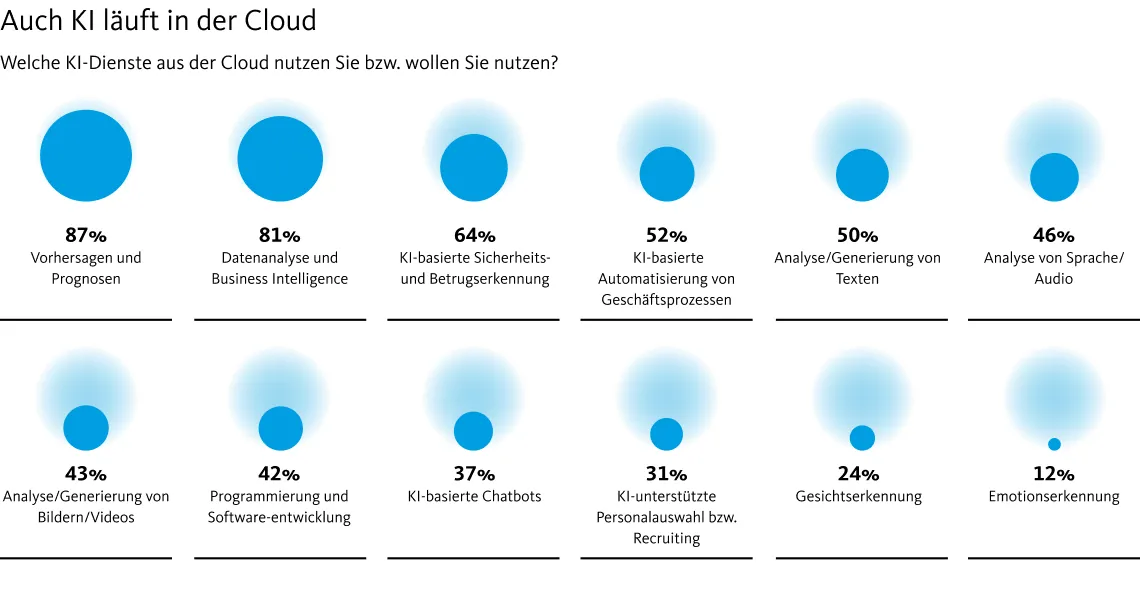
The impact of AI on cloud services: the integration of artificial intelligence (AI) into cloud technologies is revolutionising the way companies use their cloud services. AI optimises the provisioning and management of resources, increasing efficiency and lowering operating costs. AI-based security solutions also enable early threat detection by analysing behavioural patterns and identifying anomalies. In data analytics, machine learning enables advanced analysis and accurate forecasting, giving companies valuable insights. On top of that, chatbots, speech recognition and recommendation systems in cloud applications improve the customer experience by creating personalised interactions across the entire customer journey.
Edge computing and IoT: As the Internet of Things (IoT) grows, edge computing is becoming increasingly important, processing data closer to where it is generated instead of sending it to remote data centres. In addition to improved security and reduced bandwidth costs and network load, this technology enables significantly faster data processing and is particularly interesting for applications in industrial manufacturing, healthcare or the automotive sector.
7 | Getting started: recommendations for cloud migration
Our experience with cloud projects has shown that the following aspects are crucial for successful cloud migration:
It takes expertise and specialist knowledge that goes beyond the technological aspects, into project, process and change management.
A thorough analysis guards against unexpected obstacles. Outdated IT infrastructures grown over years (so-called legacy systems), for example, aren't cloud-ready and must first be modernised.
Define the goals of the cloud transformation as precisely as possible, but bear in mind they may change during the project. Agility is key to success here.
Choose a cloud platform that best fits your business and that you trust.
The result must deliver noticeable improvements for users, since they ultimately decide on the success of the cloud transformation.
See cloud migration now as an opportunity to streamline processes.
8 | Migrating the IT infrastructure: in 9 clear steps
If you include the following steps in your roadmap, your business will be perfectly prepared for cloud migration.
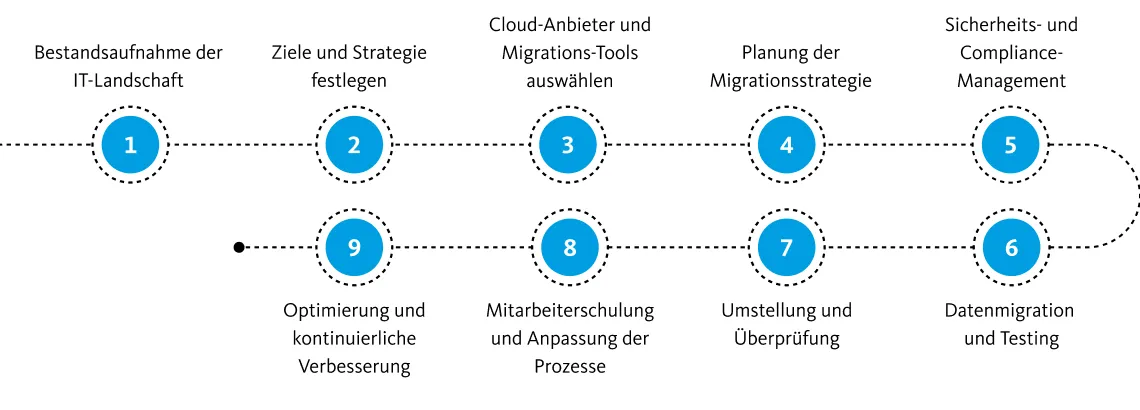
A long-term cloud strategy and close collaboration between the teams involved are crucial to the success of any cloud project. The good news – we support you from the first step through to launch and beyond.
9 | Examples: What does a successful cloud transformation look like?
To see what a successful cloud transformation can look like in practice, take a look at our cloud projects with Traton, Uhlmann and KTR:
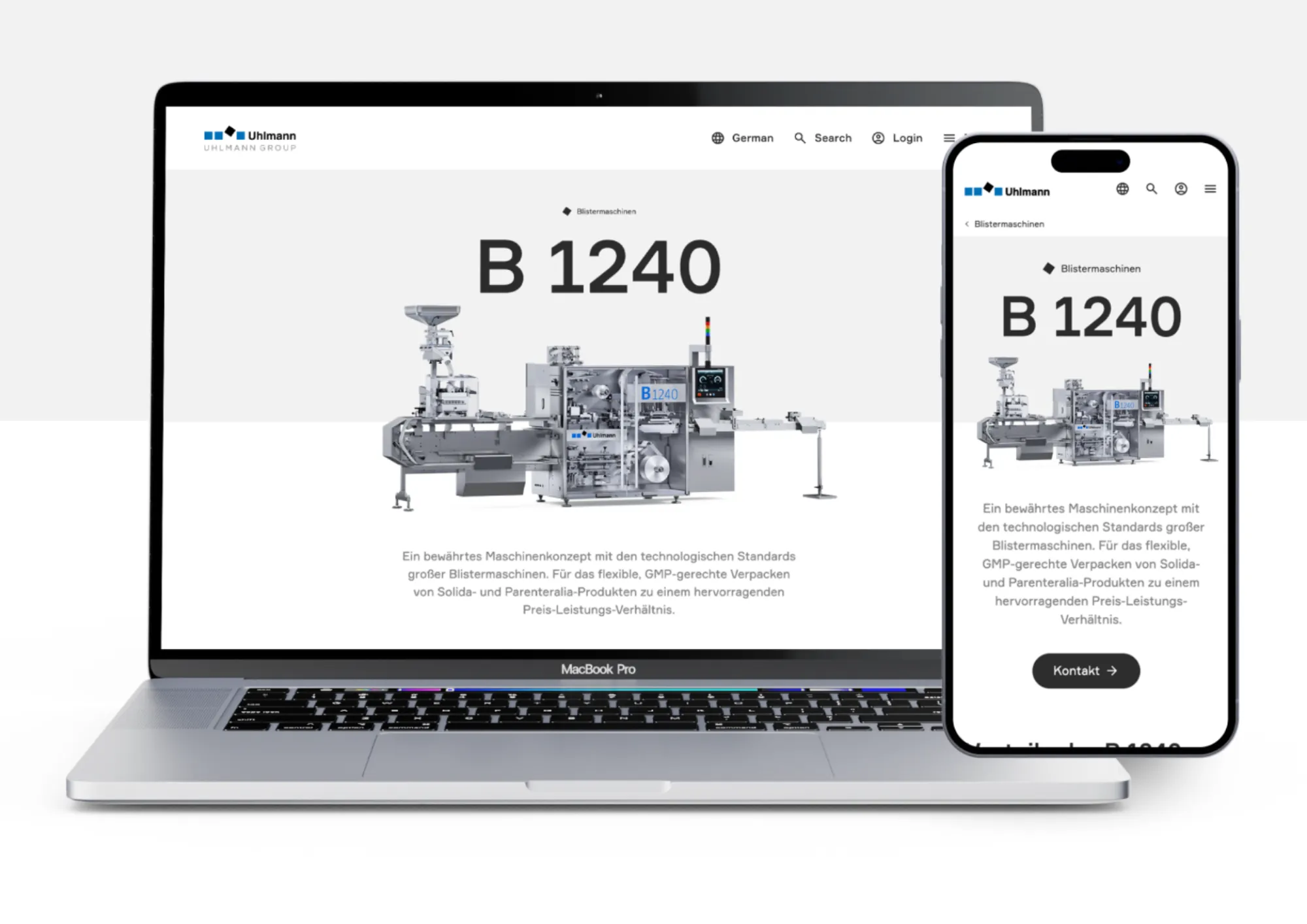
Uhlmann: at Uhlmann Pac-Systeme, we developed a comprehensive digital strategy to modernise the complex information architecture and the integration of CRM and marketing automation systems. By introducing the cloud-based Magnolia Digital Experience Platform (DXP), we significantly reduced this complexity. Our solution integrates marketing content, product information and digital services into a scalable headless/microservice architecture that lets Uhlmann orchestrate content centrally and deliver it multilingually across various channels. Details on Uhlmann's cloud DXP.
KTR Systems: At the heart of KTR's relaunch is also the cloud transformation towards Magnolia's cloud DXP with a headless/microservice architecture, enabling central integration and maintenance of company-wide content. This strengthens the international brand presence and significantly optimises sales and service processes. How KTR is becoming globally visible with the new DXP.
TRATON GROUP (Scania, MAN, Navistar, VW Trucks & Bus): The project's key goal was modernising the existing digital infrastructure. The focus was on reworking the front end and back end and updating the cloud-based Magnolia CMS. The result is a powerful, secure and scalable platform that optimally supports TRATON's innovative strength. Find out more about the new TRATON website here.
Uhlmann success story: cloud transformation par excellence
Serverless, headless CMS, microservice architecture: Uhlmann's new DXP fully embraces the possibilities of the cloud.
9 | Why you should tackle cloud transformation
Moving applications to the cloud is not inherently better or worse. On-premises has advantages — and the cloud has advantages.
The fact remains, though, that the trend is moving towards the cloud, and businesses with load peaks, limited IT resources or a desire for agile collaboration in particular can benefit from cloud services: "In 5 years, cloud will dominate corporate IT", writes Bitkom in a press release dated 3 July 2024 ("Companies are driving their digitalisation forward with the cloud").
You don't have to become totally dependent on a single provider – you can, for example, use hybrid multi-cloud environments to retain more control, following the principle of "the best of both worlds". Make the most of the cloud's benefits for yourself – and proactively offset the drawbacks. With a well-founded cloud strategy and an experienced partner at your side, you clear the way for your company's successful digital transformation.

The direction is clear: the future lies in the cloud.
We are your partner for cloud transformation!
Interested in a tailored cloud strategy? Together, we'll find the best cloud solution for your project, wherever you currently stand in the process. Visit our service page for an overview of our cloud services, or arrange a no-obligation consultation with one of our specialists via the contact form below.
Get in touch now
Your contact person
- Daniel Richter
Web Developmentsynaigy
Show phone numberShow email address